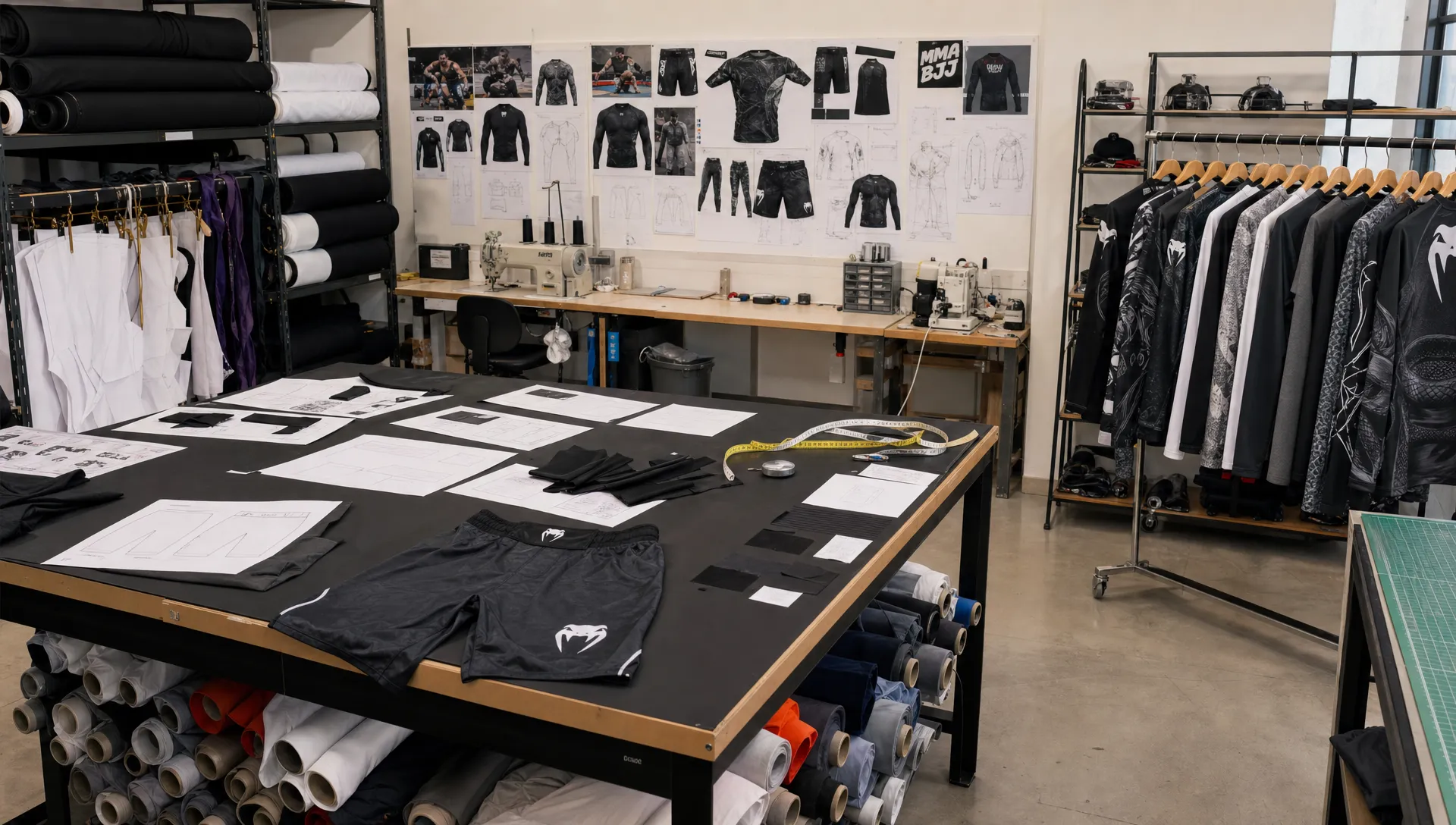
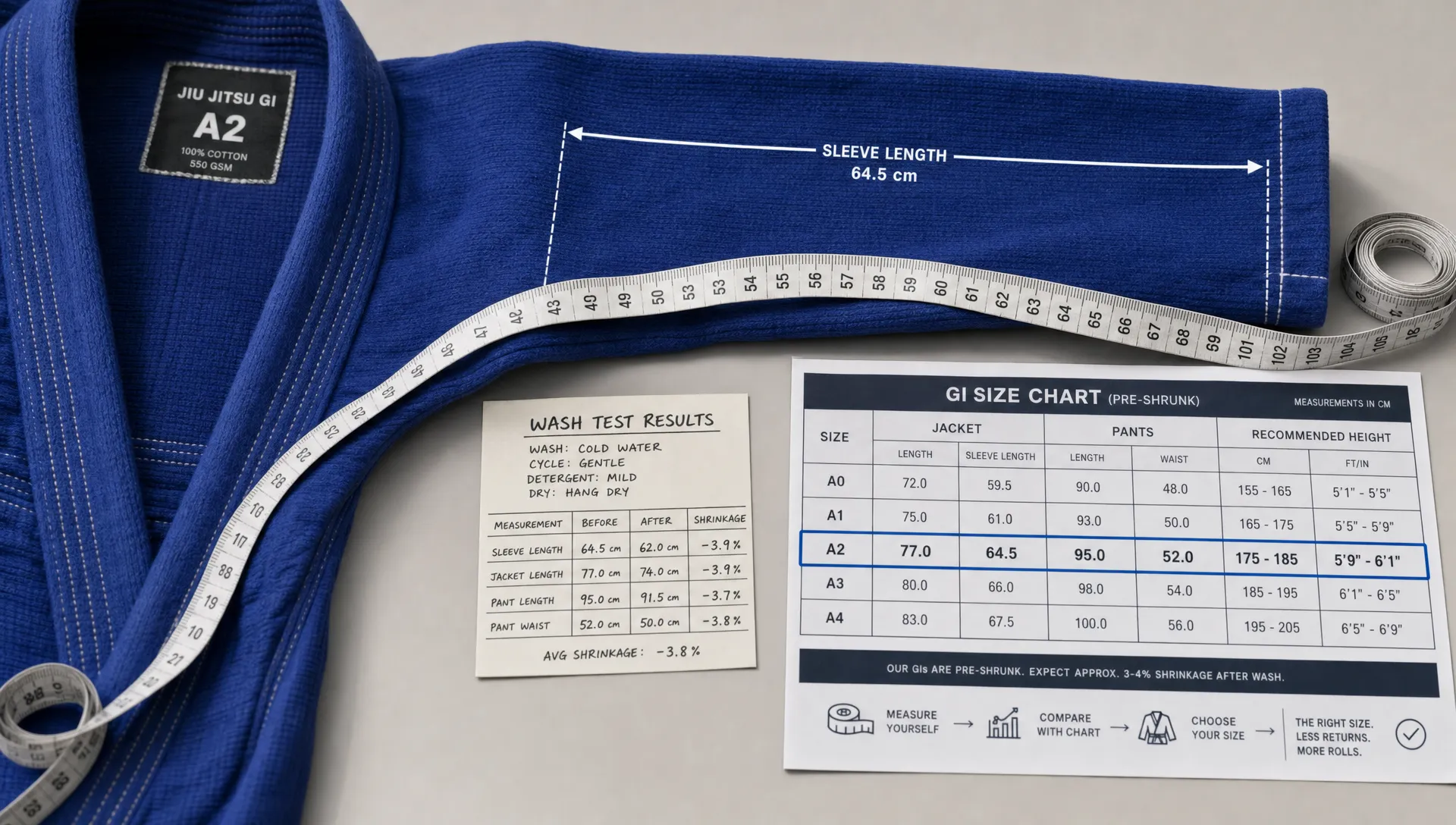
Fit-related returns are often blamed on the customer, but the problem usually starts much earlier. If a jiu jitsu suit size chart is vague, copied from a competitor or based only on height and weight, buyers have to guess. Guessing creates exchanges, refunds and support tickets that eat into margin, especially for brands shipping across the USA, Canada, Europe, Australia, Japan and other international markets.
A strong size chart does more than list sizes. It translates your pattern, fabric, shrinkage behavior and intended fit into information a real athlete can use before checkout. For private label brands, gyms and distributors, that makes the chart part of product development rather than a marketing afterthought.
This guide explains how to create a jiu jitsu suit size chart that reduces returns by giving shoppers the right measurements, setting the right expectations and feeding customer data back into future production runs.
Treat the size chart as a return prevention tool
Jiu jitsu suits are harder to size than basic T-shirts because the jacket, pants and belt all interact with movement, grip fighting, washing and tournament expectations. A suit that feels fine when standing may be too tight when framing, passing or playing guard. A jacket that fits on day one may become too short after repeated hot washes if shrinkage was not considered.
That is why a useful size chart must answer three questions for the buyer:
- Will this fit my body type?
- How will it feel during training?
- What will happen after washing?
For the seller, the chart has another job. It should reduce preventable returns without overselling certainty. No chart can guarantee perfect fit for every athlete, but a good one can remove most avoidable confusion.
If you are still defining fabrics, size ranges, branding placements or packaging for a new gi line, it helps to map those choices alongside your sizing system. The BJJ gis buyers guide for brands, gyms, and distributors covers those broader sourcing decisions in more detail.
Start with a clear fit promise
Before measuring anything, decide what your jiu jitsu suits are supposed to feel like. A competition-oriented fit, a relaxed academy fit and a beginner-friendly entry-level fit should not use the same language, even if some size codes overlap.
Many returns happen because the customer bought the right size for the wrong fit expectation. If your gi is cut slim, say so. If your pants have more room through the thigh, say so. If the jacket is designed for a traditional roomy feel, do not describe it as athletic.
| Fit direction | Best suited for | What the size chart should clarify |
|---|---|---|
| Slim competition fit | Athletes who prefer less excess fabric | Choose the larger size if between ranges or broad in the shoulders |
| Standard training fit | Most academy members and everyday training | Follow the main height and weight range, then check chest and wingspan |
| Relaxed traditional fit | Beginners, larger builds or athletes who prefer room | Expect more space in the jacket body and pants before washing |
| Youth or kids fit | Growing athletes | Include age only as a guide, not as the main sizing method |
The fit promise should appear near the chart, not hidden in a product paragraph. A short note such as ‘standard training cut with moderate room in the shoulders’ gives context to every measurement below it.
Separate body measurements from garment measurements
One of the biggest mistakes brands make is mixing athlete body measurements and garment measurements without labeling them. A shopper reading a chest measurement of 23 inches may not know whether that is their own chest circumference, the flat jacket width or the finished garment after washing.
Your chart should separate these two measurement types clearly.
Body measurements help customers choose a size. Garment measurements help customers compare your jiu jitsu suits with a gi they already own. Both matter, but they serve different decisions.
| Measurement type | Examples | Why it reduces returns |
|---|---|---|
| Athlete body measurements | Height, weight, chest, waist, wingspan | Helps new buyers find the most likely size |
| Finished garment measurements | Jacket length, chest width, sleeve length, pants length | Helps experienced buyers compare with an existing gi |
| Post-wash measurements | Same garment specs after recommended wash testing | Prevents complaints about expected shrinkage |
| Fit notes | Slim, standard, relaxed, long, husky | Helps buyers choose between overlapping sizes |
For jiu jitsu suits, wingspan deserves more attention than many size charts give it. Two athletes can have the same height and weight but very different arm length. If your return data shows complaints about sleeves being short or long, add a wingspan reference or sleeve comparison guide.
Pants also need more than waist size. Thigh room, rise and inseam affect comfort during guard work, kneeling and hip movement. If you only publish a waist range, customers with athletic legs may order too small.
Build the chart from real samples, not generic size codes
Common adult BJJ sizing often uses codes such as A0, A1, A2, A3 and larger variations. Those codes are helpful because buyers recognize them, but they are not standardized across all manufacturers. An A2 from one brand may not match an A2 from another brand.
For a private label line, your chart should be based on your own approved production pattern and samples. The process is straightforward, but it requires discipline.
Measure approved pre-production samples in every size you plan to sell. Record flat garment measurements using the same method each time. Wash samples according to your care instructions, then measure again. Confirm whether the finished production batch matches the approved sample within your agreed tolerance.
This is also where manufacturing communication matters. A reliable supplier should understand grading, shrinkage control, fabric behavior and tolerance reporting. If you are evaluating production partners, this guide on how to choose a Brazilian jiu jitsu gi manufacturer explains what to check before committing to bulk production.
Use a size chart layout customers can scan quickly
A chart can contain accurate data and still fail if it is hard to read. On a product page, the customer wants fast confidence. Use clear labels, consistent units and fit notes that explain what to do when measurements overlap.
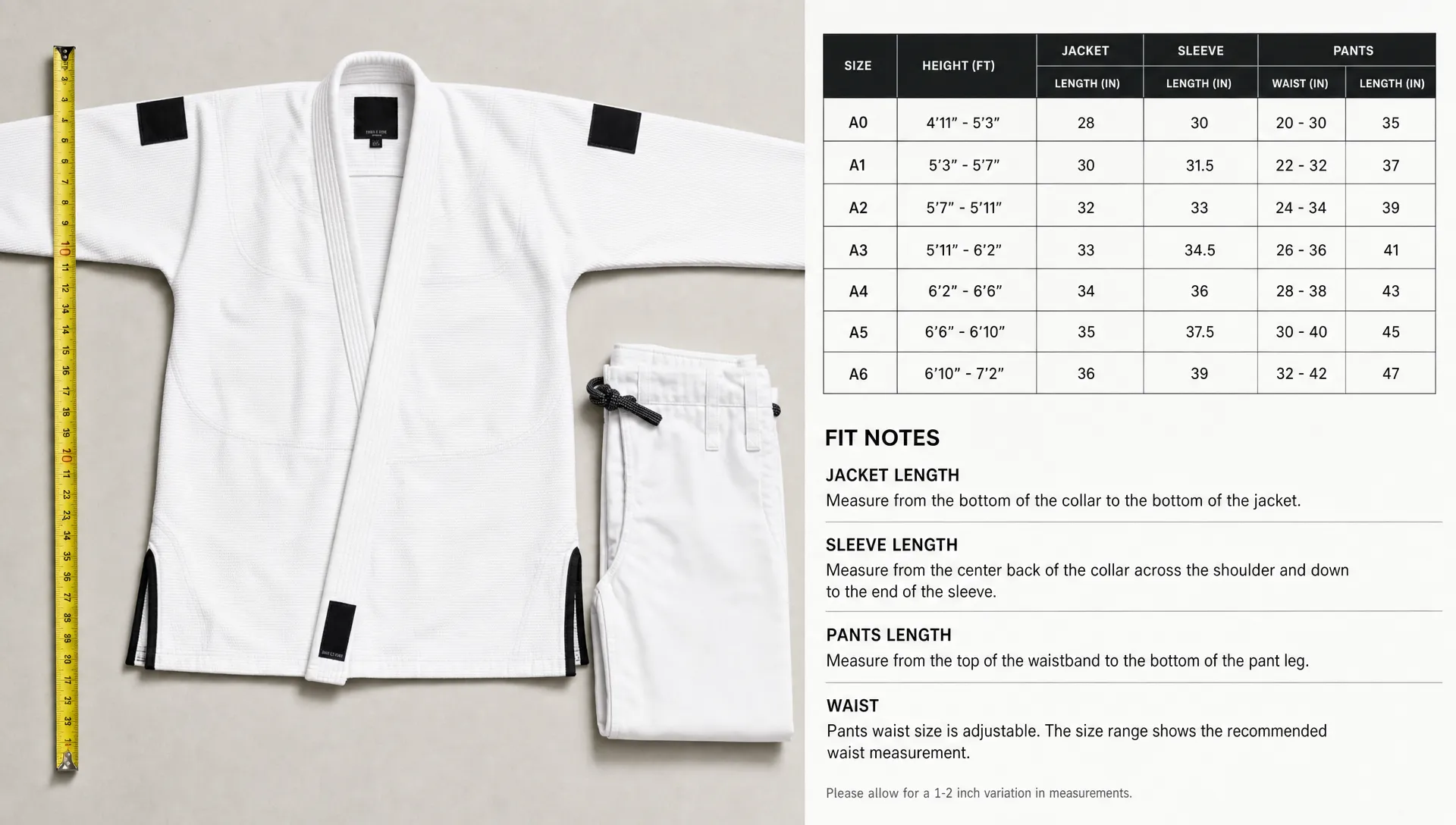
A practical jiu jitsu suit size chart usually needs three layers: recommended athlete range, key garment specs and a short decision note. You can publish the full technical chart on a separate tab if needed, but the first visible chart should be simple.
| Size | Recommended athlete height | Recommended athlete weight | Key garment checks | Fit note |
|---|---|---|---|---|
| A0 | Your tested range | Your tested range | Jacket length, sleeve length, pants length | Best for smaller adult builds |
| A1 | Your tested range | Your tested range | Jacket length, sleeve length, pants length | Standard choice for many lighter athletes |
| A2 | Your tested range | Your tested range | Jacket length, sleeve length, pants length | Check wingspan if between sizes |
| A3 | Your tested range | Your tested range | Jacket length, sleeve length, pants length | Consider body shape and preferred fit |
| A4 and above | Your tested range | Your tested range | Jacket width, pants rise, cuff width | Add notes for broad or tall athletes |
Do not copy these ranges from another brand. Use this as a structure, then fill it with your own tested measurements. The more your chart reflects your actual pattern, the fewer surprises customers will face.
Account for shrinkage before the customer does
Shrinkage is one of the main causes of dissatisfaction with cotton martial arts uniforms. Even when shrinkage is normal, customers may see it as a defect if they were not warned clearly before purchase.
Your size chart should state whether measurements are taken before wash, after wash or both. If you only publish fresh-out-of-bag measurements, buyers may choose a size that looks perfect on arrival but becomes too short later.
A clean shrinkage note can be simple: ‘Measurements are based on post-wash testing using the care instructions on the label.’ If your fabric is expected to shrink slightly after the first wash, say that before checkout.
For better quality control, track shrinkage by size and by fabric lot when possible. Pearl weave jackets, twill pants, ripstop pants and different GSM fabrics can behave differently. Color can also influence finishing behavior depending on dyeing and washing processes, so do not assume one sample tells the whole story for every variation.
Make international sizing easy to understand
Arus Sportswear works with brands and buyers across markets where sizing habits differ. A shopper in the USA may think in feet, inches and pounds. A buyer in Germany, the Netherlands or Japan may expect centimeters and kilograms. If your chart supports international sales, include both systems directly in the table instead of asking customers to convert.
This is especially important for gyms and distributors placing bulk orders. If a coach is collecting sizes from 30 academy members, the chart must be easy to share and explain. Confusing unit conversion at that stage can turn into a full box of wrong sizes.
Use the same measurement order everywhere. For example, do not list height first in one chart, then weight first in another. Keep adult, women-specific and youth charts separate if the patterns differ. If you sell long, short or husky variants, define them with measurable differences rather than vague terms.
Reducing returns is partly about reducing uncertainty. High-consideration ecommerce brands do the same thing in other categories by pairing detailed product information with strong trust signals, whether customers are buying technical apparel or authenticated luxury timepieces. The principle is the same: the more confident the buyer feels before purchase, the fewer preventable returns you create after delivery.
Add decision rules for buyers between sizes
Size overlap is unavoidable because human bodies do not fit neatly into chart rows. The return-reducing difference is how you explain overlap.
Instead of saying ‘size up if unsure,’ give rules based on body type and use case. For jiu jitsu suits, a few well-written decision notes can prevent many exchanges.
Useful notes include:
- If you are between sizes and have broad shoulders or a larger chest, choose the larger size.
- If you are between sizes and prefer a tighter competition feel, choose the smaller size only if your wingspan also fits the sleeve range.
- If you plan to wash warm or tumble dry despite care instructions, allow extra room for shrinkage.
- If you are buying for a growing youth athlete, prioritize sleeve and pants length with room to grow.
Keep the language direct and avoid promising perfect fit. The goal is to help the buyer make an informed choice, not to remove every possible exception.
Consider competition rules without making the chart too complex
If your line includes competition gis, sizing has to balance comfort, brand identity and uniform inspection. Sleeves, pants length, jacket fit and fabric thickness can all matter at events. A chart that encourages an overly tight size may cause problems for athletes who need to pass inspection.
You do not need to reproduce tournament rulebooks in your size chart. Instead, add a short competition note and link it to a more complete guide. For example, if you sell a competition range, your product page can tell athletes to avoid choosing a size that is intentionally too small after shrinkage. For design and compliance planning, this article on competition BJJ gis that meet rules without losing brand identity is a useful companion.
For non-competition training suits, keep the chart focused on comfort, durability and movement. Mixing too much rule language into every product page can make casual buyers hesitate.
Test the chart before launching the full range
A size chart should be tested just like the garment. Before publishing it, put it in front of real users who match your intended customers: beginners, experienced athletes, coaches, tall athletes, stockier athletes and youth parents if relevant.
Ask them to choose a size using only the chart. Then compare their choice with the sample they actually prefer after trying it on. If several people choose wrong for the same reason, the chart needs clearer wording or better measurements.
The best feedback usually comes from simple questions. Where did they hesitate? Which measurement was missing? Did they understand whether the chart showed body or garment measurements? Did the fit note match the way the gi felt?
For wholesale programs, test the chart with the person who will collect orders. A gym owner needs to translate your sizing into quick advice for members. If the chart is too technical for that use case, it may still cause bulk order errors.
Track return reasons after launch
The work does not stop when the chart goes live. Returns, exchanges and customer support messages should be coded by reason so you can improve the next batch.
Do not settle for broad labels like ‘wrong size.’ Break the data into useful categories such as sleeves too short, pants too long, jacket too tight, expected shrinkage issue or customer between sizes. Over time, patterns will show whether the problem is the chart, the pattern or the customer's expectation.
| Return signal | What it may indicate | Possible chart improvement |
|---|---|---|
| Many sleeve complaints in one size | Wingspan range is too broad or sleeve spec is off | Add sleeve length and wingspan guidance |
| Pants too long across smaller sizes | Inseam grading may not match target market | Add post-wash pants length and model references |
| Jacket too tight for heavier athletes | Weight range does not reflect chest or shoulder width | Add chest range and size-up note |
| Shrinkage complaints | Care instructions or post-wash notes are unclear | Publish post-wash measurements and washing guidance |
| High exchange rate between two adjacent sizes | Overlap rule is weak | Add body type and fit preference advice |
When return data and production data are reviewed together, the size chart becomes a living asset. It helps product development, customer service, merchandising and factory communication.
Common mistakes that increase jiu jitsu suit returns
The fastest way to improve a chart is often to remove confusion. Watch for these common problems:
- Using only height and weight with no garment measurements.
- Copying a competitor's chart instead of measuring your own samples.
- Publishing pre-wash measurements without saying so.
- Combining adult, youth and women-specific fits in one chart when patterns differ.
- Using vague notes such as ‘fits normal’ without defining the fit.
- Hiding the chart in a product image that is hard to read on mobile.
- Failing to update the chart after pattern changes or fabric changes.
Mobile readability matters more than many brands realize. If the chart is pinched, blurry or hidden behind multiple taps, shoppers may guess rather than study it. Keep the most important decision data visible near the size selector.
What to give your manufacturer before production
If you want a return-reducing chart, include sizing requirements in the production brief from the start. Do not wait until finished stock arrives.
Your manufacturer should receive your target fit, size range, measurement points, tolerance expectations, shrinkage testing method and labeling requirements. If you already have a best-selling gi, send its measurements as a benchmark. If you are building a new brand, define the athlete profile you want to serve first.
For private label and OEM production, this planning step keeps the commercial promise aligned with the factory output. Your size chart, product pattern and quality inspection checklist should all describe the same garment.
Frequently Asked Questions
What measurements should a jiu jitsu suit size chart include? At minimum, include athlete height, athlete weight, jacket length, sleeve length, jacket chest width, pants length and waist range. For better accuracy, add wingspan, post-wash measurements and fit notes for body type.
Should I use A0, A1, A2 and A3 sizing for jiu jitsu suits? You can use common BJJ size codes because customers recognize them, but do not rely on the code alone. Each size should be supported by real body ranges, garment measurements and shrinkage notes from your own product.
How do I reduce returns from customers between sizes? Add clear decision rules. Tell broad-shouldered athletes, tall athletes, slim athletes and growing youth buyers how to choose when their height and weight fall between two sizes. Fit preference should also be part of the guidance.
Should the chart show pre-wash or post-wash measurements? Post-wash measurements are usually more helpful for long-term fit, especially if cotton fabric shrinkage is expected. If you show pre-wash measurements, label them clearly and explain expected shrinkage after following the care instructions.
How often should a brand update its jiu jitsu suit size chart? Review the chart after every pattern change, fabric change or production batch that produces sizing feedback. You should also review return and exchange data regularly to spot repeated fit issues.
Build better sizing into your next gi production run
A strong size chart is not just a customer service tool. It is a manufacturing, merchandising and brand trust tool. When your measurements, samples, shrinkage data and fit language all line up, customers buy with more confidence and return fewer products for preventable sizing reasons.
Arus Sportswear manufactures custom MMA and martial arts apparel for brands, gyms and distributors worldwide, including private label and OEM jiu jitsu suits, BJJ gis and related combat sports uniforms. If you are planning a new range, refining an existing fit or preparing bulk orders for multiple markets, Arus Sportswear can help align custom design, branding, production and sizing from the start.