For fightwear brands, gyms and distributors, a competition BJJ gi has to satisfy two demanding audiences at the same time. It must pass the uniform inspection table, then still look like something an athlete is proud to wear on the podium, in photos and in your online store.
That balance is harder than it looks. Tournament rules limit colors, patch placement, fit and fabric characteristics. Brand identity pushes in the other direction, toward recognizable graphics, signature trims and design details that stand out in a crowded market. The best competition BJJ gis do not ignore either side. They start with compliance as a product requirement, then build a clear brand system inside the space the rules allow.
Why competition compliance belongs in the first design brief
A competition gi should not be designed like a normal training uniform and checked against rules at the end. By then, the fabric may be too stiff, the sleeve opening may be too narrow after washing or the main patch may sit in a risky placement. Fixing those problems late can delay sampling, increase cost and weaken the original design.
For brands selling across the USA, Canada, Germany, Australia, Japan, Thailand, the Netherlands and the rest of Europe, the safest approach is to design around the most conservative requirements your target events are likely to use. The International Brazilian Jiu-Jitsu Federation publishes official IBJJF uniform guidance, and many tournaments either follow it closely or use it as a reference point. Local promotions and national federations can still apply their own rules, so brands should verify the current requirements for every competition market they target.
The practical takeaway is simple: treat tournament legality as part of the tech pack, not as a marketing claim added later.
| Rule-sensitive area | What brands should control | Brand identity impact |
|---|---|---|
| Gi color | Use event-approved colors for the competition line and keep jacket and pants consistent | Forces creativity into patches, labels, stitching and packaging instead of unusual base colors |
| Fabric and weave | Choose a weave that supports gripping, durability and inspection requirements without excessive stiffness | Helps create a recognizable hand feel and performance position |
| Post-wash fit | Test shrinkage before bulk production and set realistic measurement tolerances | Protects the athlete experience and reduces returns |
| Patch placement | Map all external branding against the target rule set | Keeps logos visible without risking disqualification |
| Labels and trims | Separate functional labels, retail branding and tournament-facing decoration | Lets the brand feel premium even when external artwork is restrained |
| Quality condition | Inspect seams, embroidery, stains, loose threads and color consistency | A clean gi reinforces trust before the athlete ever competes |
Color is the first branding compromise
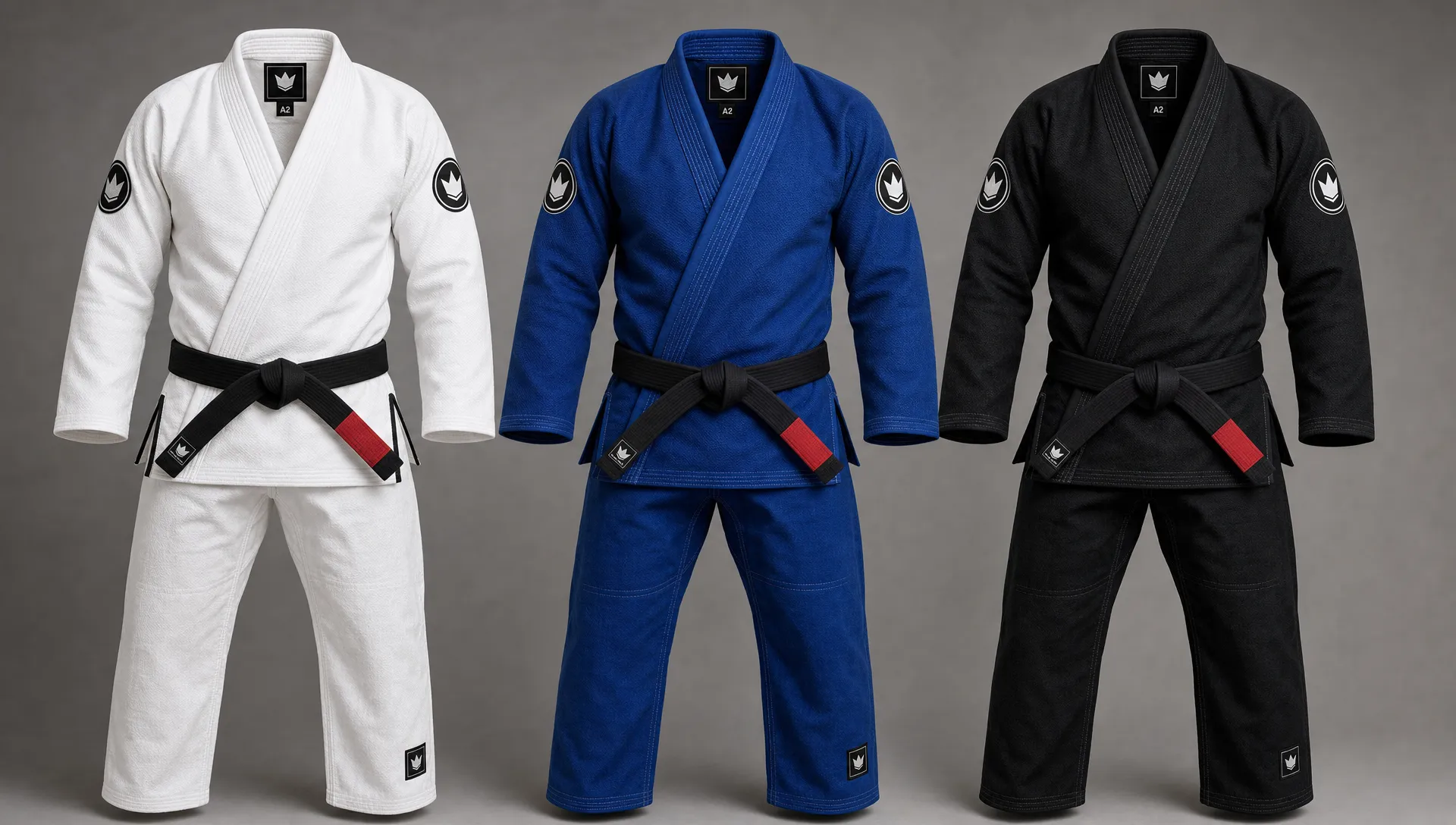
Many apparel brands love seasonal color drops because they are easy to photograph and easy to promote. Competition BJJ gis are different. For major tournaments, the safest commercial palette is usually white, royal blue and black, with no mismatched jacket and pants. Colors such as navy, gray, cream, red or olive may work for training, but they can create unnecessary risk if the product is marketed as competition ready.
That does not mean a competition line has to look plain. A white gi can carry a sharp black and gold patch system. A royal blue gi can use tonal embroidery and a clean woven label story. A black gi can feel premium through restrained contrast stitching, a strong interior label and a consistent brand mark on permitted areas.
This is where discipline matters. If the base color must be simple, the identity needs to come from repetition, proportion and detail. A small logo used consistently in the right places often looks more professional than a large graphic that makes tournament approval uncertain.
Fit and shrinkage decide whether a competition BJJ gi works in real life
A gi can look legal in the showroom and become a problem after a few washes. Sleeves may shorten, pants may rise, the skirt may distort or the collar may behave differently after drying. For competitors, that is not just a comfort issue. A poorly controlled pattern can affect grips, movement and whether the uniform passes inspection.
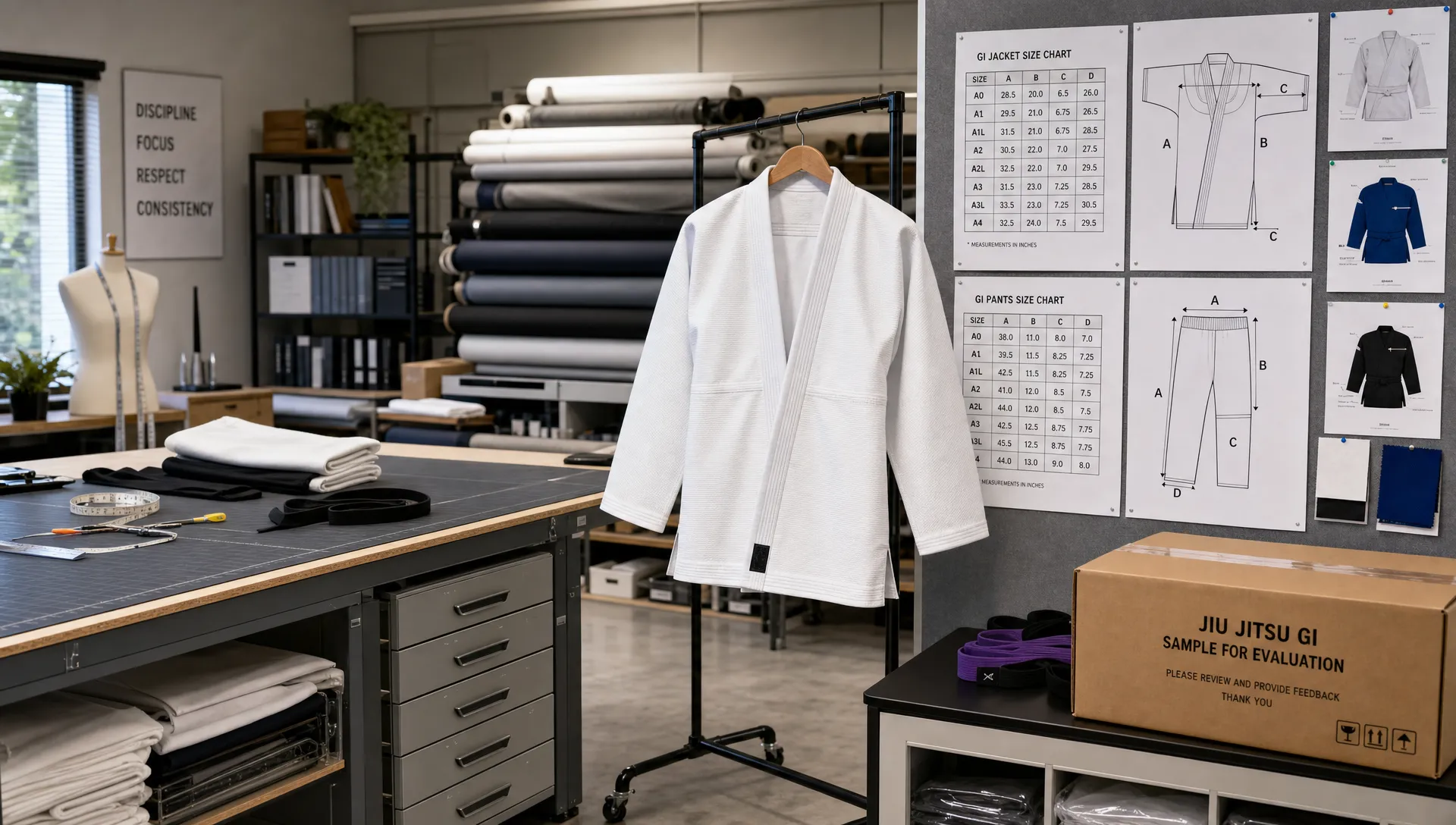
Brands should request samples in the intended final fabric, not a substitute that behaves differently. Measure the gi before washing, after washing and after wear testing. The goal is not only to control shrinkage, but to understand how the garment sits on different body types once an athlete actually rolls in it.
A useful fit process usually includes:
- Size set sampling across the core size range rather than relying on one middle size
- Wash testing using the care instructions that will appear on the label
- Athlete feedback from competitors who understand sleeve length, pants rise, collar feel and mobility
- Measurement tolerances agreed with the manufacturer before bulk production
If you are still defining fabrics, weights, sizing and packaging for a wider range, the BJJ gis buyers guide for brands, gyms and distributors is a helpful companion to this competition-focused approach.
Fabric and weave: performance without inspection risk
Competition athletes often want a gi that feels strong without becoming heavy, stiff or restrictive. That is why weave selection is a strategic decision. Pearl weave is common in BJJ because it can balance durability and weight, while pants are often developed with cotton twill or ripstop depending on the brand position and target user.
The mistake is choosing fabric based only on a catalog description. A gi fabric has to work with your pattern, washing process, reinforcement details and collar construction. A fabric that looks premium on a swatch may feel too rigid once the lapel is built. A fabric that feels light may not support the durability expectations of serious athletes.
For global buyers, climate also matters. Athletes in Thailand and Australia may appreciate a competition gi that feels less oppressive in heat, while buyers in Germany, Canada or the Netherlands may focus more on year-round durability and shrinkage control. A strong competition range can serve all of these markets, but only when the brand defines the performance target before production begins.
How to preserve brand identity inside legal design zones
Rule compliance limits the canvas, so brand identity needs to become more systematic. Instead of asking how large the main logo can be, ask what makes the gi recognizable from several touchpoints: the patch shape, typography, thread color, neck label, trim language, care label, drawstring color, packaging and product photography.
For emerging fightwear labels, this is where brand strategy matters as much as garment construction. A clear visual system helps smaller brands look coherent even when tournament rules restrict artwork. Partners focused on brand growth for challenger brands can be useful when a label needs its positioning, identity and go-to-market story to work across apparel, packaging and digital channels.
Once the brand system is defined, the manufacturer can translate it into production details that make sense on a gi. Not every graphic belongs on woven cotton. Fine lines may disappear in embroidery. Dense patches can feel bulky. Certain placements may interfere with grips or raise inspection questions. A production-ready identity is one that looks good and behaves well on the garment.
| Branding element | Rule-safer use for competition gis | What to avoid |
|---|---|---|
| Shoulder or chest patches | Use approved placement areas and keep scale controlled | Oversized patches that extend into restricted zones |
| Skirt or thigh patches | Build a consistent patch map for every size | Placement that shifts too much between small and large sizes |
| Embroidery | Use it for compact marks, initials or tonal details | Dense embroidery in high-grip or high-flex areas |
| Woven neck labels | Reinforce brand identity inside the jacket | Relying only on interior labels if the product needs shelf impact |
| Contrast stitching | Use subtle, repeatable color accents where allowed | Treating stitching as a substitute for proper construction quality |
| Hangtags and packaging | Carry the fuller brand story off the mat | Ignoring packaging because it is not part of tournament inspection |
Build separate competition and training identities
One of the smartest ways to protect brand creativity is to stop forcing every design idea into the competition gi. A brand can keep a rule-safe competition line and a more expressive training line, both connected by the same logo system, fit philosophy and quality standard.
The competition line should focus on approved colors, controlled shrinkage, clean branding zones and predictable sizing. It is the product athletes trust when they are paying entry fees, traveling to events and standing in uniform inspection lines. The training line can carry broader colors, limited editions, academy collaborations and stronger graphics because it is not always bound by the same event restrictions.
This two-line structure also helps distributors and gyms sell more clearly. Instead of explaining why one loud design may or may not pass inspection, they can position each product for a specific use. Competition gis serve tournament athletes. Training gis serve daily academy wear, team identity and lifestyle appeal.
What a manufacturer needs in the tech pack
A competition gi tech pack should be specific enough that the sample room, production team and quality control team all understand the same target. Vague instructions such as premium fit or competition approved are not enough. A manufacturer needs measurable details and artwork files that can be checked before production starts.
| Tech pack item | Why it matters for competition BJJ gis |
|---|---|
| Target rule set | Tells the manufacturer which colors, placements and construction risks to consider |
| Fabric and weave specification | Aligns durability, weight, shrinkage and collar behavior |
| Measurement chart | Controls fit across the full size range |
| Wash test expectations | Reduces surprises after the athlete follows care instructions |
| Patch placement map | Keeps branding consistent and easier to inspect |
| Artwork files | Improves embroidery, patch and label accuracy |
| Labeling and packaging plan | Supports retail presentation and market requirements |
| QC checklist | Gives the final inspection team a clear standard before shipment |
The right manufacturing partner should understand that BJJ gis are not ordinary uniforms. They need reinforced stress points, grappling-specific fit, shrinkage control and branding that survives real mat use. If you are comparing supplier options, this guide on how to choose a Brazilian Jiu Jitsu gi manufacturer explains what to look for before committing to samples or bulk orders.
Quality control before the gi reaches the athlete
Quality control for competition gis should happen in stages. The first sample checks whether the concept is possible. The pre-production sample confirms that fabrics, colors, labels, patches and measurements match the approved direction. Bulk inspection verifies that the production run has stayed consistent.
For a competition product, visual inspection alone is not enough. A gi can look clean in a folded stack but still have inconsistent sleeve lengths, twisted pants, uneven patch placement or embroidery that irritates the athlete. Random measurement checks across sizes are especially important because grading errors often appear at the smallest and largest ends of the range.
Brands should also check that the external decoration is securely attached. Loose patch corners and rough embroidery backing make the product feel unfinished, and they can become worse through washing and rolling. The athlete may blame the brand, even if the root issue was a weak production specification.
This is one reason many serious fightwear labels prefer a specialized martial arts supplier over a generic clothing factory. A factory that understands grappling apparel is more likely to anticipate stress points, sizing issues and construction requirements. For a broader view of this sourcing decision, see why brands often choose a specialized martial arts apparel manufacturer instead of a general apparel producer.
Positioning competition gis for global buyers
A competition BJJ gi is not just a garment. For wholesale buyers, it is a trust product. Gyms do not want students returning gis because they shrank too much. Distributors do not want rule complaints from athletes. Online shoppers do not want vague product descriptions that leave them wondering whether the gi is suitable for tournaments.
Clear positioning reduces that friction. Product pages should state the intended use, target rule assumptions, care instructions and fit notes without overpromising universal approval for every event. Since tournaments can update or interpret rules differently, the most honest approach is to say that the gi is designed for competition use under common requirements, then encourage athletes to confirm the specific event rules.
Packaging can support the same message. A hangtag might explain the competition design philosophy, fabric choice and care guidance. Size charts should be easy to read. If the product is sold in Europe, Japan or other international markets, brands should also confirm local labeling requirements with their importer, distributor or compliance advisor.
Good positioning does not dilute the brand. It shows buyers that the brand understands the athlete's actual problem: finding a gi that looks sharp, fits correctly and does not create stress on tournament day.
Common mistakes that create rule risk or weaken the brand
Competition gi development often goes wrong when branding and compliance are treated as separate conversations. The strongest products bring design, production and rule awareness together from the start.
Avoid these common mistakes:
- Designing the artwork first and trying to force it into legal placement zones later
- Marketing fashion colors as competition gis without checking target event rules
- Approving a sample in one fabric, then switching fabric before bulk production without retesting shrinkage
- Using a generic size chart that does not reflect grappling posture, grips and movement
- Putting the whole brand identity into one large external logo instead of building a complete visual system
- Skipping competitor feedback because the gi looks good on a mannequin or product photo
A rule-safe gi is not automatically a strong product. It also needs a clear commercial role, a fit that athletes trust and a brand identity that works at retail. When those elements align, compliance becomes part of the value proposition rather than a limitation.
Frequently Asked Questions
What colors are safest for a competition BJJ gi? White, royal blue and black are the safest starting point for many major tournament environments. Brands should still check the current rules for each federation or event, since local requirements can vary.
Can a competition BJJ gi still have custom branding? Yes. Custom branding can work through permitted patches, embroidery, woven labels, stitching accents, packaging and a consistent visual system. The key is to map every external element against the target rule set before sampling.
How can brands reduce shrinkage problems in competition gis? Use the final production fabric during sampling, measure before and after washing, test across several sizes and agree on tolerances with the manufacturer. Care instructions should match the way the shrinkage testing was performed.
Should a brand sell separate training and competition gi lines? Often, yes. A competition line can stay conservative and rule-aware, while a training line can use broader colors, graphics and collaborations. Both lines can still share the same fit philosophy and brand identity.
Do all tournaments follow IBJJF uniform rules? No. IBJJF rules are influential, but other organizers may use different requirements or interpretations. Brands should design conservatively, then advise athletes to confirm the rules of their specific event.
Manufacture competition gis without losing the brand
A strong competition gi starts with a clear brief: target rule set, approved colors, fabric direction, fit expectations, patch map, size range and brand assets. When those details are aligned before sampling, the final product has a much better chance of passing inspection and selling with confidence.
Arus Sportswear manufactures custom BJJ gis and martial arts apparel for brands, gyms and distributors worldwide, with private label production, OEM support, custom designs, branding options, low minimum orders and bulk order support. If you are planning a competition BJJ gi range, work with Arus Sportswear to turn your rule-aware concept into a production-ready uniform line.