Choosing a martial arts uniform manufacturer is not only a sourcing task. It is a product quality decision, a brand decision, and a customer retention decision. A uniform that shrinks too much, restricts movement, tears at the seams, or arrives late can damage trust with athletes, coaches, retailers, and distributors.
The best way to compare martial arts uniform manufacturers is to move beyond the first quote you receive. Price matters, but it should sit inside a broader evaluation that includes discipline expertise, fabric selection, stitching quality, sampling, branding options, communication, lead times, minimum order quantities, and scalability.
Whether you are launching a private label martial arts brand, ordering uniforms for a gym, or building a wholesale program, the goal is the same: find a manufacturing partner that can produce consistent uniforms at the quality level your buyers expect.
Start With Your Uniform Requirements Before Contacting Factories
Many sourcing problems begin before a brand ever speaks to a manufacturer. If your request is vague, every factory will quote a different product. One supplier may price a lightweight student uniform, while another prices a heavier premium uniform with reinforced seams and custom labels. On paper, one looks cheaper, but you are not comparing the same product.
Before asking for quotes, define the exact type of martial arts uniform you need. A karate gi, taekwondo dobok, BJJ gi, judo uniform, kung fu uniform, and MMA training set all have different performance requirements. Fabric weight, cut, reinforcement, sleeve shape, pant construction, and branding placement can vary significantly.
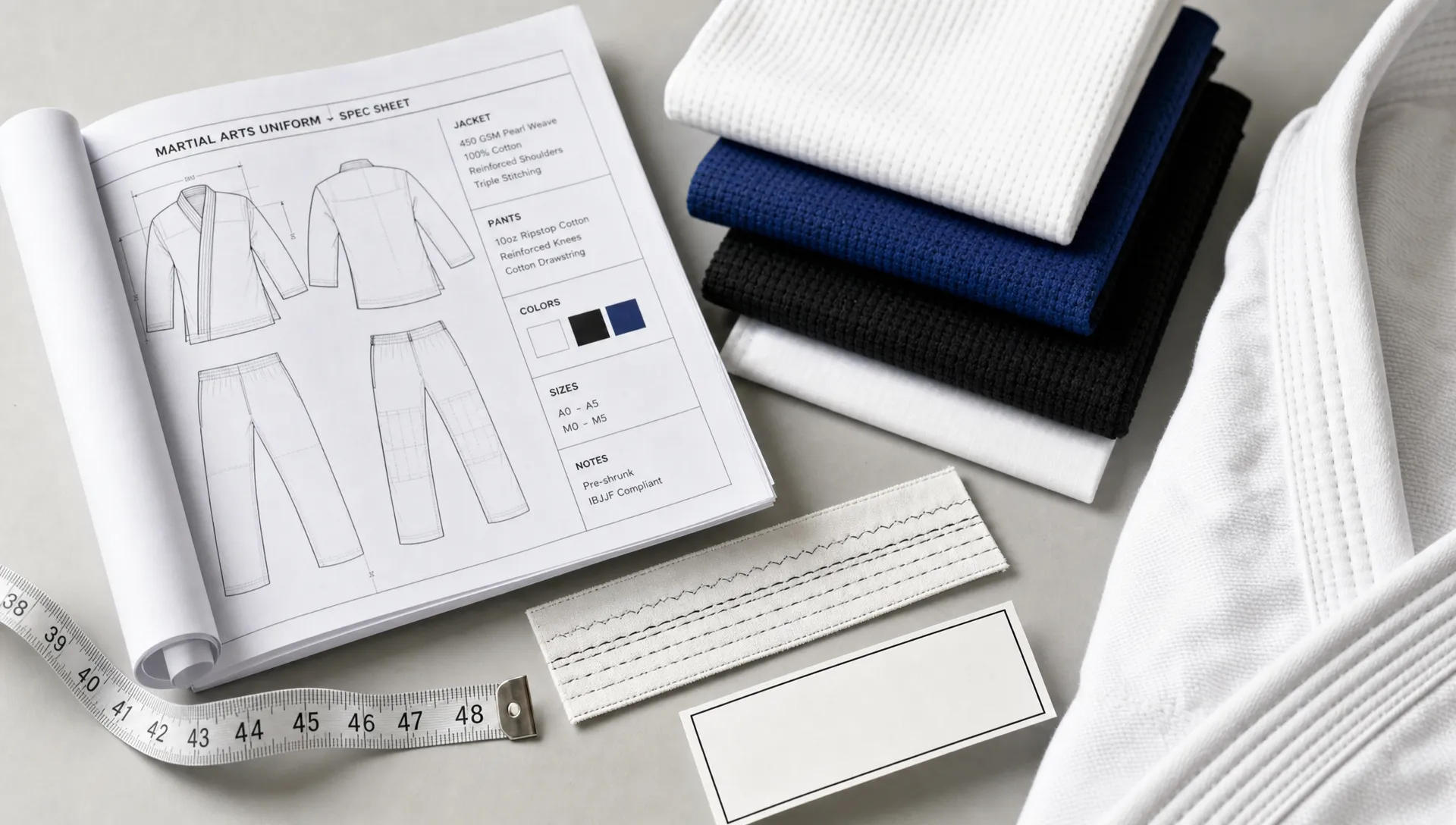
Your technical pack should include:
- Uniform type, discipline, and intended user level
- Fabric composition, weave, weight, and color
- Jacket and pants measurements by size
- Stitching and reinforcement requirements
- Branding details such as embroidery, woven labels, patches, or prints
- Packaging requirements and carton labeling
- Target order quantity, size ratio, and delivery destination
If you are not sure how detailed your requirements should be, it helps to review how an OEM martial arts uniform manufacturer typically turns product specifications into repeatable production.
| Uniform category | Key comparison points | Why it matters |
|---|---|---|
| Karate gi | Fabric weight, snap, shrinkage, sleeve length, belt loop quality | Karate buyers often expect a crisp shape, clean finish, and reliable sizing |
| Taekwondo dobok | Lightweight movement, V-neck construction, ventilation, print durability | Athletes need flexibility for kicking and fast footwork |
| BJJ gi | Weave strength, collar thickness, reinforcement, competition fit | Grappling creates heavy stress on seams, collars, and pants |
| Judo uniform | Heavy fabric, grip resistance, reinforced stress points | Judo uniforms must handle pulling, throwing, and repeated washing |
| MMA apparel | Stretch, moisture control, sublimation quality, waistband structure | Training gear must move well and withstand contact work |
Compare Specialized Manufacturers, Not Just General Apparel Factories
A general clothing factory may be able to sew jackets and pants, but martial arts uniforms require knowledge of movement, grip, shrinkage, reinforcement, and discipline-specific fit. A factory that mainly produces fashion garments may not understand why a BJJ gi collar needs a certain structure or why a karate uniform must maintain shape after repeated washing.
Specialization matters in many buying decisions. For example, when customers need wheels where fitment, material, and compatibility are important, they often rely on a category-focused retailer such as Velgensupermarkt instead of a generic marketplace. The same logic applies when comparing martial arts uniform manufacturers: the more specialized the supplier, the better they can anticipate product requirements and prevent avoidable mistakes.
When reviewing a manufacturer, ask what categories they produce regularly. A strong martial arts uniform manufacturer should be comfortable discussing fabric weights, reinforcement methods, grading, shrinkage, logo application, and size consistency. They should also understand the difference between producing a student uniform for entry-level programs and a premium uniform for serious practitioners.
This is especially important if your brand sells across multiple disciplines. A manufacturer that can support karate, BJJ, taekwondo, boxing apparel, MMA fightwear, and related training gear may simplify production planning and help keep branding consistent across your product line.
Use a Weighted Scorecard Instead of Choosing by Price Alone
The lowest unit price is rarely the best comparison tool. A cheaper uniform can become expensive if it has a high defect rate, poor fabric recovery, inconsistent sizing, weak packaging, or long delays. A weighted scorecard gives you a clearer view of total value.
You can adjust the weights based on your business model. A new gym may prioritize low minimum orders and fast communication. A distributor may prioritize bulk production consistency, documentation, and shipping reliability. A premium brand may place more weight on fabric feel, custom branding, and sample development.
| Evaluation factor | Suggested weight | What to check |
|---|---|---|
| Martial arts expertise | 20% | Product categories, past uniform experience, understanding of discipline requirements |
| Sample quality | 20% | Fit, stitching, shrinkage, reinforcement, fabric hand feel, logo execution |
| Communication | 15% | Response speed, clarity, willingness to explain options, accuracy of details |
| Production capacity | 15% | Ability to handle your current order and future growth |
| Pricing transparency | 10% | Clear quotation, setup costs, packaging, branding, shipping terms |
| MOQ flexibility | 10% | Suitability for test orders, seasonal drops, and larger reorders |
| Quality control process | 10% | Inspection steps, measurement checks, defect handling, packing standards |
This structure helps you avoid emotional decisions. A manufacturer with a slightly higher unit price may score much better if they offer stronger sampling, clearer communication, and more reliable production.
Examine Samples Like a Product Developer
A sample is not just a preview. It is evidence of how the manufacturer interprets your instructions, handles construction, and communicates changes. Treat sampling as a serious stage of supplier comparison.
Start by checking the fit and movement. Have athletes try the sample during realistic training motions, not just while standing still. For karate, check sleeve length, pant rise, and jacket closure. For BJJ or judo, test pulling stress at collars, lapels, knees, and underarms. For taekwondo, check kicking mobility and neck construction. For MMA gear, review stretch recovery and waistband comfort.
Next, check workmanship. Look at seam straightness, stitch density, loose threads, bar tacks, hem finish, belt loops, labels, and reinforcement areas. A few minor corrections are normal in product development, but repeated careless mistakes are a warning sign.
You should also wash and dry the sample according to the intended care instructions. Measure shrinkage before and after washing. Check whether colors bleed, embroidery puckers, prints crack, or fabric becomes too stiff. Many uniform complaints appear only after a few washes, so sample testing should include basic laundering before approval.
If you want to understand what happens after sample approval, Arus Sportswear explains the broader martial arts uniform factory process from product brief to packing.
Look Beyond Unit Price to Total Landed Cost
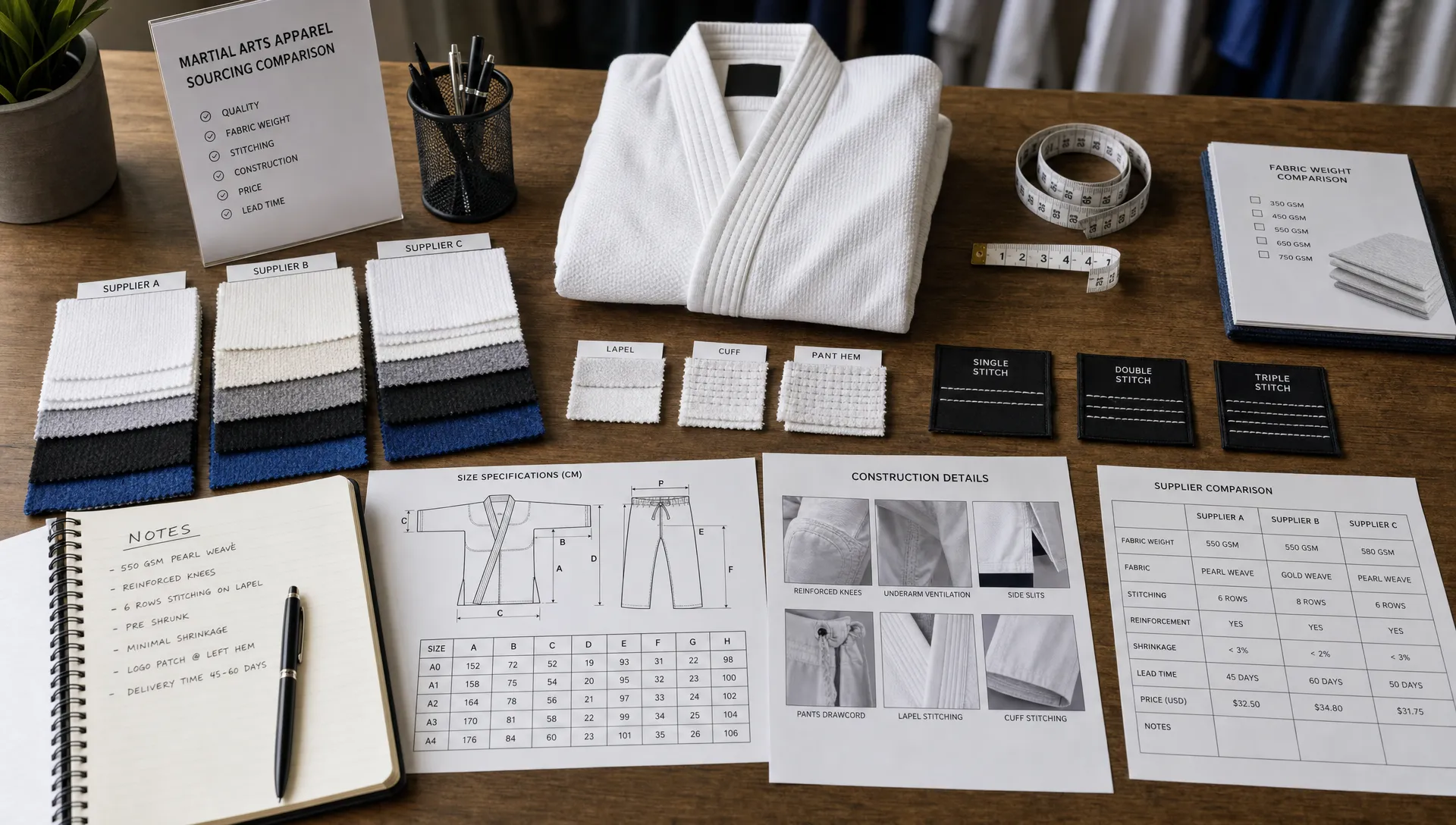
When comparing quotes, make sure each manufacturer is pricing the same product and service level. A low quote may exclude custom labels, embroidery, sublimation artwork setup, packaging, inner polybags, carton marks, inspection, or freight. It may also assume a higher order quantity than you are ready to place.
A better comparison is total landed cost, which includes everything needed to receive sellable inventory at your destination. This gives you a clearer view of profitability and helps prevent unpleasant surprises after production begins.
| Quote item | Why it matters when comparing manufacturers |
|---|---|
| Unit price | Shows base production cost, but only if specifications match |
| MOQ | Affects cash flow, inventory risk, and ability to test new designs |
| Sample cost | Reflects development complexity and may vary by customization level |
| Branding cost | Includes embroidery, patches, woven labels, heat transfers, or sublimation |
| Packaging cost | Impacts retail presentation, warehouse handling, and distributor requirements |
| Freight and duties | Can change the final landed cost significantly |
| Defect policy | Determines who is responsible if goods fail agreed quality standards |
For wholesale buyers planning 2026 orders, it is also useful to compare order timing, size ratios, and reorder planning. Arus Sportswear covers this in more detail in its guide to martial arts uniform wholesale buying tips.
Evaluate Branding and Customization Capability
Branding is one of the main reasons brands, gyms, and distributors choose private label or OEM production. A uniform is not only a functional garment. It is also a visible symbol of your academy, team, or brand identity.
Ask each manufacturer what branding methods they can support. Common options include embroidery, woven labels, printed neck labels, patches, sublimation panels, custom drawcords, branded waistbands, hang tags, and retail packaging. The right option depends on the uniform type and the level of durability required.
For example, embroidery may work well for a chest logo on a karate gi, while sublimation may suit rash guards, fight shorts, or MMA training apparel. Patches can look premium on BJJ gis, but placement and stitching must withstand grappling. A manufacturer should help you choose branding methods that fit the garment, not just offer the cheapest decoration.
Also check brand consistency. If you plan to sell multiple products, your manufacturer should be able to keep colors, labels, logo placement, and packaging aligned across categories. Inconsistent branding can make a product line look less professional, especially for wholesale and retail buyers.
Test Communication Before You Commit
Good production depends on clear communication. During the quotation and sampling phase, pay attention to how the manufacturer handles questions. Do they confirm details in writing? Do they ask useful follow-up questions? Do they explain trade-offs between fabric options, branding methods, and costs?
A reliable manufacturer will not simply say yes to everything. They will point out potential problems before production begins. For example, they may warn that a fabric is too light for a grappling uniform, that a logo placement may distort during movement, or that a specific color needs lab dip approval before bulk dyeing.
Communication quality becomes even more important when you are ordering from another country. Time zones, language differences, shipping documents, and production schedules all require discipline. A manufacturer that communicates clearly during sampling is more likely to communicate clearly when timelines become tight.
Review Capacity, Lead Times, and Scale Potential
A manufacturer may be a good fit for your first order but not for your long-term growth. Before selecting a supplier, ask whether they can support repeat orders, seasonal launches, new size ranges, and expanded product categories.
Lead time should be broken into stages: sample development, sample revision, material sourcing, bulk production, quality inspection, packing, and shipping. If a manufacturer gives one vague date without explaining the process, it becomes harder to manage expectations with your customers.
Also ask how they handle reorders. Can they keep patterns and specifications on file? Can they reproduce the same fit and fabric in future batches? Can they help you scale from a small test order into bulk production? These questions matter because martial arts uniforms are often reordered by size, rank, team, or seasonal demand.
For emerging brands, low minimum order options can reduce risk during product testing. For established distributors, bulk order support and production consistency become more important. The right manufacturer should match your current stage while giving you room to grow.
Check Quality Control and Compliance Processes
Quality control should not happen only at the end of production. Strong manufacturers build checks into each stage, from fabric inspection to cutting, sewing, finishing, measurement, labeling, and packing. Ask what quality checks are performed and how defects are handled.
Important quality control topics include measurement tolerances, seam strength, shrinkage expectations, color consistency, logo placement, loose thread control, fabric defects, packing accuracy, and carton labeling. For children’s uniforms or regulated markets, you may also need to discuss applicable safety, labeling, and material requirements based on your destination country.
You do not need to become a textile engineer, but you should ask enough questions to understand whether the factory has a repeatable process. A manufacturer that can explain its inspection steps clearly is usually more prepared than one that relies only on a final visual check.
Watch for Red Flags During Comparison
Some warning signs appear early. If you notice them during the quotation or sampling phase, proceed carefully. A manufacturer that is disorganized before receiving your order may become more difficult once production starts.
Common red flags include:
- Quotes that are much lower than every other supplier without a clear reason
- Refusal to provide samples or detailed product specifications
- Vague answers about fabric composition, GSM, shrinkage, or reinforcement
- Poor understanding of martial arts disciplines and uniform construction
- No clear process for revisions, approvals, or defect handling
- Pressure to place a large order before sample approval
- Inconsistent communication or repeated missed details
A single red flag does not always mean a supplier is unsuitable, but patterns matter. If several issues appear before production, they are likely to continue.
Make the Final Decision Based on Fit, Not Just Capability
The best martial arts uniform manufacturer is the one that fits your product, order size, brand standards, communication style, and growth plan. A large factory may be strong for mass production but less flexible for small custom runs. A smaller specialized manufacturer may be better for development, testing, and private label customization.
Before placing a bulk order, compare your top options side by side. Review their samples after washing, confirm all specifications in writing, compare total landed costs, clarify packaging, and agree on quality standards. If possible, start with a controlled order before scaling into larger production.
The strongest supplier relationships are built on clarity. When both sides understand the product, timeline, quality expectations, and commercial terms, production becomes more predictable and your brand can focus on selling, marketing, and customer relationships.
Frequently Asked Questions
What is the most important factor when comparing martial arts uniform manufacturers? The most important factor is product expertise. A manufacturer should understand the specific requirements of the discipline you sell, including fit, fabric weight, reinforcement, shrinkage, and movement.
Should I choose the cheapest martial arts uniform manufacturer? Not automatically. A low unit price can lead to higher costs if quality is inconsistent, samples require many revisions, packaging is poor, or delivery is delayed. Compare total landed cost and overall reliability.
How many samples should I request before bulk production? At minimum, request a development sample and approve a final pre-production sample before bulk manufacturing. More revisions may be needed for complex designs, new fabrics, or detailed branding.
What MOQ should I expect for custom martial arts uniforms? MOQ varies by product type, fabric, customization method, and manufacturer. Instead of focusing only on the lowest MOQ, compare whether the order quantity supports your testing, cash flow, and future reorder plan.
How can I compare quality between two uniform manufacturers? Use the same specifications for both samples, then test fit, stitching, reinforcement, shrinkage, color stability, branding durability, and measurement accuracy. A side-by-side sample review is far more useful than comparing photos alone.
Ready to Compare Manufacturers With More Confidence?
If you are sourcing custom martial arts uniforms for a brand, gym, or distribution program, a structured comparison process will help you avoid costly mistakes. Define your specifications, test samples carefully, compare total landed cost, and choose a partner that understands combat sports apparel.
Arus Sportswear manufactures custom MMA and martial arts apparel for brands, gyms, and distributors worldwide, including private label and OEM production, custom branding, low minimum order options, and bulk order support. To discuss your next uniform project, visit Arus Sportswear and share your product requirements.