A martial arts uniform looks simple when it is hanging on a rack, but producing it consistently is a technical process. A good gi, dobok, kung fu suit, or training uniform has to balance movement, durability, comfort, shrinkage control, branding, and size consistency. For brands, gyms, and distributors, understanding what happens inside a martial arts uniform factory makes it easier to brief a manufacturer, review samples, and avoid costly production delays.
Behind every finished uniform is a chain of decisions: fabric weight, weave, pattern shape, seam type, reinforcement points, labeling, packing, and final inspection. When those decisions are managed well, the result is a uniform that feels right in training, holds up under stress, and reflects the brand behind it.
What Happens Inside a Martial Arts Uniform Factory?
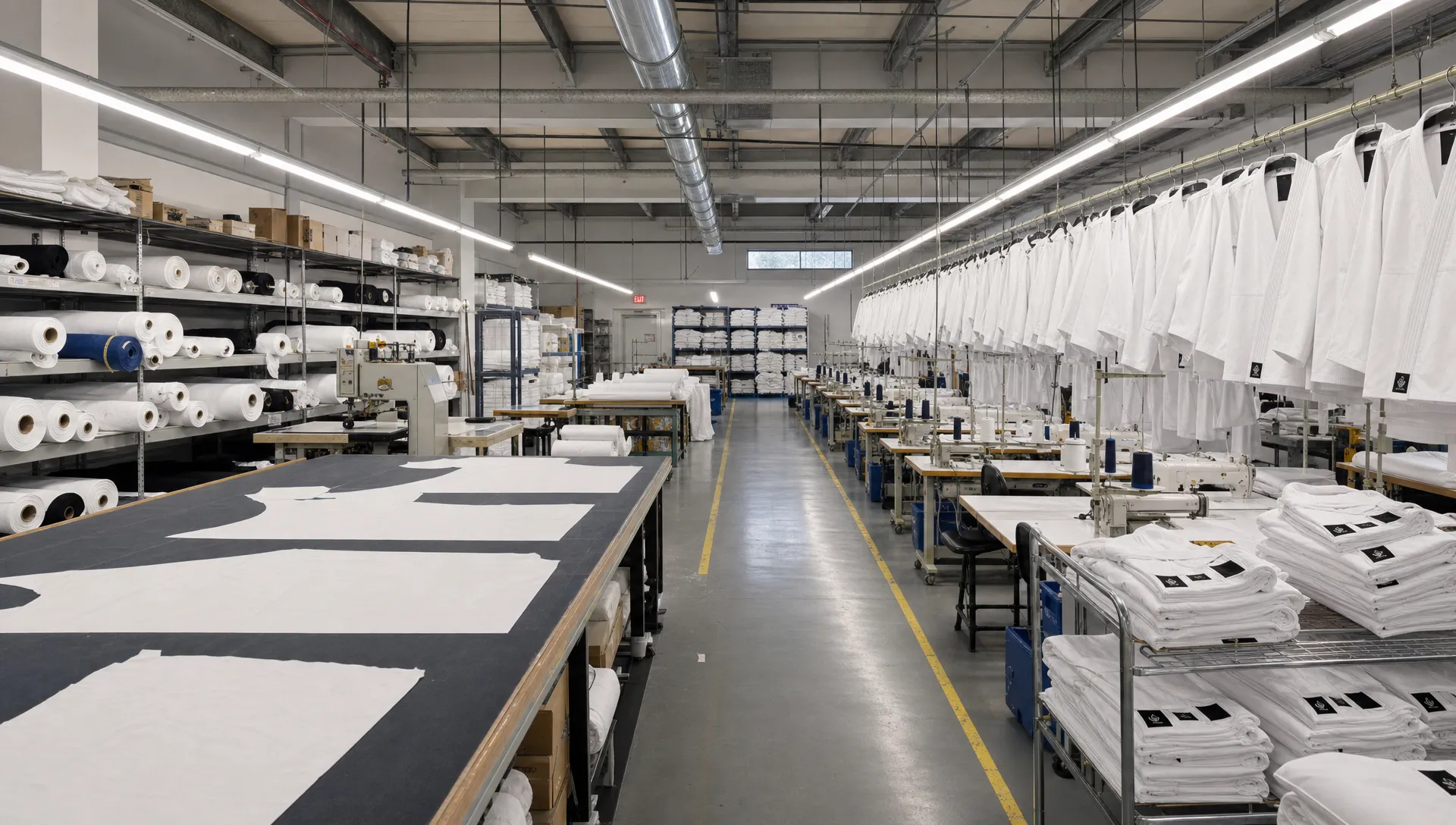
A martial arts uniform factory turns a product idea into a repeatable garment. The process usually begins with a design brief or tech pack, then moves through fabric sourcing, pattern making, sampling, cutting, sewing, quality control, finishing, and packing.
The goal is not just to make one good sample. The real test is whether the factory can reproduce that sample across dozens, hundreds, or thousands of pieces with consistent fit and finish.
This matters because martial arts uniforms are functional products. Unlike ordinary casualwear, they are pulled, stretched, gripped, washed frequently, and worn during intense training. A small weakness in the stitching or a poorly graded size chart can become a visible product problem once uniforms reach students, athletes, or retail customers.
Stage 1: Product Brief and Technical Requirements
The process starts before fabric is cut. A brand, academy, or distributor needs to define what the uniform is meant to do. A lightweight karate uniform for beginner classes has different needs from a heavier BJJ gi, a traditional judo uniform, or a loose-fitting tai chi set.
At this stage, the factory reviews the core product requirements. These often include garment type, fabric composition, fabric weight, color, size range, logos, labels, packaging, order quantity, and target use. A strong brief reduces guesswork and helps the factory quote more accurately.
A professional factory may also ask practical questions that new brands sometimes overlook. Will the uniform be used mainly for training or competition? Does the garment need embroidery, woven patches, or printed branding? Should the fit be traditional, athletic, relaxed, or youth-friendly? Will the product be sold online, through gyms, or through wholesale distribution?
For buyers comparing suppliers, it helps to understand the difference between simple cut-and-sew work and full OEM production. If you are still evaluating partners, this guide on how to pick an OEM martial arts uniform manufacturer explains what to check before committing to production.
Stage 2: Fabric Selection and Inspection
Fabric is one of the most important decisions in martial arts uniform manufacturing. It affects comfort, durability, shrinkage, appearance, and cost. A uniform that looks impressive in a photo can still fail if the fabric is too stiff, too thin, too rough, or unstable after washing.
Factories commonly work with cotton, poly-cotton blends, polyester fabrics, canvas, twill, ripstop, and specialty weaves depending on the martial art. For example, a karate gi may use a lighter brushed cotton or canvas, while a BJJ gi often requires a stronger jacket weave and reinforced pants. Tai chi uniforms may prioritize breathability and drape rather than heavy structure.
Before production, fabric rolls should be checked for defects. This inspection may include color consistency, weave irregularities, holes, stains, fabric width, GSM or weight, and shrinkage behavior. If fabric is dyed in batches, shade variation must be controlled so that jackets, pants, belts, and replacement pieces do not appear mismatched.
| Factory decision | Why it matters | Common risk if ignored |
|---|---|---|
| Fabric weight | Controls structure, comfort, and durability | Uniform feels too flimsy or too heavy |
| Weave type | Affects strength, grip resistance, and appearance | Fabric tears, pills, or stretches poorly |
| Shrinkage testing | Helps protect final sizing after washing | Customer receives a good fit that changes later |
| Color matching | Keeps batches visually consistent | Jackets and pants differ in shade |
| Hand feel | Impacts comfort during long training sessions | Uniform feels rough, stiff, or irritating |
Stage 3: Pattern Making and Sample Development
Once the fabric and product requirements are clear, the pattern team builds or adjusts the garment pattern. This is where a flat design becomes a three-dimensional uniform.
Pattern making is especially important for martial arts clothing because the wearer needs range of motion. A uniform may need room through the shoulders, hips, knees, and inseam without looking oversized. Sleeve length, jacket overlap, pant rise, collar width, and gusset placement can all affect performance.
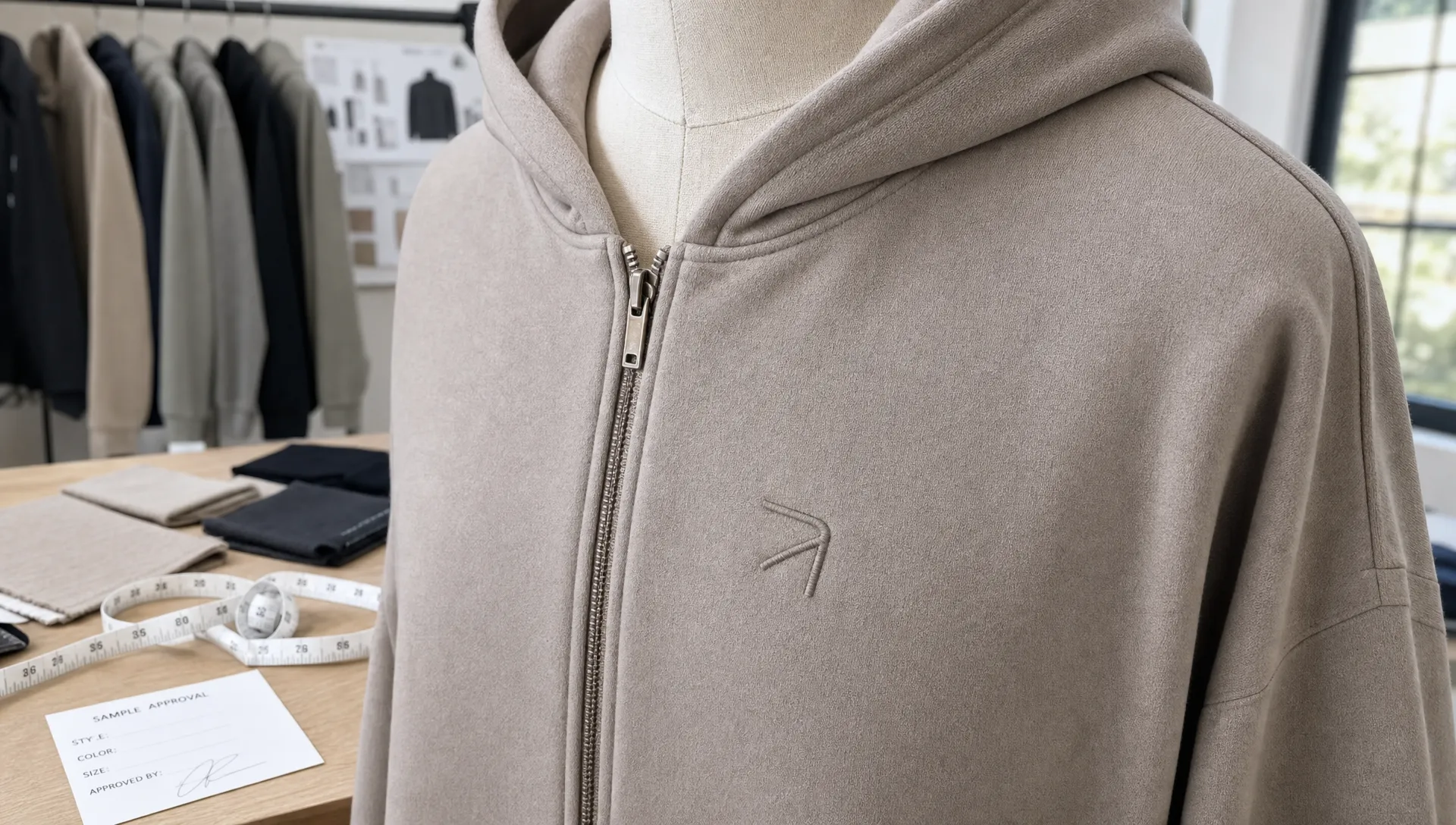
The first sample, often called a development sample, allows the buyer and factory to test the concept. At this stage, the goal is to confirm proportions, construction, fabric behavior, and branding placement. The sample may need revisions before production begins.
For private label martial arts clothing, sampling is also the point where the brand identity becomes visible. Labels, trims, embroidery, patches, hang tags, and packaging choices should all align with the intended market. A premium academy uniform, for example, may need a different finish than a budget-friendly starter uniform.
That is why factories treat garment fit as a product system, not a final adjustment. The same principle applies across apparel categories, from combat sports uniforms to formalwear specialists such as Le Michel Bruidsmode, where silhouette, sizing, and presentation shape the customer’s confidence before the garment is ever worn at an important event.
Stage 4: Size Grading and Marker Planning
After the sample is approved, the factory grades the pattern into the full size range. Size grading is the controlled process of increasing or decreasing a pattern so each size keeps the intended fit.
This step can be more complex than it looks. Children’s sizes, adult sizes, plus sizes, and competition-focused fits may require different grading rules. If grading is rushed, a medium might fit well while the extra-large feels too short, or youth pants may become too wide as they increase in length.
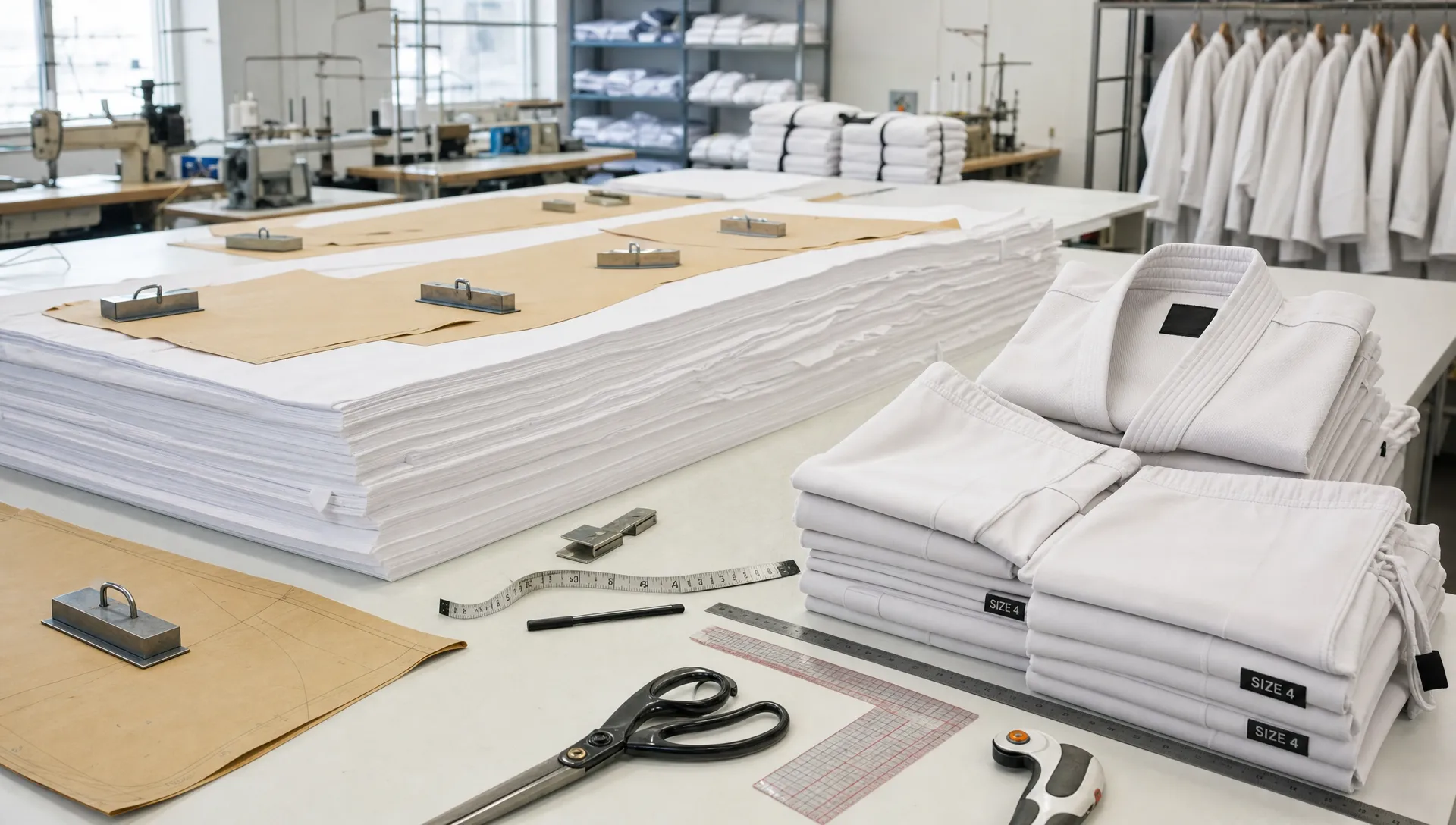
Marker planning comes next. This is the layout process that determines how pattern pieces are arranged on fabric before cutting. Efficient marker planning reduces fabric waste while keeping grain direction and pattern placement correct. For uniforms with directional textures or visible weaves, the factory must be careful that panels are aligned properly.
Stage 5: Cutting the Fabric
Cutting is where production becomes physical. Fabric is spread in layers on long cutting tables, then cut according to the approved patterns and marker. Accuracy at this stage affects the entire production run.
If fabric layers shift during cutting, panels can come out slightly uneven. That can lead to twisting seams, uneven hems, misaligned collars, or inconsistent garment measurements. Experienced cutting teams control fabric tension, layer height, blade sharpness, and panel bundling.
Cut pieces are usually sorted into bundles by size, color, and garment part. Each bundle must stay organized as it moves to printing, embroidery, sewing, or assembly. A good tracking system helps prevent size mixing and missing components.
Stage 6: Branding, Embellishment, and Custom Details
Branding can happen before or after sewing, depending on the technique and placement. Martial arts uniforms often include embroidered logos, woven patches, printed marks, sublimated panels, custom neck labels, size labels, and branded packaging.
Embroidery is popular for gis and traditional uniforms because it has a durable, premium look. However, dense embroidery can affect fabric flexibility if it is placed in the wrong area. Patches must be positioned accurately, especially when uniforms are used by schools or teams that expect consistency across members.
For lightweight sportswear or modern fightwear, sublimation and printing may be used more often. These methods require careful color control and artwork preparation. The factory should confirm file quality, logo size, placement, and color references before bulk application.
This is where private label planning becomes valuable. Brands that want to build a full martial arts apparel line can use a consistent system for labels, trims, packaging, and logo placement across different products. For a broader look at this model, Arus Sportswear’s complete guide to private label martial arts clothing covers how private label production supports brand development.
Stage 7: Sewing and Assembly
Sewing is the heart of the martial arts uniform factory process. Operators assemble panels into finished jackets, pants, belts, collars, cuffs, waistbands, and reinforcements.
Unlike fashion garments that may prioritize appearance alone, martial arts uniforms need stress-resistant construction. Common reinforcement zones include the crotch, knees, side vents, lapels, belt loops, sleeve seams, pant inseams, and collar attachment points. In grappling uniforms, extra reinforcement may be needed because the garment is regularly pulled and gripped.
Factories use different machines for different operations. Straight stitch machines may handle basic seams, while overlock machines secure raw edges. Bartack machines reinforce stress points. Specialized machines may be used for waistbands, collars, belt loops, and heavy fabrics.
The order of operations matters. For example, it may be easier and cleaner to attach certain patches before side seams are closed. Collars often require careful handling because uneven thickness or poor feeding can cause puckering. Pants need consistent rise, inseam length, and waistband tension across sizes.
A well-managed sewing line includes in-line checks, not just final inspection. Supervisors review seam allowance, stitch density, thread tension, matching components, and measurement points while production is still moving. This reduces the chance of discovering a large problem only after the entire batch is complete.
Stage 8: Quality Control During Production
Quality control is not a single checkpoint at the end. In a strong factory, QC is built into the full production flow. Fabric is checked before cutting, panels are checked after cutting, sewing is checked in line, and finished garments are checked before packing.
For martial arts uniforms, common QC points include measurements, stitching strength, symmetry, color, logo placement, shrinkage, stains, loose threads, missing labels, and packing accuracy. Factories may inspect a percentage of the batch or apply a more detailed inspection plan depending on buyer requirements.
| QC checkpoint | What inspectors look for | Why it protects the buyer |
|---|---|---|
| Fabric inspection | Holes, stains, shade variation, weave defects | Prevents defective fabric from entering production |
| Cutting inspection | Accurate panels, correct sizes, clean edges | Reduces fit and assembly problems |
| In-line sewing checks | Seam strength, stitch tension, reinforcement quality | Catches defects before the full batch is complete |
| Measurement check | Chest, sleeve, length, waist, inseam, collar width | Keeps sizing consistent across the order |
| Final inspection | Appearance, labels, packaging, quantity, carton marks | Ensures finished goods match the approved order |
For karate-specific production, quality control often centers on clean lines, crisp finishing, proper sleeve and pant proportions, and reliable stitching. Arus Sportswear has covered this topic in more detail in its article on how a karate gi factory handles quality at scale.
Stage 9: Washing, Pressing, Folding, and Packing
After sewing and final trimming, garments may go through finishing steps. Depending on the product, this can include thread cleaning, pressing, folding, size sorting, polybagging, labeling, and carton packing.
Some uniforms may require washing or pre-shrinking before final packing, depending on the fabric and buyer specification. This is especially important when shrinkage control is part of the product promise. If washing is not required, the factory may still press or steam garments to improve presentation.
Packing should be treated as part of the product experience. A uniform that arrives wrinkled, mislabeled, or mixed by size creates extra work for the buyer. Clear size stickers, barcodes if required, branded bags, hang tags, carton markings, and packing lists help distributors and gyms manage inventory more efficiently.
For worldwide shipping, carton strength and packing method also matter. Martial arts uniforms can be bulky and heavy in bulk quantities, so poor packing may increase freight issues or damage presentation before the products reach customers.
What Brands Should Prepare Before Contacting a Factory
The better the information a buyer provides, the smoother the factory process becomes. A factory can help refine a product, but it still needs clear direction to avoid delays.
Useful preparation includes:
- A reference sample or clear product photos
- A size chart with target measurements
- Fabric preference, weight, or performance requirement
- Logo files in production-ready formats
- Branding details such as labels, patches, and packaging
- Target order quantity and expected delivery timeline
- Notes about fit, shrinkage tolerance, and end use
If you do not have every detail ready, that does not mean production is impossible. It simply means the sampling stage becomes more important. For new brands, a factory with private label and OEM experience can help translate the concept into a manufacturable product.
Common Bottlenecks in Uniform Production
Many production delays come from unclear approvals rather than sewing itself. Artwork changes, late label decisions, incomplete size charts, unconfirmed fabric choices, and repeated sample revisions can all slow down the schedule.
Another common issue is assuming that one martial arts uniform pattern works for every discipline. Karate, taekwondo, judo, BJJ, kung fu, and tai chi uniforms each have different movement needs and customer expectations. A factory that understands these differences can recommend better construction choices before production starts.
Bulk consistency is also a frequent challenge. A buyer may approve a great sample but receive a bulk order with inconsistent sleeve length, embroidery placement, or fabric shade if the factory lacks strong production controls. This is why buyers should evaluate process discipline, not just sample appearance.
Why the Factory Process Matters for Brand Growth
For a martial arts brand, the factory is more than a supplier. It directly affects customer reviews, repeat orders, academy reputation, and wholesale reliability. A uniform that fits well and lasts through training encourages trust. A uniform with inconsistent sizing or weak seams can damage the brand quickly.
That is why experienced manufacturing partners focus on repeatability. The objective is to create a product system that can scale: approved specs, reliable materials, documented construction, consistent branding, and predictable QC.
Arus Sportswear supports brands, gyms, and distributors with custom martial arts and combat sports apparel manufacturing, including private label and OEM production, custom designs, branding options, low minimum orders, bulk order support, and worldwide shipping. For businesses building a long-term product line, the right manufacturing process can turn a single uniform into a scalable apparel program.
Frequently Asked Questions
What is the first step in a martial arts uniform factory process? The first step is usually reviewing the product brief or tech pack. This defines the uniform type, fabric, size range, branding, construction details, order quantity, and intended use.
How long does it take to make a martial arts uniform sample? Sampling time varies based on fabric availability, design complexity, branding methods, and revision needs. A simple uniform may move faster than a heavily customized gi with embroidery, patches, and special sizing.
What makes martial arts uniform manufacturing different from regular apparel? Martial arts uniforms need stronger construction, better movement allowance, reinforcement at stress points, shrinkage control, and discipline-specific fit. They are built for training, gripping, kicking, stretching, and frequent washing.
Why is fabric testing important for martial arts uniforms? Fabric testing helps control shrinkage, color consistency, strength, weight, and comfort. Without testing, a uniform may fit correctly at first but change after washing or fail under training stress.
Can a factory produce private label martial arts uniforms? Yes, many factories can produce private label uniforms with custom logos, labels, patches, packaging, and design details. Arus Sportswear offers private label and OEM manufacturing for martial arts and combat sports apparel.
Build Better Uniforms With a Process-Driven Partner
A reliable martial arts uniform factory does more than sew garments. It helps turn your idea into a repeatable product through fabric control, sampling, grading, cutting, sewing, quality checks, finishing, and packing.
If your brand, gym, or distribution business is planning custom martial arts uniforms, working with a manufacturer that understands both performance and presentation can make production smoother from the first sample to the final shipment. Arus Sportswear manufactures custom MMA and martial arts apparel for clients worldwide, with support for private label, OEM production, custom branding, low minimum orders, and bulk manufacturing.