Choosing a private label judo gi manufacturer is not just a sourcing decision. It affects your product quality, brand reputation, customer reviews, reorder consistency, and margins. A good supplier can help you turn a gi concept into a repeatable product line. The wrong one can leave you with inconsistent sizing, weak stitching, poor shrinkage control, delayed shipments, or branding that does not look retail-ready.
This checklist is designed for martial arts brands, academies, distributors, and fightwear startups that want to evaluate manufacturers before placing a first production order. Use it to compare suppliers clearly, ask better questions, and avoid choosing only on the lowest quoted price.
Start with the product you want to sell
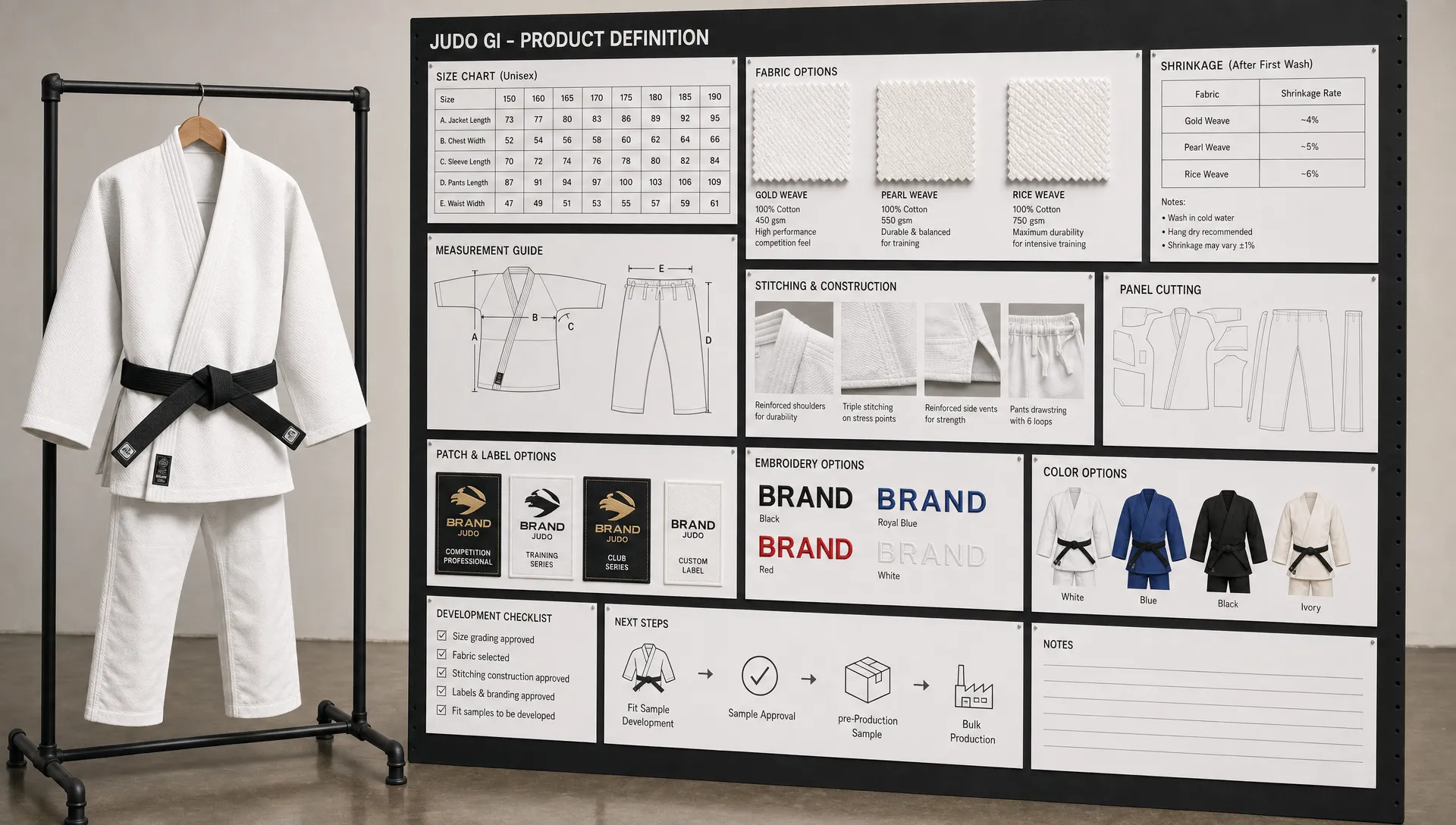
Before contacting any private label judo gi manufacturer, define the gi you are trying to build. Many sourcing problems happen because the buyer asks for “a custom judo gi” without specifying customer type, fabric expectations, fit, branding, and sales channel.
A beginner gi for academy students is different from a premium gi for serious competitors. A kids’ uniform needs different sizing priorities than an adult retail line. A distributor may prioritize stable bulk supply, while a brand launching online may care more about packaging, labels, and photography-ready finishing.
| Product decision | What to define before quoting | Why it matters |
|---|---|---|
| Target customer | Beginner, club student, competitor, kids, adult retail buyer | Impacts weight, fit, durability, and price point |
| Fabric weight | Lightweight, midweight, or heavyweight cotton blend or cotton fabric | Affects comfort, strength, shipping weight, and cost |
| Fit profile | Traditional, relaxed, athletic, or academy-standard fit | Influences pattern, grading, and returns |
| Branding level | Woven labels, patches, embroidery, custom packaging | Determines production complexity and MOQ |
| Sales channel | Gym sales, wholesale, ecommerce, distributor supply | Affects packaging, barcoding, and reorder planning |
If you are still shaping the product brief, Arus Sportswear’s guide on custom judo gi manufacturer tips for growing labels can help you think through the early product development stage before sampling.
Check judo-specific manufacturing experience
A judo gi is not a generic cotton uniform. It must handle repeated gripping, pulling, twisting, mat friction, washing, and body contact. Your manufacturer should understand the structural demands of judo, especially around the collar, lapel, shoulders, sleeves, skirt, pants, knees, and stress seams.
Ask whether the factory has made judo gis before, not only karate uniforms, BJJ gis, or casual sportswear. Related martial arts experience is useful, but judo has its own performance expectations. The collar should feel substantial. Reinforcements should be placed where athletes actually need them. Sleeve width, jacket length, and pant fit must be consistent across sizes.
A capable manufacturer should be able to discuss:
- Jacket weave options and fabric weights
- Collar construction and lapel firmness
- Reinforced stitching at high-stress areas
- Pant knee reinforcement and drawstring or elastic options
- Shrinkage allowances after washing
- Size grading from kids to adult sizes
- Branding methods that do not compromise performance
If a supplier treats a judo gi as a simple “white uniform,” that is a warning sign. You need a partner that understands martial arts use, not just garment assembly.
Verify private label and OEM capabilities
Private label production means the manufacturer can make products under your brand name, with your labels, design details, packaging, and specifications. OEM production usually goes deeper, with products made to your technical requirements rather than copied from a generic catalog.
For a judo gi line, private label capability should include more than placing your logo on an existing garment. Ask what elements can be customized and which ones are fixed. Some factories offer only basic label replacement, while others can develop patterns, fabric combinations, trims, embroidery, patches, packaging, and bulk order specifications.
| Capability | Basic private label | Strong private label or OEM partner |
|---|---|---|
| Labels | Standard neck or size label with your logo | Custom woven labels, care labels, size labels, and brand tags |
| Design | Limited catalog styles | Custom cut, fit, reinforcements, and trims |
| Branding | Simple patch or embroidery | Full branding system across gi, pants, packaging, and carton marks |
| Sizing | Standard size chart only | Adjusted grading for your customer base |
| Documentation | Minimal order notes | Tech pack, sample comments, approved specs, and QC references |
For brands planning to expand beyond judo into MMA, BJJ, karate, or boxing apparel, it is also worth reading Arus Sportswear’s overview of private label martial arts clothing manufacturing to understand how broader product lines are typically developed.
Evaluate fabrics, shrinkage, and construction
Fabric choice is one of the biggest drivers of quality, comfort, and price. A heavier gi can feel more durable, but it may also be warmer, more expensive to ship, and less attractive to beginners. A lighter gi may be comfortable and cost-effective, but it still needs enough structure for training.
Ask your manufacturer for fabric details in writing. Do not rely only on photos. Request information about material composition, weave, fabric weight, collar filling, pant fabric, reinforcement fabric, and expected shrinkage. If the supplier cannot explain shrinkage control, the final fit may change significantly after washing.
Your checklist should include these construction points:
- Collar firmness and consistency across sizes
- Reinforcement at shoulders, chest, side vents, armpits, and sleeve openings
- Strong seam type and stitch density in stress areas
- Pant knee panels that stay aligned after washing
- Drawcord or waistband construction suitable for training
- Clean inside finishing without loose threads or rough seams
- Color consistency for white, blue, black, or custom color options
A reliable manufacturer should be open to discussing trade-offs. For example, heavier fabric may improve perceived durability, but a midweight design may be better for academy programs where comfort, price, and bulk ordering matter.
Review the sampling process carefully
Sampling is where your idea becomes a real product. Do not skip it, even if the manufacturer has a catalog gi that looks close to what you need. A sample allows you to evaluate hand feel, fit, shrinkage, stitch quality, branding placement, and overall presentation before committing to bulk production.
The first sample may not be perfect. That is normal. What matters is how the manufacturer handles feedback. A professional supplier should record changes clearly and provide an updated sample or pre-production confirmation before mass production begins.
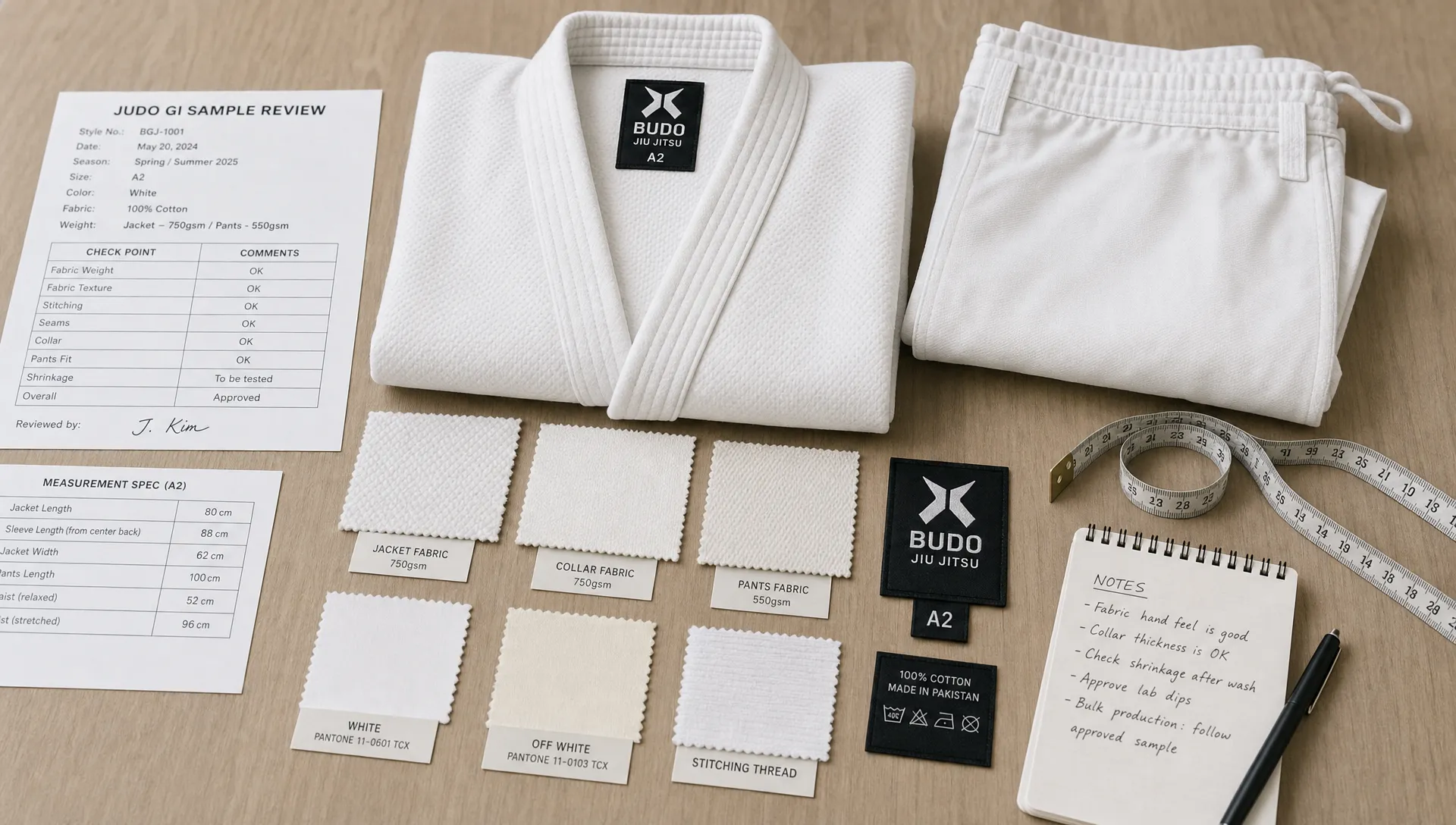
Test your sample as close to real use as possible. Wash it, dry it according to the care instructions, measure it before and after washing, and have a judo practitioner wear it for movement and grip feedback. If you sell to academies, ask an instructor to review whether the fit works for their students.
Confirm sizing and grading before bulk production
Sizing problems are expensive because they often appear only after customers start wearing the product. A2 may fit well, but A0, A4, or kids’ sizes can still be off if the grading is not handled properly.
Ask for a full size chart with key measurements for jacket and pants. Important measurements include jacket length, sleeve length, chest width, skirt width, pant length, waist range, and hip width. If you serve a specific market, such as U.S. academy students, European distributors, or youth programs, share that customer profile with the manufacturer.
A good private label judo gi manufacturer should be willing to discuss measurement tolerance. No bulk production run is perfectly identical piece by piece, but tolerances should be controlled and agreed upon. For example, a small variation may be acceptable in certain areas, while sleeve length, jacket width, and pant length need tighter control.
Inspect branding quality, not just logo placement
Branding is one of the main reasons to choose private label production. However, poor branding can make even a strong gi look cheap. Evaluate how your logo appears on labels, patches, embroidery, and packaging.
Embroidery should be clean, balanced, and positioned accurately. Woven patches should not curl or feel flimsy. Labels should remain comfortable against the skin. Care labels should include accurate washing information. Packaging should protect the gi during shipping and present your brand professionally.
Consider how your gi will look when a customer opens it for the first time. The unboxing experience matters, especially for ecommerce brands and premium academy programs. Clean folding, correct size stickers, branded polybags, hangtags, and carton labeling can reduce confusion and improve perceived value.
Ask about quality control checkpoints
Quality control should happen throughout production, not only at the end. A factory that waits until final packing to find problems may already have produced hundreds of defective pieces. Ask where inspections happen and who signs off on each stage.
This is where process discipline becomes as important as sewing skill. In any custom physical project, clear scopes, skilled execution, and controlled workflows protect the final result. You can see the same principle in companies built around quality craftsmanship and smooth project management, where the outcome depends on both technical work and organized delivery.
For judo gi manufacturing, key QC points should include fabric inspection, cutting accuracy, sewing checks, measurement checks, branding checks, thread trimming, stain inspection, folding, packing, and carton verification. If you want to understand how these steps fit together in a real production flow, Arus Sportswear explains the broader martial arts uniform factory process in more detail.
| QC checkpoint | What to verify | Risk if ignored |
|---|---|---|
| Fabric inspection | Weight, shade, defects, shrinkage behavior | Inconsistent look or poor durability |
| Cutting | Accurate panels by size | Twisted garments or wrong measurements |
| Sewing | Reinforcements, seams, stitch density | Open seams and weak stress points |
| Branding | Logo placement, label accuracy, embroidery quality | Retail presentation problems |
| Final inspection | Measurements, stains, loose threads, packing | Customer complaints and returns |
Understand MOQ, pricing, and reorder terms
Low minimum orders can be useful for new brands, gyms, and test launches, but MOQ should not be the only factor in your decision. A very low MOQ with poor consistency can cost more in the long run than a slightly higher MOQ from a better manufacturer.
Ask how MOQ changes by size range, fabric color, branding method, and packaging. A plain white gi with a woven label may have a lower minimum than a custom-colored gi with embroidery, patches, and retail packaging. Make sure your quote separates sample costs, bulk unit price, branding charges, packaging costs, shipping, and any mold or setup fees if applicable.
Also ask about reorders. A good first production run is valuable only if the manufacturer can repeat it. Your supplier should keep approved patterns, size charts, branding files, fabric references, and sample comments so future orders match the original product.
Review communication and documentation
Strong communication prevents expensive misunderstandings. You should not have to guess whether your fabric, logo placement, size chart, or packaging instructions were understood. Professional manufacturers document key decisions and confirm them before production.
Before placing an order, check whether the supplier provides clear answers, organized quotations, sample feedback records, and production updates. Slow communication during quoting often becomes worse during production. Fast but vague communication is also a risk if details are not documented.
Your final approval file should include the product name, style number, size range, fabric details, colors, branding placements, label artwork, packaging instructions, approved sample photos, measurement chart, order quantity, and shipping details.
Watch for red flags before you commit
Some problems are visible early if you know what to look for. Be cautious if a manufacturer refuses to make samples, avoids discussing shrinkage, cannot explain construction details, or pushes you to approve bulk production too quickly.
Other red flags include unclear pricing, inconsistent answers, no martial arts-specific experience, poor logo mockups, missing size charts, unrealistic lead times, and unwillingness to document specifications. A supplier does not need to be the cheapest or fastest to be the best choice. For private label judo gis, reliability and repeatability are often more valuable than saving a small amount on the first order.
Final private label judo gi manufacturer checklist
Use this condensed checklist when comparing suppliers:
- The manufacturer has real judo gi or martial arts uniform experience.
- Fabric weight, weave, shrinkage, and construction details are confirmed in writing.
- The supplier can support private label branding, labels, patches, embroidery, and packaging.
- A sample is produced, tested, washed, measured, and revised if needed.
- Full size charts and measurement tolerances are agreed before bulk production.
- Quality control checkpoints are defined across fabric, cutting, sewing, branding, and packing.
- MOQ, pricing, lead time, shipping, and reorder terms are clear.
- Communication is organized, responsive, and documented.
- Approved samples and specifications are saved for future production.
Frequently Asked Questions
What should I ask a private label judo gi manufacturer first? Start by asking about judo gi manufacturing experience, fabric options, MOQ, sample process, branding capabilities, size charts, quality control, and shipping support. These answers will quickly show whether the supplier understands martial arts apparel or only general garment production.
How many samples should I make before bulk ordering judo gis? Most brands should expect at least one sample and sometimes a revised sample before bulk production. If you change fabric, fit, embroidery, or sizing after the first sample, a second confirmation sample can prevent costly production mistakes.
What makes a judo gi different from a karate gi or BJJ gi? A judo gi is built for gripping, pulling, and repeated throwing practice, so collar strength, reinforced stress points, sleeve shape, and fabric durability are especially important. Karate gis often prioritize movement and snap, while BJJ gis may use different cuts, weaves, and branding styles.
Can a new brand start with low MOQ judo gi production? Yes, many growing brands begin with smaller runs to test sizing, customer demand, and branding. The key is to choose a manufacturer that can support low minimum orders while still maintaining consistent quality and clear reorder records.
Build your private label judo gi line with the right partner
A strong judo gi line starts with a clear brief, a disciplined sample process, and a manufacturer that understands combat sports apparel. If you are building a brand, outfitting an academy, or preparing wholesale supply, your checklist should protect both product quality and long-term scalability.
Arus Sportswear manufactures custom MMA and martial arts apparel for brands, gyms, and distributors worldwide, including private label and OEM production for fightwear, uniforms, and combat sports gear. If you are ready to develop custom judo gis with branding, bulk order support, low minimum orders, and worldwide shipping, visit Arus Sportswear to start the conversation.