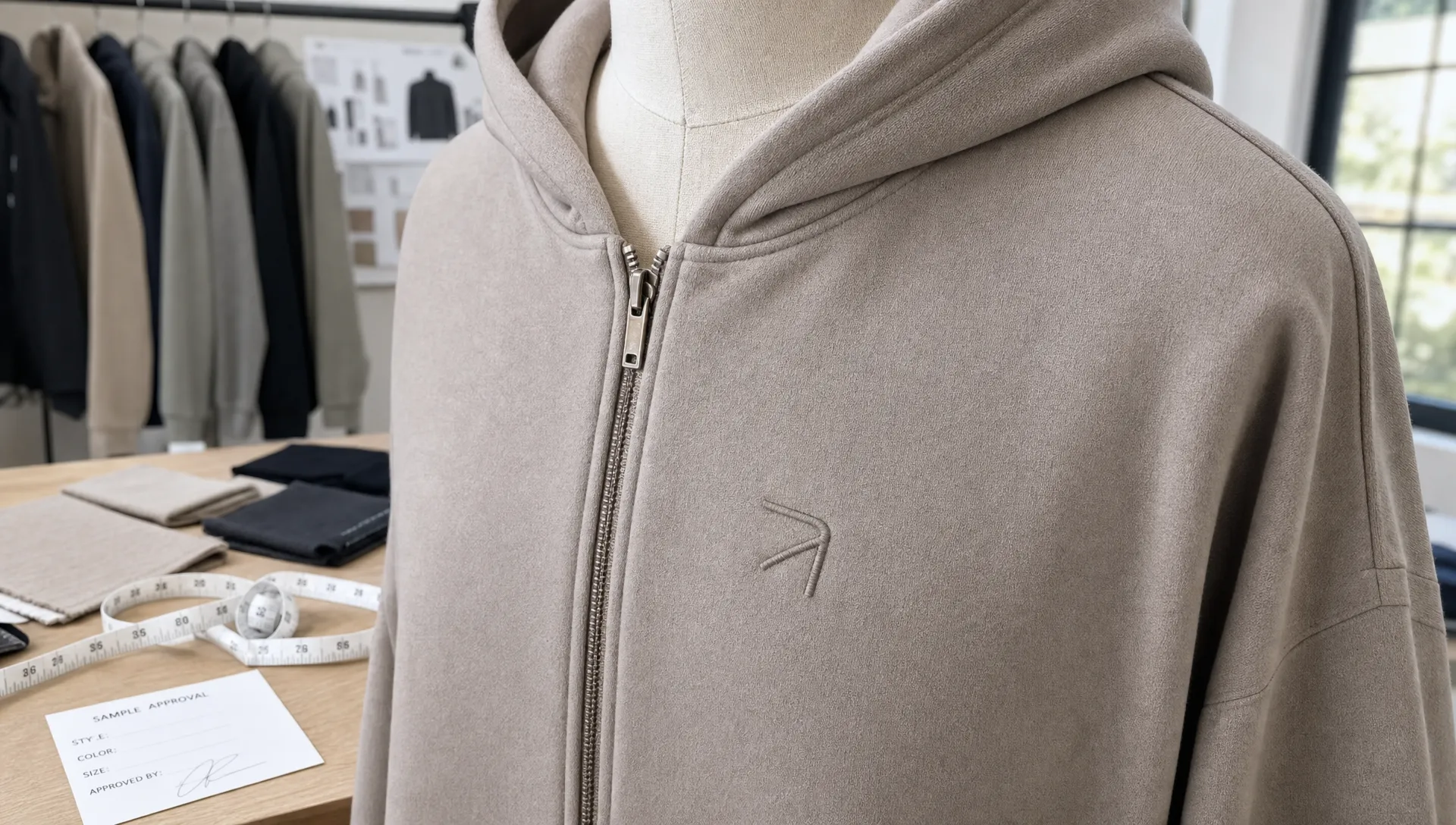
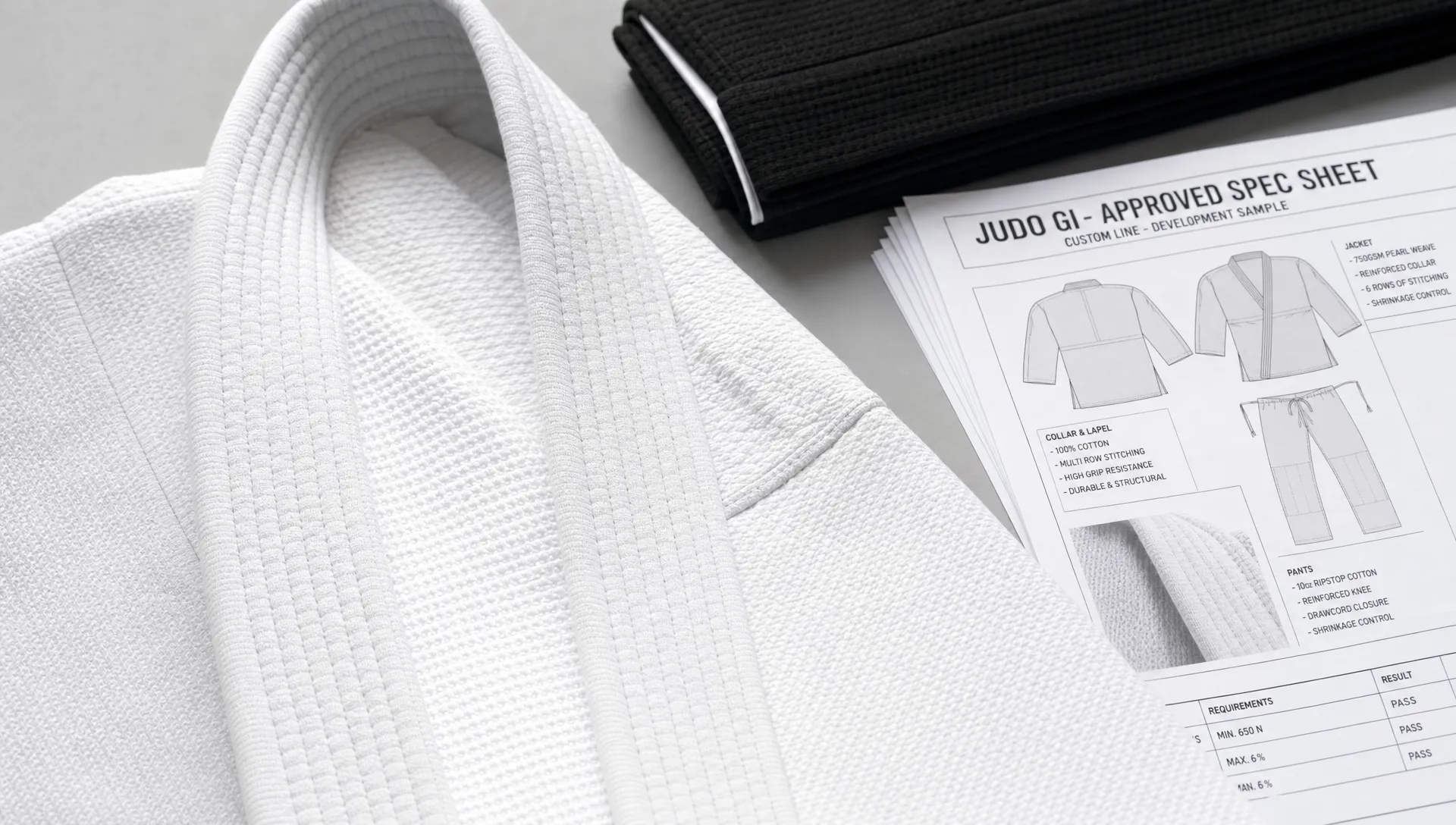
A judo gi is not just another martial arts uniform with a different patch. It must survive repeated gripping, pulling, throwing, mat friction, washing, and team use while still looking sharp enough to represent your label. For a growing brand, gym, or distributor, choosing a custom judo gi manufacturer is one of the most important sourcing decisions you will make.
The right partner helps you turn a concept into a repeatable product line. The wrong partner can leave you with inconsistent sizing, weak collars, shrinking jackets, delayed deliveries, or inventory that does not match what your customers expected.
If your label is moving from small test orders to a serious martial arts apparel range, use the tips below to brief manufacturers clearly, reduce sampling mistakes, and build judo gis that can scale.
Understand what your judo customers actually need
Before asking for quotes, define who the gi is for. A beginner training gi, a club uniform, a premium retail gi, and a competition-focused judogi can have very different expectations.
For example, children’s judo uniforms need durability and easy sizing more than heavy fabric. Club uniforms often need reliable repeat orders, consistent white color, and enough room for many body types. A premium judo label may care more about fabric hand feel, reinforced stress points, embroidered branding, and controlled shrinkage.
A manufacturer can only guide you properly if your target product is clear. Do not start with “send me your best judo gi price.” Start with the customer, use case, expected retail position, and quality level.
| Product direction | Best for | Key priorities | Common sourcing risk |
|---|---|---|---|
| Entry-level training gi | Beginners, youth programs, school clubs | Comfort, price control, easy sizing | Fabric too thin or stitching too weak |
| Club/team gi | Gyms, academies, recurring uniform programs | Consistent fit, repeatable branding, durable seams | Reorders do not match first batch |
| Premium retail gi | Growing fightwear and martial arts labels | Better fabric, refined finish, stronger packaging | Overbuilding the gi and raising landed cost too much |
| Competition-oriented gi | Serious judoka and advanced athletes | Rule awareness, precise fit, tested shrinkage | Claiming compliance without proper verification |
This first decision affects almost everything else: fabric weight, cut, collar construction, embroidery placement, packaging, MOQ planning, and production lead time.
Build a product brief before requesting samples
A vague request creates vague samples. If you want a manufacturer to take your label seriously, prepare a simple technical brief before you start development.
Your brief does not need to be a full professional tech pack on day one, but it should answer the basic questions that affect cost and production. Include the jacket, pants, belt if included, size range, fabric preference, branding details, color, packaging, and target quantity.
A strong judo gi brief usually includes:
- Target customer, such as kids, adult beginners, clubs, or premium retail buyers
- Jacket fabric type, weave, color, and approximate weight
- Pants fabric, reinforcement panels, waistband type, and drawcord preference
- Size range, including whether you need kids, adult, slim, or extended sizing
- Branding plan, such as woven labels, embroidery, patches, inside neck labels, and care labels
- Packaging requirements, including polybag, size sticker, barcode, hangtag, or custom box
- Quality expectations, including shrinkage tolerance, seam strength, and color consistency
If you are building a broader private label martial arts range, it is worth studying how uniform categories connect. Arus Sportswear’s guide to private label martial arts clothing manufacturing covers useful planning points for labels that want to expand beyond one product.
Choose fabric and construction with the sport in mind
Judo puts unusual stress on a uniform. Athletes grip the lapel, sleeves, back, and shoulders constantly. That means your gi cannot be designed only for appearance. It must be engineered around tension points.
Fabric weight and weave
Heavier fabric can feel more durable and premium, but it also increases cost, shipping weight, drying time, and stiffness. Lighter fabric can be more comfortable for beginners, but it may not hold up well if the weave, sewing, and reinforcements are weak.
Instead of choosing weight from a catalog alone, ask your custom judo gi manufacturer for physical swatches and finished garment samples. Fabric behavior changes after cutting, washing, sewing, and pressing. A swatch may look good, but a full jacket tells you how the collar, sleeves, skirt, and shoulder panels behave together.
Collar and lapel strength
The collar is one of the first places judoka will notice quality. A collar that collapses, twists, or feels uneven can make the entire gi feel cheap. Ask how the collar is filled, stitched, and finished. You do not need to overcomplicate the design, but you do need consistency from size to size.
Reinforcement points
Reinforcement matters most where the gi is pulled, bent, or rubbed against the mat. Look closely at the shoulders, armpits, side vents, sleeve openings, knee panels, crotch seam, and belt loops. Poor reinforcement may not show during a quick photo review, but it appears fast in real training.
Brands that already source BJJ gis should avoid assuming the same cut and construction will work for judo. The sports overlap, but the fit expectations and grip dynamics are not identical. If your label sells across grappling categories, this BJJ gis buyer’s guide can help you compare product requirements before briefing a new gi project.
Get sizing right before scaling production
Sizing is where many growing labels lose money. A judo gi can be well made and still fail if customers keep returning it because the sleeves, pants, or jacket length are inconsistent.
Start by deciding whether you will use height-based sizing, numeric sizing, alpha sizing, or a hybrid size chart. Then test the actual garment measurements, not only the label size. Review sleeve length, jacket width, skirt length, pant inseam, waist stretch, and post-wash shrinkage.
Also consider your market. A club selling uniforms to kids may need easy parent-friendly sizing. A premium online label may need a detailed size chart with body height, weight guidance, and garment measurements. A distributor may need cartons clearly marked by size to reduce warehouse errors.
Do not approve bulk production from a single perfect sample in one size. Ask for size-set samples, especially for your best-selling sizes. Fit issues often appear when grading moves from small sizes to large sizes.
Treat sampling as a development process, not a formality
A sample is not just a preview. It is your chance to test the manufacturer’s understanding, communication, production discipline, and attention to detail.
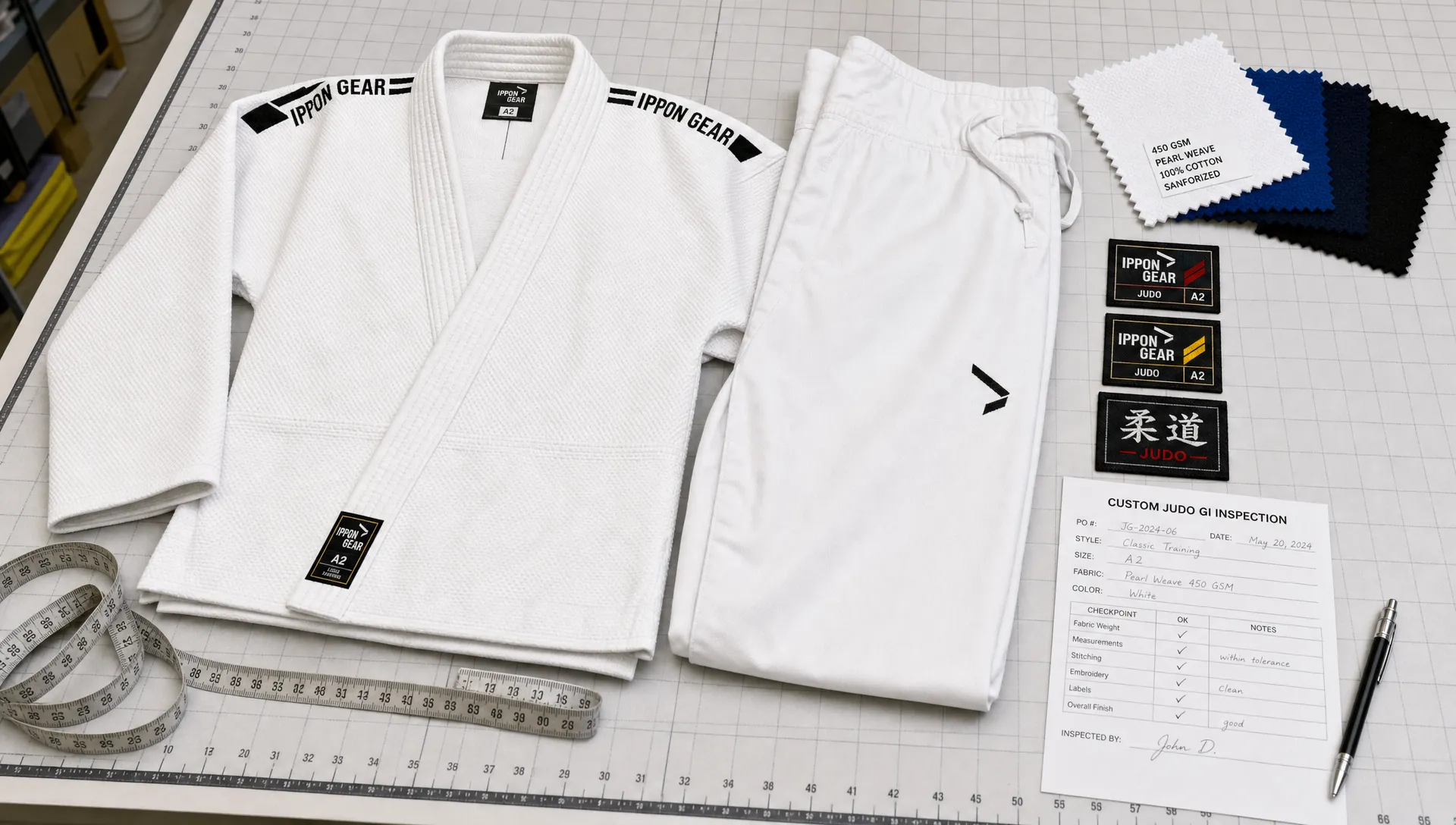
When the first sample arrives, inspect it like a customer and like a production manager. Try it on. Wash it. Measure it before and after washing. Pull the collar. Check the sleeve openings. Look at stitching density, loose threads, label placement, fabric shade, embroidery clarity, and packaging quality.
Create written feedback with photos. Do not rely on casual messages like “make the collar stronger” or “fit is not good.” Say exactly what needs to change. For example, “increase sleeve opening by 1.5 cm on adult sizes,” or “move woven label 2 cm lower inside neck seam.” Clear corrections help your manufacturer produce a second sample that actually solves the issue.
Set quality standards your manufacturer can repeat
Quality control is not one final inspection at the end of production. It should happen at every stage, from fabric sourcing to packing. A reliable custom judo gi manufacturer should be able to explain how they check materials, cutting accuracy, sewing consistency, measurements, trims, labels, and finished goods.
For growing labels, the goal is repeatable quality. Your first order may be small, but if your product sells well, your second and third orders need to match it. That requires standards.
| QC stage | What to check | Why it matters |
|---|---|---|
| Fabric inspection | Color, weave consistency, GSM, visible flaws | Prevents shade variation and weak panels |
| Cutting | Size accuracy, panel direction, fabric alignment | Protects fit and symmetry |
| In-line sewing | Seam strength, reinforcement, skipped stitches | Catches problems before the full batch is finished |
| Measurement check | Jacket, sleeve, pants, waist, shrinkage tests | Reduces returns and customer complaints |
| Branding check | Embroidery, patches, labels, care instructions | Protects brand presentation |
| Final packing | Size stickers, cartons, barcodes, packing list | Reduces warehouse and fulfillment errors |
If you want to understand how uniform factories maintain standards at higher volumes, this article on how a karate gi factory handles quality at scale is a useful comparison. The garment category is different, but many factory control points are similar.
Balance branding with performance
Branding is important, but judo customers still care most about function. A beautiful logo cannot compensate for a jacket that shrinks unpredictably or pants that tear at the knee.
Use branding to strengthen trust rather than overload the product. Woven neck labels, clean embroidery, small sleeve marks, hem labels, care labels, and premium packaging can all create a professional impression. But large patches, stiff decorations, or poorly placed embroidery may irritate athletes or interfere with training.
For growing labels, consistency is more valuable than complexity. A simple, repeatable branding system across white, blue, kids, and adult gis can make your line easier to reorder and easier for customers to recognize.
Plan MOQs, lead times, and inventory carefully
Low minimum orders can help growing labels test the market, but even a small judo gi order has many moving parts. Each size, color, embroidery option, and packaging variation adds complexity. A white adult gi in six sizes is simpler than white and blue versions with different patches for three gyms.
Ask your manufacturer what affects MOQ and lead time before locking your launch plan. Fabric availability, custom dyeing, embroidery workload, label production, packaging, and peak-season factory capacity can all influence timelines.
A practical approach is to start with a focused size range and one clear product tier. Once sales data confirms demand, you can expand into kids sizes, blue gis, premium versions, or club-specific designs.
This is especially important for labels that want to scale without creating cash-flow pressure. The principles in Arus Sportswear’s custom sports apparel tips for brands that want to scale apply strongly to judo gi sourcing: simplify what you launch, standardize what sells, and avoid unnecessary variation too early.
Think beyond the factory: protect your supply chain
Growing labels often focus on production but forget the operational side of the business. Once inventory arrives, you need a clean system for storage, picking, packing, returns, and stock counts. If you operate a showroom, gym retail area, or warehouse, your samples and finished goods are real business assets.
That is why apparel businesses should treat physical security as part of supply chain management. Just as you vet a manufacturer before trusting them with your product, you should protect your premises with reliable access control, camera systems, and alarm planning where appropriate. For companies looking at professional security support, providers such as Locked Safe Holland show how business security can combine alarms, cameras, access control, and surveillance into one controlled setup.
Good operations do not make a poor gi better, but they do help a strong product line stay organized, traceable, and profitable.
Avoid the most common sourcing mistakes
Many judo gi sourcing problems are preventable. They usually come from rushing the early decisions or approving production without enough detail.
Common mistakes include:
- Choosing only by the lowest unit price without comparing fabric, stitching, sizing, or service
- Approving a sample without washing and measuring it
- Using generic martial arts sizing without testing your customer base
- Adding too many custom options before you know which products sell
- Forgetting packaging, carton marks, barcodes, and size labels until the order is finished
- Claiming competition suitability without checking current requirements for your target market
- Failing to document approved fabric, trims, labels, and measurements for future reorders
A strong manufacturer should help you avoid these issues, but your label also needs internal discipline. Keep approved samples, spec sheets, measurement records, packaging files, and photos from each production run. That archive becomes invaluable when you reorder or expand the line.
What to ask a custom judo gi manufacturer before ordering
Before placing a bulk order, ask questions that reveal process, not just price. You want to understand how the manufacturer thinks, communicates, and controls production.
Useful questions include:
- What fabric and weave options do you recommend for our target customer?
- Can you produce size-set samples before bulk production?
- How do you measure shrinkage and finished garment tolerance?
- What branding methods are available for collars, sleeves, labels, patches, and packaging?
- How do you handle quality checks during cutting, sewing, and final inspection?
- What is the realistic lead time after sample approval?
- How are reorders documented so future batches match the original production?
The answers will tell you whether the supplier is only taking orders or actually helping you build a repeatable product.
FAQ
What makes a good custom judo gi manufacturer for a growing label? A good manufacturer understands judo-specific construction, offers clear sampling, supports custom branding, communicates realistic lead times, and can repeat quality across future orders.
Should a new label start with a heavy or lightweight judo gi? It depends on the target customer. Beginner and club gis often benefit from comfort and affordability, while premium or advanced products may use heavier fabric. Always test samples before committing.
How many samples should I order before bulk production? At minimum, order a development sample and, if possible, size-set samples for key sizes. Wash and measure them before approval so you understand shrinkage and fit.
Can I use the same manufacturer for judo gis, BJJ gis, and other martial arts uniforms? Yes, if the manufacturer has experience across those categories and understands the differences in cut, fabric, reinforcement, and customer expectations.
What should I prepare before contacting a custom judo gi manufacturer? Prepare your target customer, size range, fabric preference, branding plan, packaging needs, estimated order quantity, and quality expectations. A clearer brief usually leads to better pricing and better samples.
Build your judo gi line with a partner that can scale
A growing label needs more than a factory that can sew a logo onto a uniform. You need a manufacturing partner that understands product development, sizing, branding, quality control, and repeat orders.
Arus Sportswear manufactures custom MMA and martial arts apparel for brands, gyms, and distributors worldwide, including private label and OEM production. If you are planning a custom judo gi line, start with a clear product brief, test samples properly, and choose a partner that can support your label as demand grows.