A first order proves a supplier can make something close to your brief. A second, third or fourth order proves whether the supplier can repeat it. For brands, gyms and distributors, evaluating wholesale BJJ gi suppliers before reordering is one of the simplest ways to prevent stock problems, customer complaints and margin loss.
The best time to review a supplier is not after a major failure. It is when you have enough real data from the previous shipment to decide whether to reorder, renegotiate or move production elsewhere. That data includes how the gis held up after washing, whether sizing matched expectations, how many returns you received, how the supplier handled issues and whether the reorder will match the original approved sample.
This guide focuses on the reorder stage: the point where many buyers move too quickly because they already have a working relationship. A repeat purchase order should never be automatic. It should be based on evidence.
Why Reorder Evaluation Matters More Than Initial Vetting
Initial supplier checks often happen under controlled conditions. You review sample photos, approve a prototype, discuss fabrics and place a trial order. The supplier knows they are being evaluated, so the first sample may receive extra attention.
Reorders are different. They reveal process control. Can the supplier maintain the same fabric weight, collar feel, stitching quality, color accuracy, shrinkage behavior and packing standards when the order is no longer new? Reliable wholesale BJJ gi suppliers build systems around consistency. Less reliable suppliers depend on one good sample, one skilled sewing line or one fabric lot that may not be available again.
For B2B buyers, reorder risk is also larger than first-order risk. If the first batch sold well, the reorder may be bigger. You may have opened wholesale accounts, promoted restocks or taken preorders from gyms. A bad reorder can damage more than one shipment. It can damage trust in your label.
Start With First-Order Performance Data
Before asking for a new quotation, review what happened with the previous order. Do not rely only on memory or a general feeling that the shipment was “good enough.” Pull together sales feedback, warehouse notes, return reasons and photos from customer service.
A practical reorder review should cover the full path from factory to end user. The gi may have looked acceptable in the carton but still failed after two washes. The delivery may have arrived on time but included uneven size ratios. The embroidery may have been clean but placed slightly differently from the approved sample.
Use a simple table like this before speaking with the supplier:
| Review area | What to check | Warning sign before reordering |
|---|---|---|
| Product quality | Stitching, reinforcements, collar firmness, pants drawstring, patches and embroidery | Defects repeat across multiple sizes or colors |
| Sizing | Measurements against your approved size chart after receipt and after washing | One size fits correctly but another size drifts from the grade |
| Shrinkage | Jacket length, sleeve length, pants length and width after controlled washing | Shrinkage exceeds the tolerance you agreed to with the supplier |
| Branding | Logo placement, woven labels, neck labels, care labels and packaging | Branding varies from piece to piece or differs from the sample |
| Delivery | Ship date, document accuracy, carton condition and received quantities | Supplier confirms late changes only after you ask |
| Communication | Response time, clarity, ownership of problems and documentation | Issues are blamed on vague “production reasons” without correction |
This table does not need to be complicated. The goal is to turn a reorder decision into a controlled purchasing process instead of a repeat transaction based on habit.
Compare the Bulk Order Against the Approved Sample
Your approved sample is your reference point. If you do not keep one in your office or warehouse, start doing it with the next order. A retained sample lets you compare every reorder against the original standard instead of comparing one new shipment to another imperfect shipment.
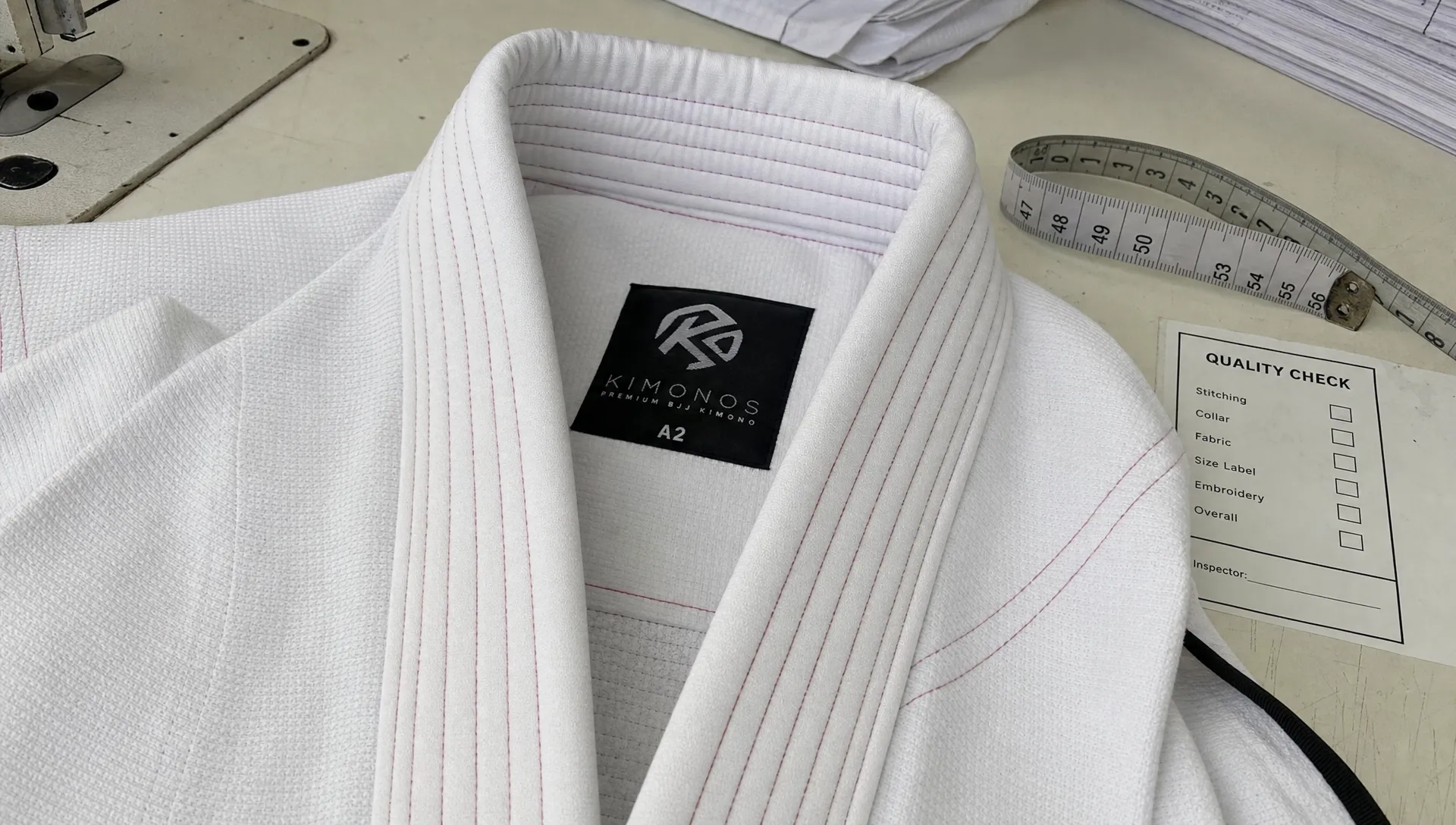
When evaluating wholesale BJJ gi suppliers, compare the bulk pieces against the retained sample in areas that matter to real BJJ customers: lapel thickness, sleeve opening, skirt length, pants rise, reinforcement at stress points, stitching density and the feel of the fabric after washing. A small change in the collar or sleeve cut can affect how the gi performs during grips, sparring and competition.
If you are still refining your original product specifications, Arus has a detailed BJJ gis buyers guide for brands, gyms and distributors that explains the core choices around fabrics, sizing, branding and order planning. For reorder evaluation, the key is to turn those choices into measurable standards.
The comparison should include at least one unit from each size and color in the shipment. If you sell multiple models, such as lightweight training gis and heavier premium gis, inspect each model separately. Do not assume one passing style means the full order is consistent.
Test Sizing, Fit and Shrinkage Before Reordering
Sizing complaints are expensive because they often lead to returns, exchanges or unsold inventory. They also damage customer confidence, especially for gyms and distributors that sell repeat uniforms to the same students.
A reorder check should include two sizing reviews. First, measure the gis as received. Second, wash and dry test pieces according to the care instructions, then measure again. The exact tolerance should be agreed with your supplier before production, but the important point is consistency. If A2 is predictable but A3 shrinks differently, the issue may be grading, cutting or fabric variation.
For international buyers, fit expectations may also vary by market. A brand selling in the USA and Australia may prefer a different cut than a distributor selling into Japan or Thailand. European customers may also have different expectations around sleeve length, jacket cut and pants fit. If your sales data shows repeated fit complaints from one region, do not simply reorder the same size chart.
Ask your supplier whether the next batch will use the same fabric source and shrinkage control process. If the answer is unclear, request a new size set or pre-production sample before placing a large reorder.
Review Quality Control Evidence, Not Just Promises
A supplier saying “we will check quality carefully” is not enough. Before reordering, ask what was checked on the previous order and what will be checked on the next one.
Useful QC evidence can include measurement reports, in-line inspection photos, final inspection records, packing lists, carton markings and photos of finished goods before shipment. You do not need a complex audit system for every reorder, but you do need proof that the supplier is checking the same things you care about.
A strong supplier can explain how defects occurred and how they will be prevented next time. For example, if a woven label was sewn too low on several jackets, the supplier should update the sewing instruction or add a placement check. If pants measurements varied, the supplier should review cutting, grading or fabric relaxation before sewing.
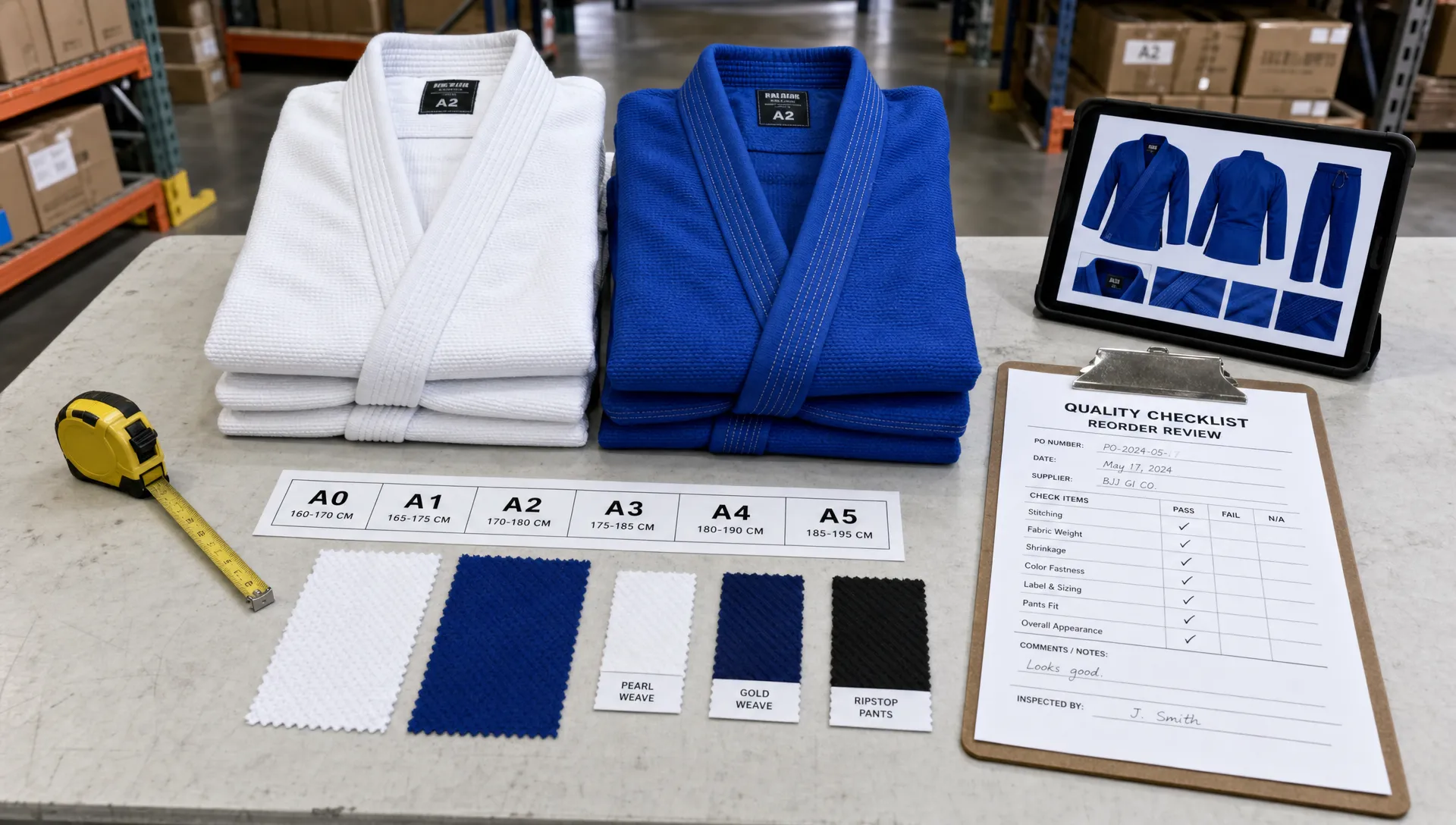
The strongest wholesale BJJ gi suppliers will not treat QC as a last-minute inspection. They will use checkpoints throughout production, from fabric inspection and cutting to sewing, branding and packing.
Score the Supplier Before Sending the Next Purchase Order
A simple scorecard helps remove emotion from the reorder decision. It also gives your team a consistent way to compare suppliers if you source from more than one factory.
| Criterion | Evidence to request | Strong reorder signal | Reorder risk |
|---|---|---|---|
| Consistency | Bulk pieces compared with retained sample | Fabric, fit and construction match the approved standard | Noticeable changes without prior approval |
| Defect handling | Photos, defect log and corrective action notes | Supplier accepts valid issues and proposes a clear fix | Supplier avoids responsibility or offers vague explanations |
| Size control | Measurement report by size | Measurements stay within agreed tolerance | Size drift appears across multiple units |
| Branding accuracy | Label, embroidery, patch and packaging review | Logo placement and colors match the artwork | Branding varies between sizes or cartons |
| Lead time reliability | Production timeline and shipping documents | Dates are confirmed early and changes are communicated | Delays are disclosed late or documents contain errors |
| Reorder readiness | Fabric availability and production capacity | Supplier confirms inputs before accepting the PO | Supplier accepts the order before checking material availability |
You can score each area from 1 to 5 or mark it as pass, watch or fail. The format matters less than the discipline of using it every time.
Confirm What Has Changed Since the Last Order
One of the biggest reorder mistakes is assuming nothing has changed. In manufacturing, small changes can affect the final product: a new fabric lot, a different dye batch, a substitute label supplier, a revised pattern, a new sewing team or a larger order quantity.
Before confirming a reorder, ask direct questions:
- Will the same fabric specification be used for the jackets and pants?
- Has the fabric source, weave, GSM or color process changed?
- Will the same pattern and size chart be used?
- Are the labels, embroidery files, patches and packaging files unchanged?
- Is the order quantity larger than last time, and will that affect production planning?
- What inspection steps will be completed before shipment?
- Can the supplier provide photos or reports before the balance is paid or goods are shipped?
If the supplier hesitates on these basics, slow down. A reorder should be easier than a first order because the standard already exists. If it feels less clear than the first order, the process needs attention before money moves.
Check Branding, Labeling and Compliance Details
For private label gis, branding errors can be just as damaging as construction defects. Customers may forgive a delayed restock, but they are less forgiving when a premium gi arrives with crooked embroidery, inconsistent labels or packaging that looks different from the product page.
Before reordering, review every branded component: neck labels, waist labels, care labels, woven patches, embroidery, printed bags, hang tags and carton marks. If you changed your logo, brand colors or packaging design, treat the reorder as a revised product rather than an exact repeat.
Labeling also matters for import and retail compliance. Requirements differ by market, especially for buyers importing into the USA, Canada, the European Union, the UK, Australia or Japan. Your supplier can prepare labels and documents, but your business should confirm what is required for your selling region. Fiber content, care instructions, country of origin and importer details should be reviewed before mass production, not after cartons are packed.
If your gis are marketed for competition use, check whether your design choices align with the rules your customers care about. Logo placement, color and fit can matter for certain events. Do not assume a popular design is automatically accepted across every federation or tournament.
Reorder Samples Are Worth It When Anything Changes
You may not need a full new sample for every exact repeat order, especially if the supplier has performed well over several runs. But if anything changes, a sample is cheap compared with a failed bulk shipment.
Request a reorder sample or size set when you change fabric weight, color, collar construction, embroidery, patch placement, size chart, packaging or order volume. You should also request one if the last order had unresolved issues. A sample does not guarantee perfect bulk production, but it gives both sides a current reference before the next run begins.
If you are reviewing supplier capability more broadly, the principles in Arus Sportswear’s guide on how to choose a Brazilian Jiu Jitsu gi manufacturer can help you separate basic sourcing questions from deeper production reliability questions.
Negotiate Corrections Before You Reorder
Do not place a new order hoping the supplier will “do better next time” without documenting what better means. If the previous order had problems, the reorder negotiation should include corrective actions.
That might mean updated measurement tolerances, added QC photos, replacement units, a credit, revised packing instructions or a smaller pilot run before a larger restock. The right solution depends on the problem, the order size and your relationship with the supplier. What matters is that the correction is written into the next purchase order or production agreement.
Professional wholesale BJJ gi suppliers should welcome clear documentation because it protects both parties. If a supplier resists written standards, that is a warning sign. In B2B manufacturing, clarity is not micromanagement. It is risk control.
Evaluate Capacity for Your Next Stage of Growth
A supplier that handled 100 gis well may not automatically handle 1,000 gis with the same consistency. Before increasing order volume, ask how the supplier will manage fabric purchasing, cutting, sewing lines, QC, packing and shipping schedules.
Capacity is especially important for brands and distributors that sell seasonal restocks or support academy networks. If you need coordinated delivery across multiple sizes, colors and private label designs, your supplier must be able to plan production instead of simply accepting a larger PO.
This is also where low minimum orders and bulk order support can both matter. Low MOQs help new brands and gyms test demand without overcommitting. Bulk support helps growing distributors restock popular sizes without losing consistency. The right supplier should match your current stage while still being able to support your next one.
When to Keep, Renegotiate or Switch Suppliers
After your evaluation, your decision will usually fall into one of three categories.
Keep the supplier if the product matches the approved sample, customer feedback is strong, defects are limited and the supplier communicates clearly. In this case, the reorder should still include updated documentation, but there is no need to overcomplicate the process.
Renegotiate if the issues are real but fixable. Examples include inconsistent packing, minor measurement drift, unclear shipping updates or branding placement errors that can be corrected with better instructions and inspection photos. A supplier that takes responsibility and improves may still be worth keeping.
Switch suppliers if the same problems repeat, the supplier cannot explain root causes, communication becomes defensive or the factory changes materials without approval. Price alone should not keep a weak supplier in your chain. A low unit cost disappears quickly when you add returns, delays, rework and lost customer confidence.
FAQ
How often should I evaluate wholesale BJJ gi suppliers before reordering? Review supplier performance before every reorder, even if the review is brief. A deeper evaluation is useful after the first bulk order, after any quality issue and before increasing order quantity.
Should I reorder from a supplier if the first order sold well? Strong sales are a good sign, but they are not enough. Check returns, sizing feedback, shrinkage, customer reviews, defect photos and delivery performance before sending another purchase order.
Do I need a new sample for every reorder? Not always. If the reorder is an exact repeat and the supplier has a consistent track record, you may rely on retained samples and QC reports. Request a new sample if fabric, sizing, branding, color, packaging or order volume changes.
What should be included in a BJJ gi reorder purchase order? Include the approved style, fabric specification, size chart, color references, branding files, label details, packing instructions, quantities by size, QC requirements, delivery terms and any corrective actions from the last order.
What is the biggest warning sign when evaluating a supplier? The biggest warning sign is lack of ownership. If the supplier cannot explain why a problem happened or how it will be prevented, the next order carries the same risk.
Build a More Reliable BJJ Gi Reorder Program
Evaluating wholesale BJJ gi suppliers before reordering helps protect your brand, your cash flow and your customer relationships. The process does not need to be complicated, but it does need to be consistent: compare against the approved sample, measure real garments, review customer feedback, confirm what changed and document the next order clearly.
Arus Sportswear manufactures custom MMA and martial arts apparel for brands, gyms and distributors worldwide, including private label and OEM BJJ gi production, custom branding, low minimum orders and bulk order support. If you are planning your next gi reorder or looking for a more structured manufacturing partner, connect with Arus Sportswear to discuss your requirements.