Scaling karate gi production is not just a matter of sewing more uniforms. A good sample can look perfect on a table, but the real test comes when a factory needs to produce hundreds or thousands of jackets and pants with the same fabric feel, fit, stitching strength, color, labels, and packaging.
For brands, gyms, and distributors, this is where factory quality systems matter. A dependable karate gi factory does not rely on luck or last-minute inspection. It builds quality into every stage, from fabric sourcing and pattern grading to cutting, sewing, branding, packing, and final shipment.
Below is a practical look at how quality is managed at scale, and what buyers should ask before placing a bulk karate uniform order.
Why quality becomes harder as orders grow
A karate gi looks simple compared with some performance sportswear, but it has many details that can drift during bulk production. Fabric can shrink differently from one lot to another. Jacket collars can become too soft or too stiff. Pants can vary in rise, waist fit, or leg length. Stitching can look clean on a sample but become inconsistent when production moves quickly.
The larger the order, the more people, machines, fabric rolls, trims, and process steps are involved. Each added variable creates room for variation. That is why a factory needs repeatable systems rather than relying only on experienced operators.
For a martial arts brand, quality inconsistency affects more than returns. It can damage trust with instructors, athletes, retail buyers, and students who expect the same fit every time they reorder. If your product line includes multiple belt levels, kids’ sizes, adult uniforms, or tournament-focused gis, consistency becomes even more important.
Quality starts before production begins
Bulk quality is usually won or lost before the first production piece is cut. A professional factory should clarify the product standard early, document every detail, and make sure the buyer and production team are aligned.
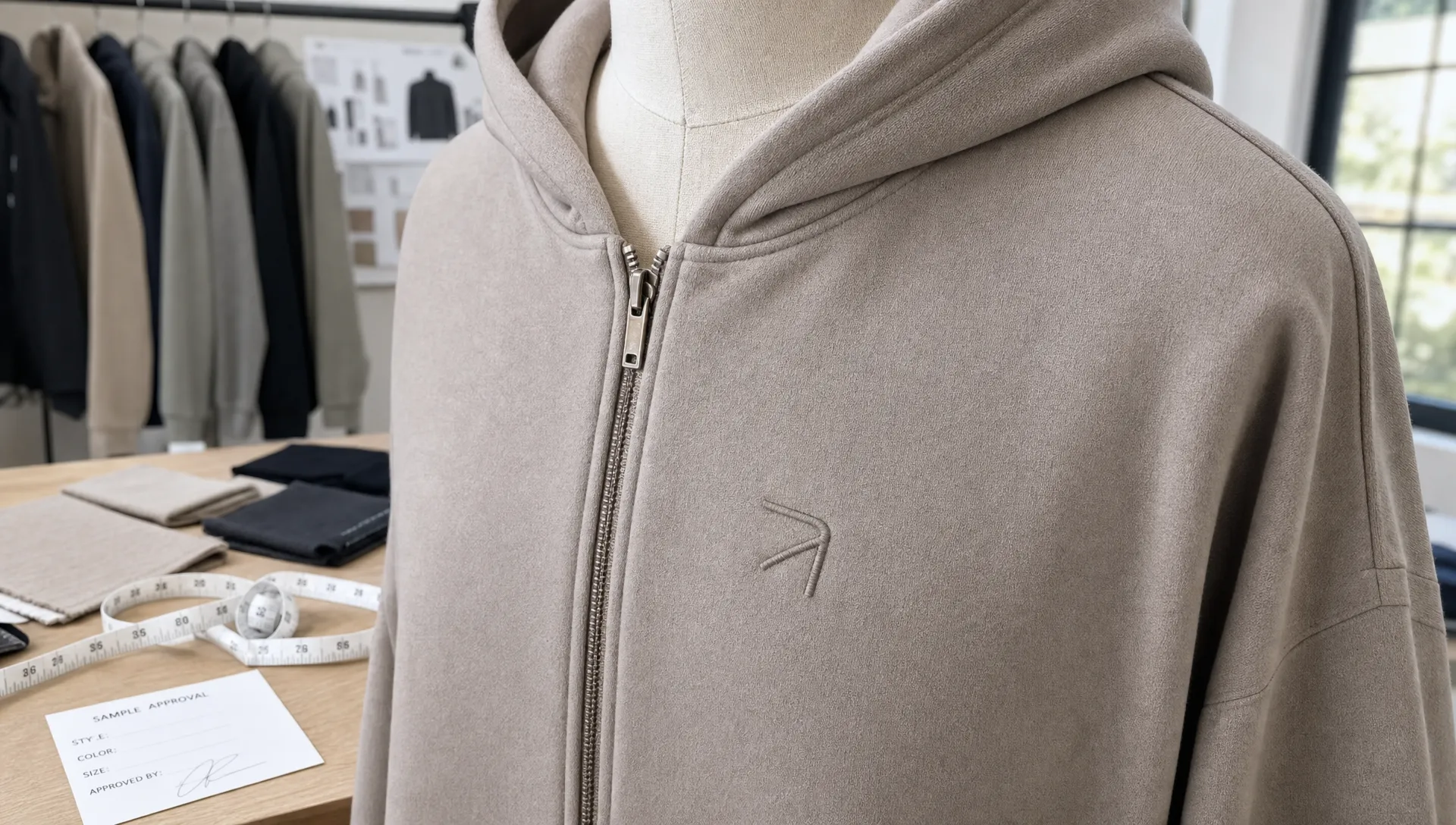
Tech packs and approved samples
A tech pack is the blueprint for production. It should define the key specifications of the karate gi, including fabric type, weight, weave, size measurements, seam construction, labels, branding placement, packaging, and acceptable tolerances.
The approved sample, often called the golden sample or pre-production sample, becomes the physical reference for the entire order. Production teams use it to compare fabric hand feel, jacket shape, pants fit, stitching layout, collar structure, logo placement, and finishing details.
If you are still comparing suppliers, Arus Sportswear has a helpful guide on how to evaluate a reliable karate gi manufacturer before you commit to bulk production.
Fabric inspection and testing
Fabric is one of the biggest drivers of karate gi quality. Before cutting begins, the factory should inspect incoming fabric for visible defects, shade variation, width consistency, weight, and hand feel. For white uniforms, cleanliness and color consistency are especially important because stains, yellowing, or shade mismatch are easy to notice.
Shrinkage control is another major factor. Cotton and cotton-blend fabrics can change after washing, and karate uniforms are expected to handle repeated training sessions and laundering. A responsible factory checks shrinkage behavior and adjusts patterns or production expectations accordingly.
Fabric inspection helps answer questions such as:
- Does the fabric match the approved sample?
- Are all rolls from the same shade family?
- Is the fabric weight suitable for the intended market?
- Will the uniform maintain its fit after washing?
- Are there stains, weaving defects, or weak areas that should be rejected before cutting?
Skipping this stage can create expensive problems later because defective fabric becomes much harder to fix once it has already been cut and sewn.
Cutting accuracy keeps every size consistent
After fabric approval, cutting is the next major control point. Even a well-made pattern can produce poor results if the cutting process is inaccurate.
A factory typically uses marker planning to arrange pattern pieces efficiently and maintain correct grain direction. Fabric layers must be controlled so pieces do not shift during cutting. Size bundles should be separated and identified clearly so small, medium, large, and kids’ sizes do not get mixed.
In karate gi production, cutting accuracy affects:
| Component | Why it matters | What quality teams check |
|---|---|---|
| Jacket body | Controls fit, overlap, and overall silhouette | Length, width, symmetry, grain direction |
| Sleeves | Affects range of motion and appearance | Sleeve length, opening width, pair matching |
| Collar pieces | Influences structure and durability | Alignment, thickness, consistency |
| Pants panels | Controls comfort and stance movement | Rise, inseam, outseam, leg balance |
| Waistband pieces | Affects fit and durability | Width, elastic or drawstring channel accuracy |
Cutting quality is not always visible immediately, but it becomes obvious when finished pieces are measured. If panels are cut off-spec, sewing teams may struggle to make the garment fit the approved measurements.
Sewing-line quality control prevents defects early
In large-scale production, waiting until the end to inspect quality is risky. By then, hundreds of uniforms may already have the same defect. A better approach is in-line quality control, where supervisors and QC staff check work during sewing.
Karate uniforms need strong, clean construction because they are pulled, stretched, washed, folded, and worn frequently. The most important sewing areas usually include shoulder seams, side seams, sleeve seams, pants crotch, waistband construction, belt loops, collar attachment, and reinforcement points.
Common sewing defects include skipped stitches, uneven seam allowance, puckering, loose threads, crooked labels, inconsistent topstitching, and weak reinforcement. These may look minor individually, but they reduce the perceived quality of the entire batch.
A strong factory process usually includes operator instructions, machine setup checks, line supervision, and defect tracking. When defects appear repeatedly, the factory should identify the cause, correct the process, and separate affected pieces for repair or rejection.
Branding quality must match the uniform quality
For private label karate uniforms, branding is part of the product experience. A uniform can be well-stitched, but if the woven label is crooked or the patch color is wrong, buyers will still see it as poor quality.
Branding control may include woven labels, size labels, neck labels, patches, embroidery, printed logos, hangtags, polybags, and carton marks. Each branding element should be checked against the approved artwork and placement guide.
This matters especially for brands building a recognizable martial arts line. A consistent logo position on every jacket, accurate size labeling, and clean packaging make the product feel professional when it reaches a gym, retail shelf, or distributor warehouse. If you are planning a branded line, this guide to private label martial arts clothing manufacturing explains how branding and production choices fit together.
Measurement control protects fit across repeat orders
Fit consistency is one of the biggest reasons buyers stay with a factory. If a student buys an A2 or size 160 today, they expect the same size to feel familiar when they reorder later.
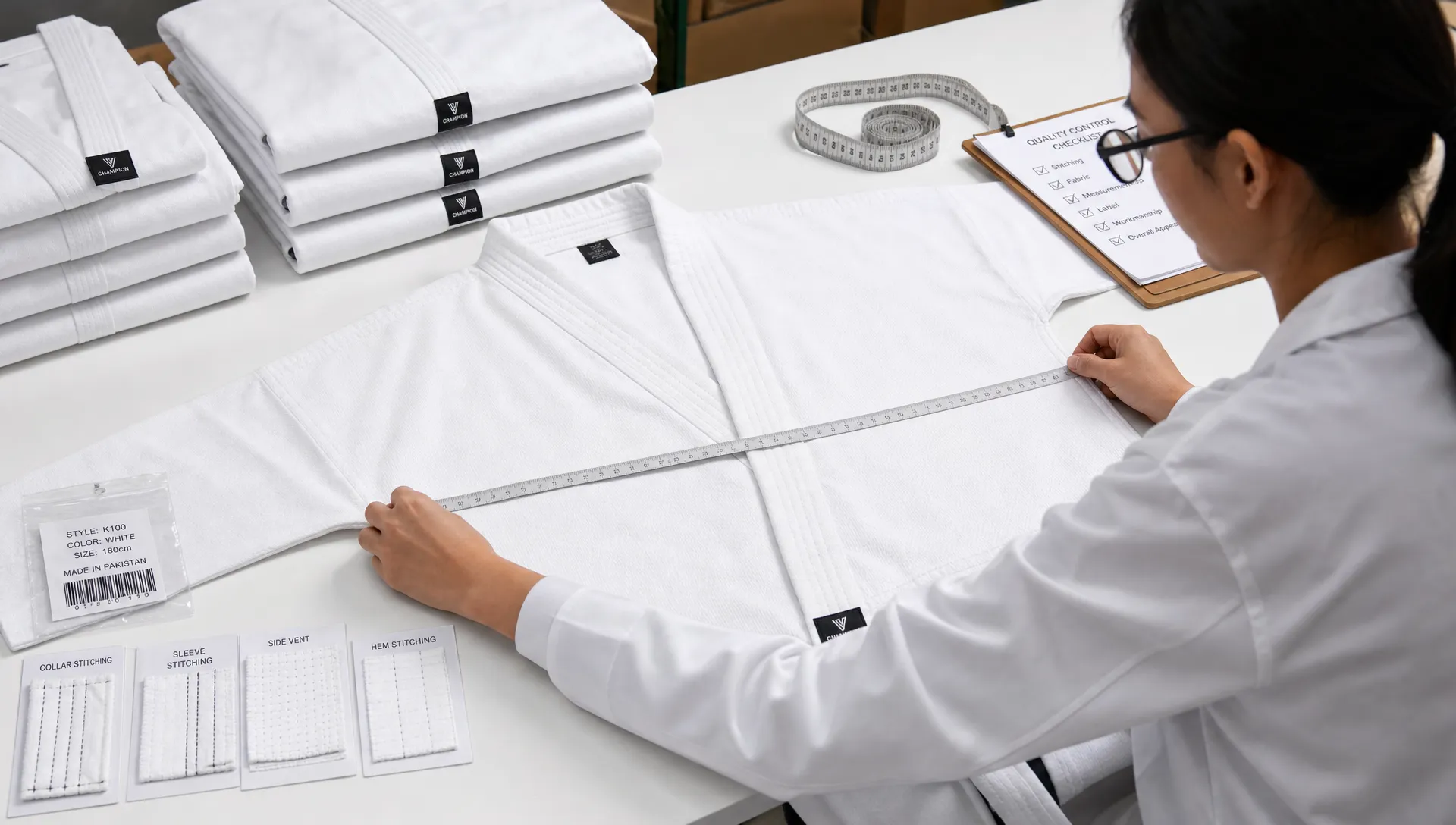
A karate gi factory should measure garments during production and again before shipment. Measurements are compared with the approved spec sheet, and any tolerance should be agreed before bulk production begins. Tolerance does not mean the factory can be careless. It simply recognizes that fabric and sewing have natural variation, so the buyer and factory define what is acceptable.
Important measurement points often include jacket length, chest width, sleeve length, sleeve opening, shoulder width, pants waist, pants length, inseam, thigh width, and leg opening. For children’s uniforms, accurate grading is especially important because small measurement changes can affect comfort and usability.
Final inspection catches what the line missed
Even with good in-line control, final inspection remains essential. This is the last structured checkpoint before packing and shipment. The goal is to confirm that the order meets the approved standard and that defects have not slipped through.
Many apparel buyers use a sampling-based inspection method for bulk orders, where a selected number of finished pieces are checked instead of inspecting every garment. The exact sampling level and acceptance criteria should be agreed between the buyer and factory.
A final inspection may include:
- Visual inspection for stains, holes, fabric defects, and shade variation
- Measurement checks against the size specification
- Stitching inspection for broken threads, skipped stitches, and loose seams
- Branding checks for logo placement, label accuracy, and size labeling
- Packaging checks for folding, polybags, carton labels, and quantity accuracy
- Random checks across sizes, colors, and production lots
The final inspection is not only about finding defects. It also confirms whether the production system worked as expected. If the same issue appears repeatedly, the factory should document it and improve the process before the next order.
Packing and carton control matter more than many buyers think
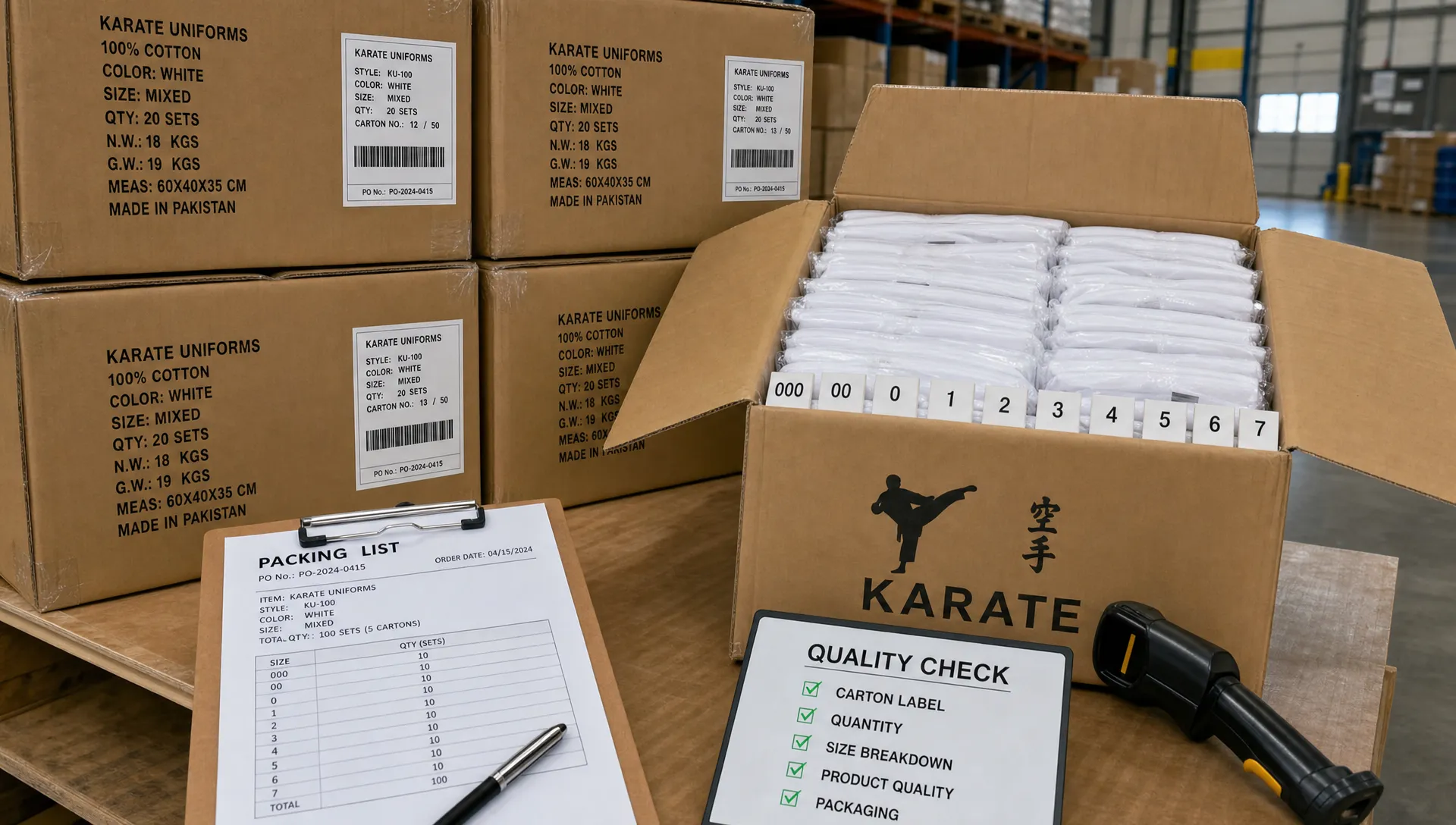
Karate uniforms are often white, folded, and shipped in bulk. Poor packing can create stains, creases, moisture issues, size mix-ups, or carton shortages. A factory that handles quality at scale treats packing as part of quality control, not just logistics.
Packing instructions should define how each gi is folded, whether belts are included, how sizes are labeled, how many pieces go into each carton, and what information appears on carton marks. This is especially important for distributors and gyms that need to sort inventory quickly when the shipment arrives.
For international orders, carton strength and protection also matter. Apparel may move through multiple handling points before reaching the buyer. Clean folding, correct counts, sealed packaging, and clear labeling reduce warehouse confusion and help buyers fulfill orders faster.
How factories balance speed with consistency
Scaling production requires speed, but speed without control creates defects. The best factories balance production efficiency with quality checkpoints. They do this through planning, clear communication, trained operators, and realistic production timelines.
This is similar to many complex service industries. Whether a business is coordinating apparel production or a traveler is planning an expert-guided Uganda Safari 2026, the customer is relying on a partner to manage details, sequencing, local knowledge, and execution. In manufacturing, that means the factory must coordinate materials, people, machines, inspections, packing, and shipping so the final result matches expectations.
For karate gi buyers, the key is to avoid treating the factory as only a sewing vendor. A stronger factory partner helps translate product requirements into repeatable production standards.
What buyers should ask a karate gi factory
Before placing a bulk order, buyers should ask practical questions that reveal how the factory controls quality. The answers do not need to sound complicated, but they should be specific and confident.
Useful questions include:
- How do you confirm fabric quality before cutting?
- Do you provide a pre-production sample for approval?
- What measurements are checked during and after production?
- How do you control shrinkage for cotton or cotton-blend uniforms?
- How do you classify and handle defects?
- Who checks branding placement and label accuracy?
- How are sizes separated during cutting, sewing, and packing?
- What happens if final inspection finds repeated defects?
- Can you support repeat orders with the same specifications?
If a supplier gives vague answers or avoids documentation, that is a warning sign. For a broader sourcing checklist, this article on what to look for in a karate uniform manufacturer covers the key evaluation points for brands and distributors.
Common red flags in bulk karate gi production
Quality problems usually show early if you know what to watch for. Some factories can make a good sample but struggle to repeat it at scale. Others may accept an order without fully understanding the buyer’s fabric, sizing, or branding expectations.
Be cautious if you notice these signs:
- The factory cannot explain its sampling and approval process.
- Fabric details are described only in general terms.
- Size charts are unclear or copied from unrelated products.
- Branding placement is not documented before production.
- The factory does not discuss shrinkage or measurement tolerance.
- There is no clear process for in-line or final inspection.
- Communication becomes vague once the deposit is paid.
A professional manufacturer should welcome clear specifications because they reduce mistakes. The more precise the standard, the easier it is to produce consistent uniforms.
Quality at scale is a system, not a single inspection
The most important takeaway is simple: quality at scale is not created by one final check. It is the result of a complete system.
A reliable karate gi factory controls quality by aligning with the buyer before production, inspecting materials, cutting accurately, monitoring sewing lines, checking measurements, managing branding, auditing final goods, and packing orders correctly. Each step reduces risk, and together they create consistency across bulk production.
For martial arts brands, gyms, and distributors, this system protects reputation. It helps ensure that every student, instructor, and customer receives a uniform that matches the standard promised by the brand.
Arus Sportswear works with martial arts and combat sports businesses on custom apparel production, including private label and OEM manufacturing. If you are planning a karate uniform line or scaling an existing program, the right starting point is a clear product specification, an approved sample, and a quality process designed for repeatable bulk manufacturing.
Frequently Asked Questions
What does a karate gi factory check during quality control? A karate gi factory typically checks fabric quality, shrinkage, cutting accuracy, stitching, measurements, branding placement, labels, packaging, and final carton quantities before shipment.
Why can a bulk order look different from the approved sample? Differences can happen because of fabric lot variation, shrinkage, cutting errors, sewing inconsistencies, or unclear specifications. A strong factory reduces this risk through documented standards and production checks.
Is final inspection enough to guarantee karate uniform quality? Final inspection is important, but it is not enough by itself. Better quality comes from controlling each stage, including fabric inspection, cutting, in-line sewing checks, measurement control, and packing audits.
What should buyers provide before production starts? Buyers should provide a clear tech pack, size chart, fabric requirements, branding artwork, label details, packaging instructions, and an approved sample reference whenever possible.
How can brands keep quality consistent across repeat orders? Brands should keep the same approved specifications, document any changes, review samples when materials change, and work with a factory that tracks measurements, materials, and production standards across orders.
Build a karate gi line with quality built in
If your brand, gym, or distribution business needs custom karate uniforms, quality should be planned before production begins. Arus Sportswear supports private label and OEM martial arts apparel manufacturing with custom design, branding, bulk order support, low minimum orders, and worldwide shipping.
To discuss your next karate gi production project, visit Arus Sportswear and share your design requirements, target market, and order goals.