Choosing a shorts manufacturer for bulk orders is not simply a matter of finding the lowest quote. Once you approve a production run, every weak seam, uneven waistband, delayed reply, or mislabeled carton can multiply across hundreds or thousands of units.
For fightwear, boxing shorts, MMA training shorts, gym shorts, compression shorts, or private label athletic shorts, the right factory should prove three things before you commit: it understands the product, it can repeat quality at scale, and it communicates clearly when problems appear.
The following vetting process is designed for apparel brands, gyms, fight teams, and distributors preparing to move from samples to bulk production.
Start with a clear product brief
Before you judge any supplier, make sure you are asking every shorts manufacturer to quote the same product. Vague requests create vague pricing, and vague pricing often turns into hidden costs later.
A professional manufacturer can help refine your concept, but your initial brief should still define the basic requirements:
- Product type, such as boxing shorts, MMA fight shorts, grappling shorts, running shorts, or gym training shorts
- Intended use, including sparring, competition, casual training, retail, team uniform, or promotional merchandise
- Fabric preferences, such as woven stretch, polyester, mesh, satin, compression fabric, or blended performance materials
- Key construction details, including waistband style, closure type, inseam length, side slits, gusset, pockets, and seam finish
- Branding needs, including logo placement, labels, embroidery, sublimation, screen print, or heat transfer
- Size range, quantity per size, target delivery location, and any packaging requirements
For example, a boxing apparel brand may need a satin-like sheen, wide elastic waistband, bold logo placement, and movement-friendly side panels. A grappling-focused short may need stronger seam reinforcement, stretch panels, and minimal external hardware. If your product line is boxing-specific, reviewing the customization options offered by a custom boxing shorts manufacturer can help you think through the level of detail needed in your brief.
A strong brief also makes supplier comparison fair. If one quote is based on basic fabric and another includes sublimation, private labels, and custom packaging, the cheaper price may not really be cheaper.
Confirm category experience, not just sewing ability
Many factories can sew basic shorts. Far fewer understand performance shorts, fightwear, and martial arts apparel. Category experience matters because athletic shorts are not static garments. They must stretch, move, absorb stress, recover shape, and survive repeated washing.
Ask for proof that the manufacturer has produced similar shorts before. This does not mean they need to reveal another client’s confidential designs, but they should be able to show sample work, describe common fabric choices, explain construction options, and answer sport-specific questions.
Useful vetting questions include:
- Which shorts categories do you produce most often?
- Do you make fully custom patterns or only decorate existing blanks?
- Can you support private label branding and OEM production?
- What fabrics do you recommend for high-movement training shorts?
- What problems commonly appear in bulk shorts production, and how do you prevent them?
A supplier that only says yes to everything may not be the safest choice. The best manufacturers ask questions back. They may challenge your fabric choice, suggest a stronger waistband, or explain why one decoration method performs better than another after washing. That kind of input is often a sign of real production experience.
If you are building a wider martial arts or combat sports collection, it is also worth understanding how OEM manufacturing helps martial arts brands scale faster across multiple apparel categories.
Inspect fabrics, trims, and construction details
Shorts may look simple, but small material choices affect comfort, durability, cost, and customer satisfaction. A bulk order should never be approved on photos alone. You need to evaluate fabric hand feel, weight, stretch, opacity, recovery, shrinkage risk, and color consistency.
For athletic and fightwear shorts, pay close attention to areas that carry stress: the waistband, crotch, side seams, hem, logo application, and any closure system. A weak drawcord or poorly attached label can make an otherwise good product feel cheap.
| Component | What to check | Why it matters |
|---|---|---|
| Main fabric | Weight, stretch, opacity, finish, color consistency | Determines comfort, durability, and perceived quality |
| Waistband | Elastic strength, stitching, drawcord placement, roll resistance | Affects fit and long-term wearability |
| Seams | Stitch density, seam type, reinforcement, loose threads | Prevents splitting during movement |
| Gusset or panels | Pattern alignment, stretch direction, mobility | Improves performance for training and combat sports |
| Branding | Print adhesion, embroidery density, sublimation clarity | Protects brand appearance after washing |
| Labels and trims | Care label accuracy, softness, attachment strength | Supports compliance and customer comfort |
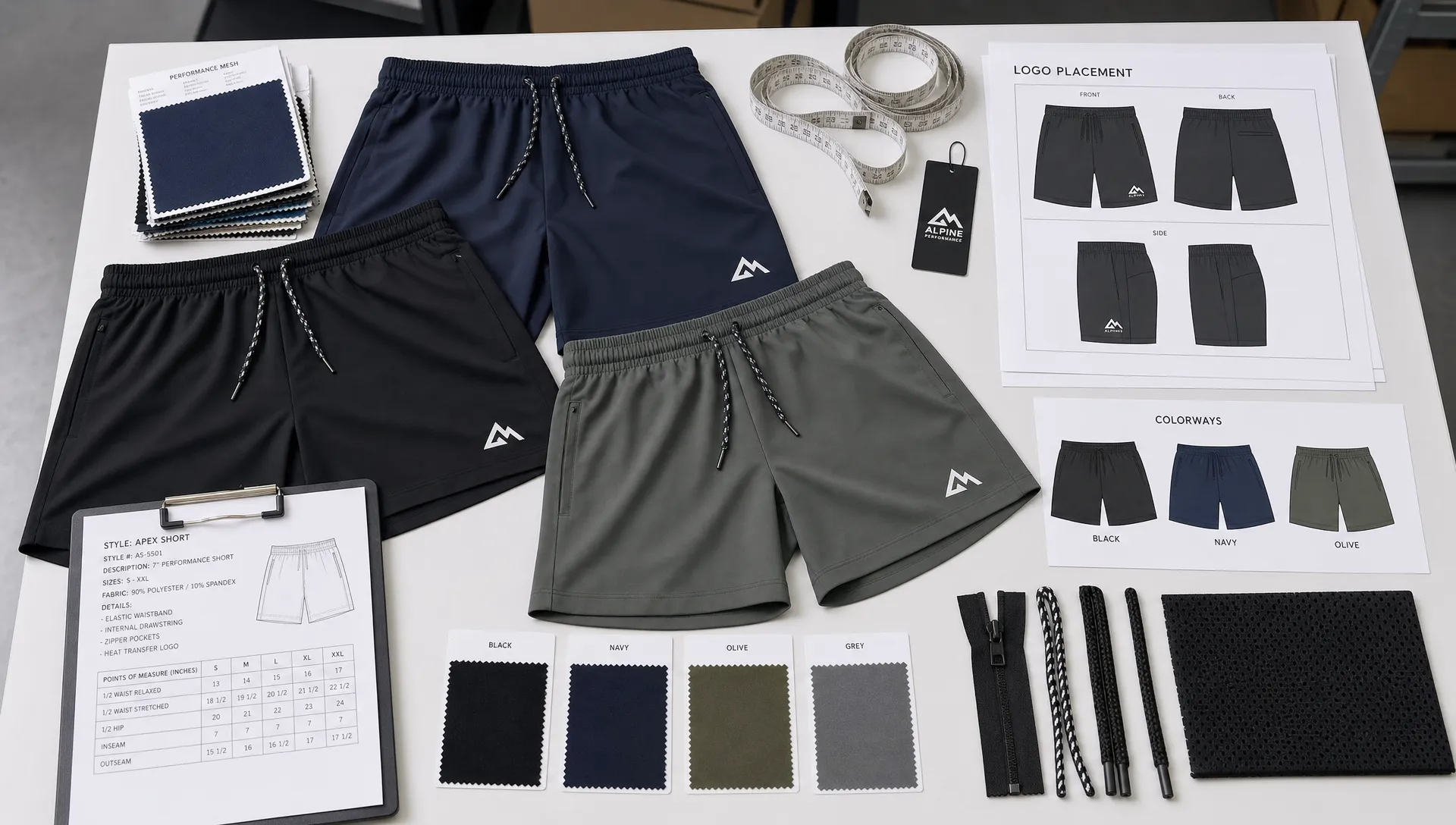
Ask the manufacturer to provide physical fabric swatches before sample approval. If possible, compare several options at different price points. A slightly higher fabric cost can sometimes reduce returns, improve reviews, and make the final product easier to sell.
Test the sampling process before trusting the bulk process
Sampling is the first real test of a shorts manufacturer. It reveals how well the factory reads instructions, communicates limitations, and translates your design into a production-ready garment.
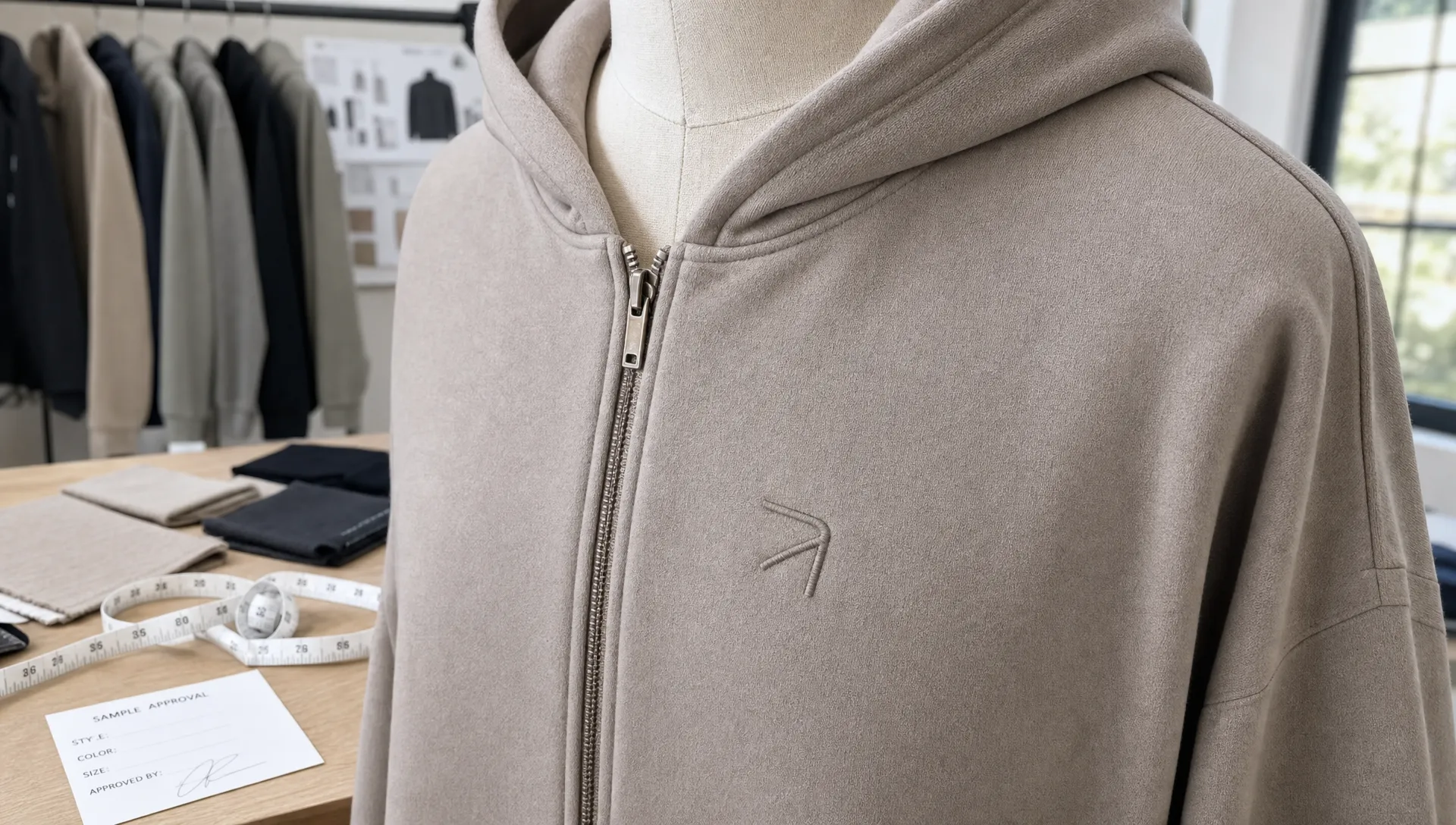
A proper sample process usually includes an initial prototype, revisions, and a final approved sample. The final approved sample is especially important because it becomes the reference for bulk production. In apparel sourcing, this is often treated as the production standard that all bulk units should match.
Do not approve a bulk order if the sample has unresolved issues. A comment like it will be fixed in production is risky unless the correction is documented, confirmed, and shown in a revised sample or clear technical update. Bulk production usually amplifies unclear instructions.
Evaluate samples for fit, measurement accuracy, fabric behavior, print placement, logo color, stitching, trims, labels, and finishing. Wash the sample if the garment will be used heavily. For performance shorts, test movement by squatting, kicking, stretching, and twisting. A short that looks good standing still may fail during actual use.
Also ask whether the bulk order will use the same fabric, trims, machines, and production method as the approved sample. If anything changes, request written confirmation and updated samples when necessary.
Check sizing, grading, and measurement control
Sizing inconsistency is one of the fastest ways to damage customer trust. For bulk shorts orders, your manufacturer should be able to follow a measurement spec and grade it across sizes in a consistent way.
Do not rely only on a single medium sample. If your order includes a broad size range, ask for a size set or at least key sizes for review. This helps catch grading issues before cutting bulk fabric.
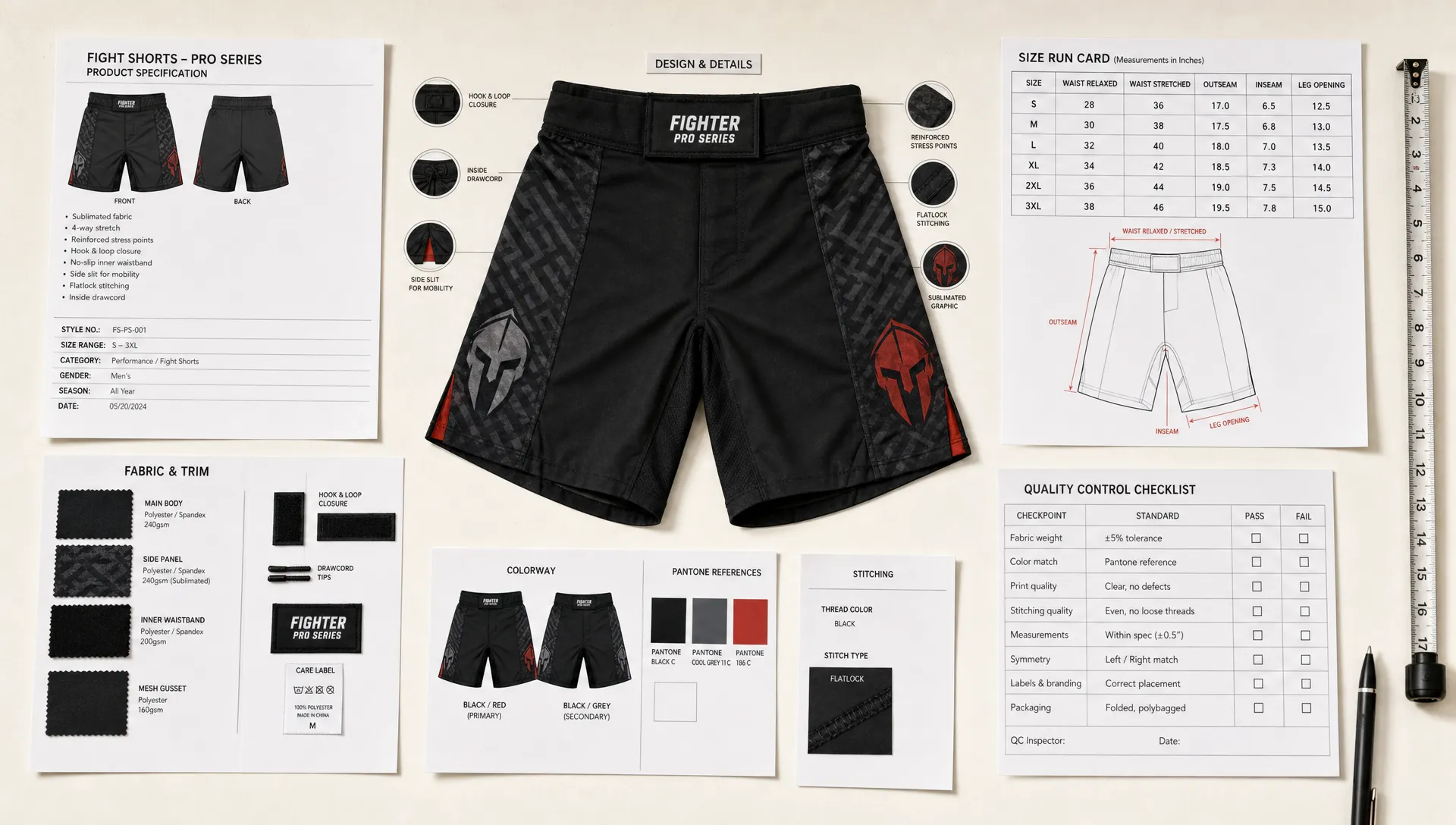
Important measurement points often include waist relaxed, waist stretched, hip, front rise, back rise, inseam, outseam, leg opening, waistband height, and side slit length. The exact points depend on the style, but they should be agreed in writing.
Set acceptable tolerances before production begins. For example, a small variation may be normal in sewn apparel, but the tolerance should be clear enough for inspection. If a factory cannot explain how measurements are checked during production, that is a warning sign.
Ask how quality control works at scale
A sample proves the manufacturer can make one good short. Quality control proves they can make the same short repeatedly.
For bulk orders, ask the manufacturer to describe each quality control checkpoint. A strong answer should include material inspection, cutting control, in-line sewing checks, measurement review, finishing inspection, packing checks, and final order review.
| QC checkpoint | What to ask | What a strong process shows |
|---|---|---|
| Fabric inspection | How are shade, defects, and shrinkage risks checked? | Problems are caught before cutting |
| Cutting control | How are panels matched to the pattern and size set? | Fit remains consistent across the order |
| Sewing inspection | Are seams checked during production or only at the end? | Defects are corrected before they multiply |
| Measurement check | Which sizes are measured and how often? | Grading and fit stay within tolerance |
| Branding inspection | Are logos checked for placement, color, and durability? | Brand presentation remains consistent |
| Packing review | Are cartons, labels, size ratios, and quantities verified? | Shipping and receiving errors are reduced |
For larger orders, ask whether the manufacturer uses an AQL-style final inspection or another documented inspection method. You do not need to become a quality engineer, but you do need a shared standard for what counts as acceptable, minor defect, major defect, or rejected goods.
Review pricing beyond the unit cost
The cheapest unit price can become expensive if it causes rework, delays, quality claims, or missed launch dates. When comparing quotes, make sure each supplier includes the same assumptions.
A complete quote should clarify:
- Sample fees and revision costs
- Fabric and trim specifications
- Logo and decoration methods
- Private label, hangtag, and packaging costs
- MOQ by color, size, and design
- Bulk production lead time
- Payment terms and currency
- Shipping terms, carton details, and destination responsibilities
Be cautious when a quote is dramatically lower than the others. It may exclude branding, use lower-grade fabric, assume a simpler construction, or rely on a production timeline that is not realistic. A good shorts manufacturer should be able to explain why the price is what it is.
This does not mean you should always choose the most expensive supplier. It means you should compare total landed value, not just unit cost. For a brand, value includes reliable fit, clear communication, consistent finishing, packaging accuracy, and the ability to reorder the same product later.
Verify capacity, MOQ, and lead time realism
Low MOQ can be valuable for new brands, gyms, and smaller distributors, especially when testing a design before committing to larger runs. But for bulk orders, you also need to know whether the manufacturer can scale without losing control.
Ask about current capacity, peak season workload, lead time for sampling, lead time for bulk production, and what happens if materials are delayed. A reliable supplier will not promise impossible timelines just to win the order.
Capacity questions matter even more if you plan repeat drops or seasonal collections. A factory that can make 200 units once may not be ready for 2,000 units across multiple colors, sizes, and styles. Conversely, a larger manufacturer may handle volume well but have higher MOQs or less flexibility for small tests.
The best fit depends on your stage. A startup may prioritize low minimums and sample support. A distributor may prioritize capacity, repeatability, and carton-level accuracy. A growing fightwear brand may need both.
Confirm branding and private label support
If you are building a brand, your shorts are not just garments. They are customer touchpoints. Every label, tag, logo, stitch, color, and package affects how your brand is perceived.
A shorts manufacturer that supports private label or OEM production should be able to discuss branding methods in practical terms. Embroidery may look premium but can add weight or stiffness. Sublimation works well for all-over designs on suitable polyester fabrics. Heat transfers can be clean and flexible, but they must be tested for wash durability. Woven labels feel professional, but placement and softness matter.
Ask for branding samples, not just a list of options. Review how each method looks on the fabric you plan to use. Also confirm the ownership of patterns, artwork, and production files, especially if your designs are custom.
Packaging is part of branding too. A simple polybag may be enough for wholesale. Retail and e-commerce orders may need hangtags, barcode labels, size stickers, carton marks, or folded presentation standards. Confirm these details before production so they are included in the quote and QC checklist.
Check logistics, documentation, and business readiness
Bulk apparel orders involve more than manufacturing. They also require shipping coordination, documentation, customs awareness, and clear responsibility for costs and risk.
At minimum, confirm who handles commercial invoices, packing lists, carton measurements, export documentation, and shipping coordination. Discuss whether your order will ship by air, sea, courier, or freight forwarder. Clarify Incoterms, destination address, customs duties, and delivery expectations before paying the deposit.
If you are importing into a regulated market, ask what labeling information is needed for fiber content, care instructions, country of origin, and brand details. Requirements vary by market, so brands should verify their own obligations instead of assuming the factory will know every rule for every destination.
Some brands also formalize their structure before scaling international sourcing. If you are establishing a UAE trading or holding company to manage apparel imports, exports, or regional operations, working with an expert partner for UAE company setup and compliance support can help keep the business side aligned with your growth plans.
Evaluate communication before problems happen
Communication quality is often the difference between a stressful bulk order and a smooth one. During vetting, notice how the manufacturer responds before they have your deposit.
Strong communication usually looks like clear answers, realistic timelines, written confirmations, organized sample feedback, and proactive questions. Weak communication often appears as vague promises, delayed replies, missed details, and reluctance to document decisions.
You do not need a supplier that writes perfect marketing language. You need one that understands product details and confirms them accurately. After every major discussion, summarize the decision in writing. This creates a clear record for sample revisions, pricing, bulk production, and inspection.
A manufacturer that communicates well during sampling is more likely to communicate well during bulk production. A manufacturer that ignores details during sampling is unlikely to become more careful after the order is placed.
Use a practical vetting scorecard
A simple scorecard helps remove emotion from supplier selection. Instead of choosing based on one attractive sample or one low quote, compare manufacturers across the factors that affect bulk order success.
| Vetting area | Strong sign | Risk sign |
|---|---|---|
| Product experience | Shows relevant shorts or sportswear work | Only offers generic garments with little detail |
| Sampling | Provides clear samples and revisions | Pushes bulk order before sample approval |
| Fabric knowledge | Explains options and tradeoffs | Cannot describe material performance |
| Construction quality | Reinforced stress points and clean finishing | Loose threads, weak seams, uneven waistbands |
| Sizing control | Provides specs, grading, and tolerances | Treats size variation as unavoidable |
| QC process | Uses documented checkpoints | Checks only after production is complete |
| Pricing | Transparent quote with inclusions | Low price with unclear assumptions |
| Lead time | Gives realistic timeline and updates | Promises urgent delivery without explanation |
| Branding support | Offers practical private label options | Cannot provide branding samples |
| Logistics | Clarifies documents and shipping terms | Leaves destination costs vague |
You can rate each area from 1 to 5, then compare totals. More importantly, note where the biggest risks are. A supplier with a lower score in packaging may still be workable if your order is simple. A supplier with weak sizing control is much harder to justify for a retail brand.
Red flags to take seriously
Some issues are normal in product development. Samples often need revisions, fabric choices may change, and timelines can shift when materials are custom. Red flags are different. They suggest the manufacturer may not be reliable for bulk orders.
Take extra caution if you see repeated signs like inconsistent answers, refusal to provide samples, unclear fabric details, no measurement specs, pressure to pay quickly, photos that do not match your requested product, or unwillingness to confirm order terms in writing.
Also be careful with manufacturers that promise everything without asking questions. A real production partner should care about fabric, fit, printing method, wash performance, quantity, destination, and timing. If none of that matters to them, your order may not receive the attention it needs.
When in doubt, start with a controlled test order before scaling. A smaller initial run can reveal how the manufacturer handles production, packing, shipping, and post-delivery support.
Frequently Asked Questions
What is the most important thing to check before placing a bulk shorts order? The most important step is approving a production-ready sample that uses the same fabric, trims, branding method, and construction planned for bulk production. The sample should be measured, tested, and documented before you pay for the full order.
How many samples should I request from a shorts manufacturer? At minimum, request an initial sample and a final revised sample. For larger orders or broad size ranges, request a size set so you can evaluate grading, fit, and consistency before bulk cutting begins.
Should I choose the shorts manufacturer with the lowest quote? Not automatically. A low unit price may exclude branding, packaging, better fabric, inspection, or realistic shipping terms. Compare total value, including quality consistency, communication, lead time, and reorder reliability.
What should be included in a bulk shorts production agreement? The agreement should confirm product specifications, approved sample reference, quantities, sizes, colors, fabric, branding, packaging, tolerances, price, payment terms, lead time, inspection process, shipping terms, and what happens if defects are found.
Can a new brand work with a manufacturer for low MOQ shorts orders? Yes, many new brands begin with lower MOQs to test designs and demand. However, you should still vet the manufacturer for sampling quality, communication, fabric consistency, and the ability to scale when orders grow.
Build bulk shorts orders on proof, not promises
A reliable shorts manufacturer should make your sourcing process clearer, not more confusing. Before you commit to bulk production, look for category experience, accurate samples, durable construction, transparent pricing, documented QC, and communication that gives you confidence.
If you are developing custom fightwear, boxing shorts, MMA apparel, or private label sportswear, Arus Sportswear supports brands, gyms, and distributors with custom designs, OEM production, low minimum orders, bulk order support, and worldwide shipping. Use the vetting framework above to prepare your brief, then choose a manufacturing partner that can grow with your brand.