Finding the right taekwondo dobok manufacturer is not just about getting a low unit price. The manufacturer you choose affects how the uniform feels in motion, how consistently it fits across sizes, how your branding appears, and whether you can reorder the same product without surprises.
For a martial arts brand, gym, distributor, or private label seller, the dobok is more than a basic uniform. It is a training tool, a visual identity, and often the first product a student associates with your school or brand. A poor supplier can create problems that show up quickly, including restricted kicks, shrinking fabric, weak seams, uneven collars, delayed shipments, and inconsistent sizing.
The goal is to find a partner that understands taekwondo specifically, not just a factory that can sew white uniforms. Here is how to evaluate the right manufacturer before you invest in bulk production.
Start With the Type of Taekwondo Dobok You Need
Before contacting suppliers, define the product you want to manufacture. Taekwondo doboks vary by training style, organization, level, and customer segment. A beginner school uniform is not the same as a competition uniform, and a private label retail dobok may need different packaging, trims, and size grading than a gym order.
At minimum, clarify these points before requesting a quote:
- Whether you need WT style, ITF style, traditional, poom, or general training doboks
- Whether the uniform is for kids, adults, beginners, advanced students, or competitors
- The preferred fabric weight, weave, breathability, and shrinkage tolerance
- Required collar color, belt options, embroidery, woven labels, patches, or printed logos
- Size range, fit expectations, packaging format, and target price level
Clear requirements help manufacturers quote accurately. They also reduce misunderstandings during sampling. If your brief is vague, each supplier may interpret it differently, making it difficult to compare quality and cost fairly.
Choose a Manufacturer With Taekwondo-Specific Experience
A taekwondo dobok has movement requirements that generic sportswear factories may overlook. Students need freedom for high kicks, turning kicks, jumping techniques, sparring drills, forms, and repeated kneeling or floor movement during warmups. The cut must support mobility without looking oversized or sloppy.
A qualified taekwondo dobok manufacturer should understand details such as jacket length, sleeve proportions, pant rise, gusset design, collar stiffness, seam reinforcement, and how different fabrics behave after washing. This matters because many uniform problems only appear after training use, not when the garment is laid flat on a table.
Ask whether the manufacturer has produced doboks for schools, martial arts brands, distributors, or competition-focused buyers. Experience with karate uniforms, BJJ gis, and other combat sports apparel can be useful, but taekwondo has its own pattern and performance needs. If you are comparing several suppliers, this guide on how to compare martial arts uniform manufacturers can help you evaluate them beyond price alone.
Review Fabric Options Carefully
Fabric is one of the biggest differences between a dobok that feels professional and one that feels cheap. The right material depends on your customer, use case, climate, and price point.
Lightweight fabrics may be more comfortable for beginners, kids, and hot training environments. Heavier fabrics can feel more structured and durable, especially for advanced practitioners or premium uniforms. Polyester blends may offer easier care and wrinkle resistance, while cotton-rich blends may provide a more traditional feel but can require closer shrinkage control.
Use the sample stage to test the fabric, not just inspect it. Wash it, dry it according to your intended care instructions, check shrinkage, and see whether the collar twists or the seams pucker. A fabric that looks good before washing may perform poorly after repeated use.
| Dobok requirement | Why it matters | What to check in samples |
|---|---|---|
| Breathability | Students train intensely and need comfort | Fabric hand feel, ventilation, and heat retention |
| Shrinkage control | Sizing consistency affects customer satisfaction | Measurements before and after washing |
| Tear resistance | Kicking, stretching, and drills stress seams | Fabric strength around crotch, sleeves, and side seams |
| Collar stability | The neckline shapes the uniform’s appearance | Collar stiffness, twisting, and stitching quality |
| Color consistency | White uniforms reveal production differences | Shade matching across jacket, pants, and repeat orders |
Inspect Pattern, Fit, and Movement
The dobok pattern is just as important as the fabric. A uniform can use strong material but still fail if the cut restricts kicking or does not fit your target customers.
Request a full size set or at least samples across key sizes, such as one child size, one average adult size, and one larger adult size. Fit problems often appear at the extremes of the size chart. For example, pants that work in medium may become too wide in youth sizes or too short in larger sizes.
When testing fit, have actual practitioners move in the uniform. Check front kicks, side kicks, roundhouse kicks, stances, squats, arm extensions, and sparring movement. The best feedback comes from training, not from showroom inspection.
A manufacturer should be open to pattern adjustments. If sleeves are too long, pants restrict hip movement, or the jacket sits incorrectly, the supplier should help refine the pattern before production.
Examine Stitching and Construction Quality
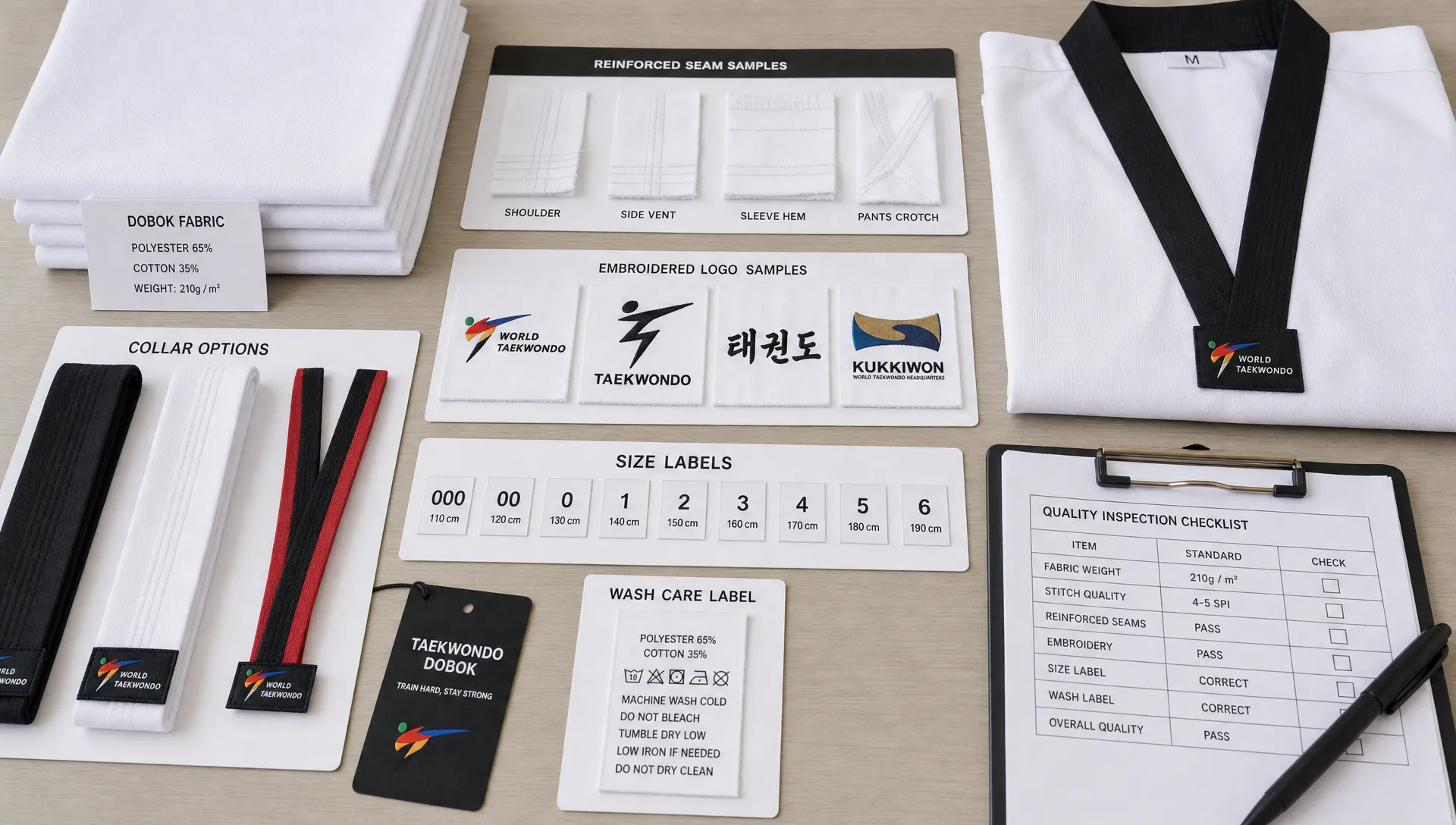
Construction quality determines how the dobok holds up after months of classes. Many buyers focus on fabric weight and overlook stitching, but weak seams are one of the fastest ways for uniforms to fail.
Pay special attention to high-stress areas, including the crotch seam, underarm seam, side vents, waistband, sleeve openings, pant hems, and collar attachment. These areas experience repeated pulling, stretching, and washing.
A good manufacturer should maintain clean stitching, even seam allowance, secure bartacks or reinforcement where needed, and consistent thread color. Loose threads are not always a deal breaker in a first sample, but uneven construction and weak reinforcement are serious warning signs.
Confirm Branding and Private Label Capabilities
If you are building a brand, the dobok must carry your identity consistently. This can include embroidered chest logos, woven neck labels, printed care labels, patches, custom belt labels, hang tags, branded polybags, and carton markings.
Do not treat branding as an afterthought. Logo placement, thread color, label quality, and packaging all affect perceived value. Ask the manufacturer to show examples of previous private label work, then confirm what can be customized at your order quantity.
For premium doboks, small details matter. A clean inner label, well-aligned embroidery, and professional packaging can make the product feel retail-ready. For gym uniforms, durability and consistency may matter more than decorative details, but the branding should still be clear and repeatable.
Understand MOQ, Pricing, and Lead Times
Minimum order quantity is often a major factor when choosing a taekwondo dobok manufacturer. A low MOQ can be helpful for new brands, small gyms, and first production runs. However, the lowest MOQ is not always the best deal if it comes with limited customization, higher unit costs, or inconsistent production quality.
Ask how pricing changes at different order volumes. Also confirm what is included in the quoted price. Some suppliers quote only the basic garment, then add separate costs for embroidery, labels, packaging, sampling, pattern changes, or shipping.
Lead time should be discussed in detail. Separate the timeline into sampling, sample revisions, bulk fabric preparation, production, quality control, packing, and shipping. This makes it easier to plan launches, school enrollment seasons, and distributor deliveries.
Ask for a Professional Sampling Process
Sampling is where you discover whether the manufacturer can turn your idea into a reliable product. A strong sampling process should include clear measurements, fabric confirmation, logo placement, label approval, and written notes for revisions.
Do not approve a sample based only on photos. Photos can hide fabric feel, movement restriction, and construction weaknesses. Whenever possible, review the physical sample and test it in real training conditions.
During sampling, document every change. If the collar needs to be firmer, record that. If the pants need more room in the hips, record that. If the embroidery should move 2 cm higher, record that. Written approvals reduce confusion when bulk production begins.
For a deeper checklist, review these practical questions to ask a taekwondo uniform manufacturer before placing an order.
Evaluate Communication and Production Discipline
A manufacturer’s communication style often predicts the production experience. If a supplier is unclear during quoting, slow during sampling, or avoids technical questions, those issues may become worse during bulk production.
Look for a manufacturer that responds with specifics. Good answers include fabric options, measurement charts, production limitations, MOQ details, branding possibilities, and realistic timelines. Vague answers such as “no problem” or “best quality” without details are not enough.
You should also evaluate how the manufacturer handles corrections. Mistakes can happen in product development, but a reliable supplier identifies the cause, proposes a solution, and updates documentation. Defensive or inconsistent communication is a red flag.
Think Beyond the First Order
The best manufacturer is not just someone who can complete one order. You want a partner who can help you build a consistent product line over time.
Ask whether they can maintain patterns, size charts, fabric references, trims, labels, and production notes for future reorders. This is especially important for schools and distributors that need the same uniform season after season. Inconsistent reorders can damage trust with customers who expect the same fit and quality each time.
If your brand may expand beyond doboks into other martial arts uniforms or fightwear, it can help to work with a broader specialist. A supplier experienced in OEM and private label production can support future product categories without forcing you to restart the sourcing process. This overview of how to choose an OEM martial arts uniform manufacturer is useful if your long-term plan includes multiple uniform lines.
Know What Belongs Outside the Apparel Factory
Some brands are exploring connected training products, smart accessories, RFID-based inventory, or wearable technology. These ideas can be valuable, but they usually require expertise beyond textile manufacturing.
A dobok manufacturer should focus on garment design, cutting, sewing, branding, and quality control. If your product roadmap includes embedded electronics, sensors, or connected training accessories, work with a specialized embedded electronics and prototyping partner rather than expecting an apparel factory to handle those technical systems. Separating textile production from electronics development helps reduce risk and keeps each partner focused on what they do best.
Watch for Red Flags Before You Commit
Not every supplier that says they manufacture doboks is the right fit. Some warning signs are easy to spot early if you know what to look for.
Be cautious if a manufacturer cannot provide clear sample photos, avoids measurement charts, refuses reasonable sampling, gives unusually low prices without explaining specifications, or cannot discuss fabric shrinkage and construction details. Also be careful with suppliers that pressure you into bulk orders before approving a physical sample.
Another red flag is inconsistency between what is promised and what is documented. If a supplier agrees to one fabric in conversation but the invoice or sample notes say something else, pause and clarify before paying for production.
Build a Practical Selection Process
A structured process helps you choose objectively rather than relying on the most persuasive sales message.
Start by shortlisting manufacturers with real martial arts apparel experience. Send the same product brief to each one so their quotes are comparable. Review communication quality, sample cost, MOQ, lead time, branding options, and production capability. Then order samples from the strongest candidates.
Once samples arrive, test them against the same criteria: fabric, fit, movement, stitching, shrinkage, branding, packaging, and overall consistency. The best manufacturer is the one that meets your product goals reliably, not necessarily the one with the cheapest first quote.
Frequently Asked Questions
What should I look for in a taekwondo dobok manufacturer? Look for taekwondo-specific experience, strong fabric options, accurate sizing, clean stitching, custom branding capability, clear communication, realistic lead times, and a reliable sampling process.
Is a low MOQ important when choosing a dobok supplier? A low MOQ can be valuable for new brands and gyms, but it should not be the only factor. Make sure the manufacturer can still deliver good fabric, consistent fit, and proper branding at your order quantity.
Should I order a sample before bulk production? Yes. A physical sample lets you test fit, movement, fabric feel, shrinkage, stitching, and branding quality before committing to a larger order.
Can one manufacturer make doboks for both training and competition? Some manufacturers can, but you should confirm their experience with the exact style and requirements you need. Training doboks and competition-focused doboks may require different fabrics, patterns, and finishing details.
How do I compare quotes from different manufacturers? Compare the full specification, not just the unit price. Check fabric type, fabric weight, size range, logo method, labels, packaging, MOQ, sample fees, production lead time, and shipping terms.
Ready to Manufacture Custom Taekwondo Doboks?
The right taekwondo dobok manufacturer should understand martial arts movement, product consistency, custom branding, and bulk production. Taking time to evaluate samples, communication, materials, and long-term reliability can prevent costly mistakes and help you build a stronger uniform line.
Arus Sportswear manufactures custom MMA and martial arts apparel for brands, gyms, and distributors worldwide, including private label and OEM production with custom designs, branding options, low minimum orders, bulk order support, and worldwide shipping. To discuss your next dobok or martial arts apparel project, connect with Arus Sportswear.