A profitable taekwondo uniform wholesale program is built before the first bulk order is placed. The winners are not always the buyers who negotiate the lowest unit price. They are the brands, gyms, importers and distributors that understand their customer segments, control landed cost, approve the right sample and create a repeatable reorder system. Doboks look simple from the outside, but wholesale profit depends on details: fabric weight, cut, shrinkage, collar structure, embroidery placement, size curve, packaging and the sales channel you choose. If you plan those decisions as a program instead of a one-time purchase, your uniform line can become a dependable product category rather than a risky inventory bet.
Why taekwondo uniform wholesale programs fail or scale
Many wholesale buyers start with a single question: “What is the cheapest price per uniform?” That question matters, but it is incomplete. A low unit cost can still lead to poor margin if the size curve is wrong, the uniforms arrive late for grading season or the fabric feels too thin for your target market.
The better starting point is commercial fit. A beginner school package has different requirements than a premium club shop line or a distributor range for multiple martial arts retailers. A taekwondo uniform wholesale plan should connect product specification, order quantity, branding and replenishment timing to a clear selling strategy.
The programs that scale usually share three traits. They choose a defined buyer, standardize the product details and build reorder rules based on real demand. That sounds less exciting than chasing a one-off bargain, but it protects your margin when shipping costs change or a school suddenly needs 200 more student sizes.
Choose the wholesale model before choosing the uniform
The right program depends on who you sell to. A gym owner selling to students cares about durability, consistent sizing and fast restocking. A martial arts distributor needs broader size coverage and packaging that works for retail shelves. A private label brand may care more about color blocking, woven labels and a recognizable fit.
Use the table below to clarify your model before requesting quotes.
| Wholesale model | Primary buyer | Best product focus | Profit lever |
|---|---|---|---|
| School supply program | Taekwondo academies | Durable beginner and intermediate doboks | Repeat orders by semester or grading cycle |
| Retail distributor line | Martial arts stores and online shops | Standard sizing, clear packaging and reliable stock | Wider market reach and SKU discipline |
| Private label brand | Direct-to-consumer buyers, gyms and teams | Custom design, labels and branded presentation | Higher perceived value |
| Event or tournament bundle | Competitors, teams and clubs | Uniforms, belts or team apparel packages | Seasonal volume and sponsorship exposure |
For a profitable taekwondo uniform wholesale offer, avoid trying to serve all four models with one product. You can build tiers over time, but your first order should solve one specific market problem well.
If you are still comparing supplier types, Arus Sportswear has a useful guide on how to find the right taekwondo dobok manufacturer that complements the business planning steps in this article.
Build product tiers that protect margin
Most buyers do better with two or three well-defined tiers than with a crowded catalog. A simple structure makes it easier for schools and retailers to choose, and it gives you room to upsell without confusing your customers.
A beginner tier should focus on affordability, comfort and easy care. This is the uniform many schools include with registration packages. An intermediate tier can add better fabric, improved collar structure and stronger stitching for students who train several times per week. A premium tier may include advanced patterning, refined branding, higher-grade fabric or competition-oriented details.
In taekwondo uniform wholesale, tiering also helps you negotiate manufacturing more intelligently. Instead of asking for one generic dobok, you can ask for fabric options, GSM ranges, collar construction and branding choices that match the expected retail price.
Keep the entry product clean and dependable. Put most customization into the mid and premium tiers, where customers are more likely to pay for brand value. If every tier carries expensive embroidery, contrast panels and special packaging, your lowest-priced product may lose the price advantage that makes it useful.
Specify the dobok like a product manager
A vague request such as “send price for taekwondo uniform” leads to vague quotations. A supplier cannot accurately price quality, and you cannot compare offers fairly, without a specification.
Your spec should define the use case first. Is the uniform for children beginning classes, adults training weekly, poomsae-focused students or club teams? From there, define the material, pattern, collar, closures, stitching, shrinkage tolerance, size chart, logo method and packaging.
The details below often influence both cost and customer satisfaction.
| Specification area | Why it matters | What to clarify |
|---|---|---|
| Fabric | Affects comfort, opacity, durability and cost | Composition, weight, weave and shrinkage behavior |
| Cut and fit | Determines mobility for kicks and stances | Sleeve length, pant rise, gusset and overall silhouette |
| Collar | Affects appearance and perceived quality | V-neck structure, stiffness and color requirements |
| Stitching | Impacts durability after repeated washing | Reinforcement points and seam consistency |
| Branding | Creates resale value and recognition | Embroidery, woven labels, patches or printed marks |
| Packaging | Helps retail presentation and logistics | Polybag, size sticker, barcode or branded insert |
A strong taekwondo uniform wholesale specification reduces misunderstandings and makes sampling more useful. It also gives your supplier a baseline for future reorders, so quality does not drift from one shipment to the next.
Price from landed cost, not factory cost
Factory price is only one part of wholesale profitability. Your landed cost includes the product cost, branding charges, packaging, freight, duties, customs brokerage, quality inspection, warehousing and local delivery to your buyer.
A common mistake is setting wholesale price from the factory quote, then discovering later that shipping and duties consumed the planned margin. Build your pricing sheet from the full landed number instead.
| Cost element | Include it in your model? | Notes |
|---|---|---|
| Unit manufacturing cost | Yes | Base uniform cost before logistics |
| Logo and label charges | Yes | May vary by embroidery size, patch type or label type |
| Packaging | Yes | Especially important for retail and private label programs |
| International freight | Yes | Compare air and sea when timing allows |
| Import duty and taxes | Yes | Rates vary by country, product classification and trade rules |
| Warehousing and local delivery | Yes | Often missed by first-time importers |
| Defect allowance | Yes | Helps protect margin if a small percentage cannot be sold at full price |
A taekwondo uniform wholesale program should also separate gross margin from cash flow. You may have strong profit on paper, but if you buy too many slow-moving sizes, your capital sits in inventory. Profitability improves when the pricing plan and size plan work together.
Plan MOQ, sampling and size curves together
Minimum order quantity is not only a supplier requirement. It is an inventory design decision. A low MOQ can reduce risk, but only if it still gives you enough units in the sizes your buyers need. A higher MOQ can reduce unit cost, but it becomes expensive if too much of the order is tied up in unpopular sizes.
Before confirming production, create a size curve by customer type. Children’s beginner programs may require a heavy concentration in small sizes. Adult club programs may need more mid-range sizes. Retail distributors should plan wider coverage, but they must monitor slow-moving extremes carefully.
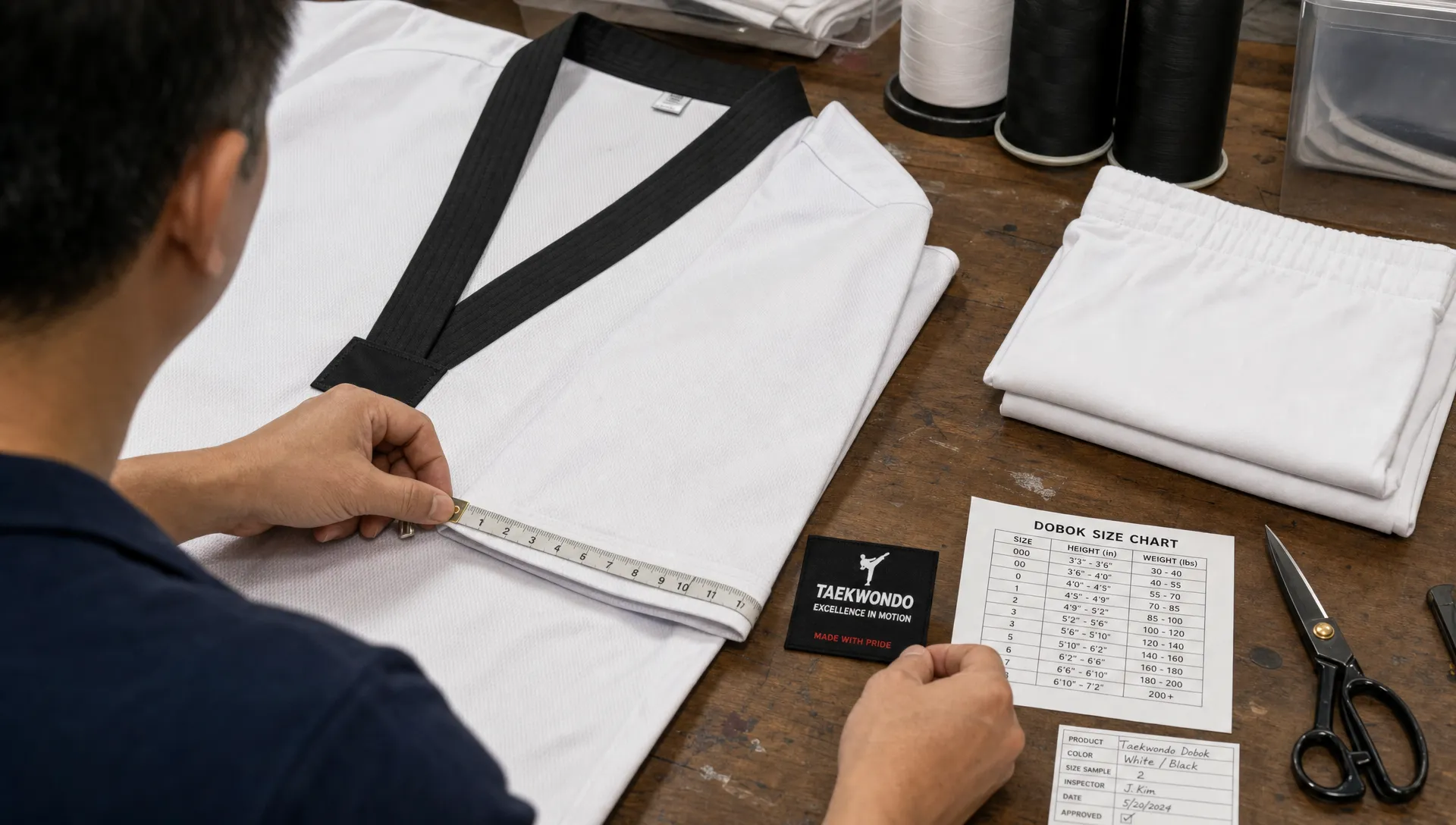
Sampling should happen before the bulk order, even when timing is tight. Use the sample to test fit, fabric hand feel, shrinkage, stitching and logo execution. Wash it, measure it and have someone perform basic taekwondo movements in it. A sample that looks good on a hanger can still restrict a high kick or twist awkwardly at the pant rise.
For broader buying discipline, this guide to martial arts uniform wholesale buying tips can help you compare taekwondo planning with other martial arts categories.
Use branding to increase perceived value
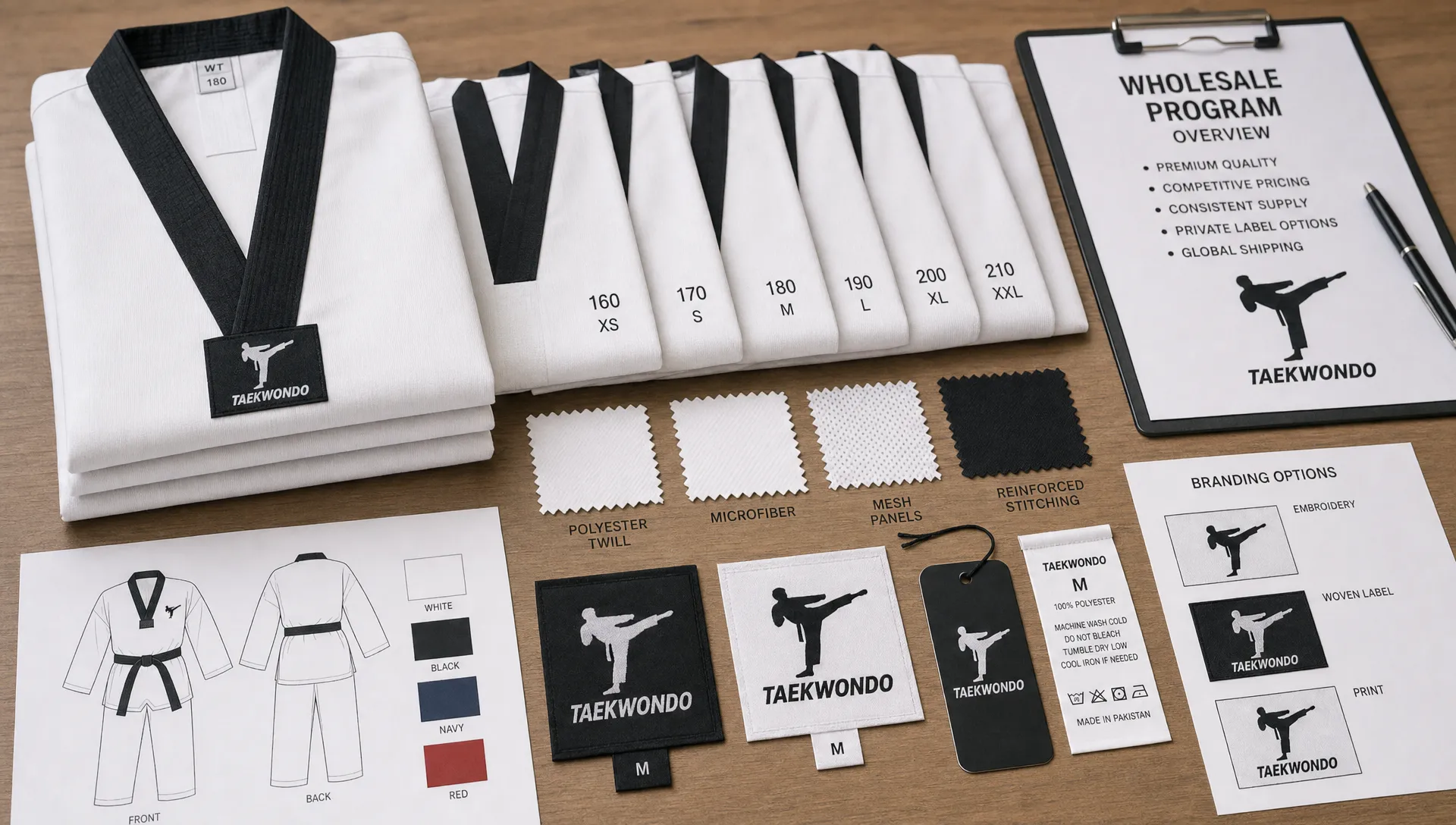
Branding is where many wholesale programs either become memorable or look interchangeable. A dobok does not need excessive decoration, but it should feel intentional. Clean embroidery, a woven neck label, a consistent size label and professional packaging can raise perceived value without turning the uniform into a costume.
For private label programs, decide which elements must remain consistent across every reorder. That may include logo size, thread color, label placement, packaging language and size sticker format. Consistency builds trust with schools and retailers because they know the next shipment will match the previous one.
A taekwondo uniform wholesale line can also use branding to separate channels. For example, a school-only uniform might carry academy branding, while a retail line uses a broader brand mark. This prevents channel conflict and gives each buyer a reason to keep ordering from you instead of comparing only on price.
Arus Sportswear supports private label and OEM production for martial arts apparel, and the company’s guide to private label martial arts clothing is a helpful next step if you want to turn uniform sourcing into a branded product range.
Build sales channels around real buying moments
Taekwondo uniforms sell best when the timing matches customer need. New student intake, belt testing, school openings, tournament season, team travel and holiday gift periods can all create spikes in demand. Your job is to place inventory and offers in front of buyers before those moments arrive.
For schools, the strongest offer is usually convenience. Bundle beginner uniforms by size, create academy-branded options and set reorder reminders before testing cycles. For distributors, focus on reliable stock, clear case quantities and product information that retailers can copy into their own listings.
Events can also support a taekwondo uniform wholesale strategy when they create visibility for teams, sponsors and club communities. If your brand is planning a launch event or promotional spectacle around a tournament, it is useful to look at how specialist producers package record-focused brand activations with visual impact, partner exposure and media-friendly moments.
The point is not to make events your only sales channel. The point is to use them as demand accelerators while your everyday wholesale system handles repeat orders.
Set quality control rules before production starts
Quality control should not begin when cartons arrive at your warehouse. It should start with approved samples, clear tolerances and written inspection points. This is especially important when you are selling to schools, since one poor batch can damage a relationship with dozens or hundreds of students.
Your inspection plan does not need to be complicated, but it should be consistent.
| QC stage | What to check | Why it protects profit |
|---|---|---|
| Pre-production sample | Fit, fabric, logo placement and size chart | Prevents bulk errors before cutting |
| During production | Stitching, collar consistency and color matching | Catches problems while correction is possible |
| Final inspection | Measurements, packaging, labeling and carton marks | Reduces returns and fulfillment mistakes |
| Post-delivery review | Buyer feedback, defect rate and size sell-through | Improves the next reorder |
A taekwondo uniform wholesale program becomes more profitable when every production run teaches you something. Track defects, returns, late sizes and customer comments. If pants run long in adult sizes or parents complain about fabric transparency, update the spec before the next order rather than repeating the same issue.
Create a 90 day rollout plan
A practical rollout helps you avoid ordering too much, too soon. Start with a focused launch and expand once you have evidence.
- Days 1 to 30: Define the target buyer, product tier, size curve, branding requirements and landed cost model. Request quotations only after the specification is clear.
- Days 31 to 60: Approve samples, test washing and fit, finalize packaging and prepare sales materials for schools, retailers or online buyers.
- Days 61 to 90: Confirm bulk production, pre-sell to key accounts, plan freight and set reorder triggers for the sizes most likely to move quickly.
This rollout also helps with cash flow. Instead of guessing demand for every possible SKU, you build a program that can be measured. Once the first batch sells through, you can adjust the size curve, refine pricing and introduce a second tier with more confidence.
Frequently Asked Questions
What margin should I target for a taekwondo uniform wholesale program? The right margin depends on your channel, landed cost and brand position. Start by calculating the full landed cost, then set wholesale and retail prices that leave room for freight changes, defects, discounts and retailer profit.
How many sizes should I include in the first order? Include enough sizes to serve your main buyer, but avoid overextending into rarely purchased sizes unless a customer has committed to them. Schools often have predictable student size patterns, while distributors may need broader coverage.
Should I choose private label or generic uniforms first? Generic uniforms can be useful for basic resale, but private label products usually create stronger customer loyalty and better differentiation. If your goal is long-term wholesale profit, private label is often the better path once your spec is stable.
How important is sampling before bulk production? Sampling is essential. It allows you to test fit, shrinkage, fabric feel, logo execution and stitching before committing to volume. Skipping this step can turn a small time saving into a costly bulk-order problem.
Can a low MOQ program still be profitable? Yes, if the landed cost, pricing and size curve are controlled. Low MOQ can be especially useful for testing a new market, but the order still needs enough depth in popular sizes to avoid stockouts.
Build your next uniform program with a manufacturing partner
Wholesale profit comes from repeatable decisions: a clear buyer, a tested spec, disciplined pricing, controlled inventory and branding that customers remember. When those pieces work together, your dobok line can become a reliable revenue stream for your gym, brand or distribution business.
Arus Sportswear manufactures custom martial arts apparel for brands, gyms and distributors worldwide, including private label and OEM production, custom designs, low minimum orders, bulk order support and worldwide shipping. If you are ready to build a structured taekwondo uniform wholesale program, prepare your target buyer, size plan and branding goals before requesting a quote. The clearer your plan, the easier it is to manufacture uniforms that sell profitably and reorder smoothly.