Buying uniforms in bulk is one of the most important decisions a martial arts brand, gym, academy, or distributor will make in 2026. The right supplier can help you deliver consistent sizing, durable construction, and strong brand presentation. The wrong one can leave you with shrinking gis, weak seams, delayed shipments, and inventory that is difficult to sell.
That is why martial arts uniform wholesale buying should start with product clarity, not just price negotiation. A low unit cost only matters if the uniform performs well, fits your audience, and arrives on time with the branding and quality your customers expect.
Below are practical tips to help you source wholesale martial arts uniforms more confidently in 2026, whether you are ordering karate uniforms, BJJ gis, taekwondo doboks, kung fu suits, judo uniforms, tai chi apparel, or mixed combat sportswear.
Start With the Discipline and Use Case
A “martial arts uniform” is not one standard product. Each discipline has different movement patterns, durability needs, fabric expectations, and visual traditions. Before asking for a quote, define what the uniform must do in real training conditions.
For example, a lightweight karate gi may need crisp movement and a clean snap, while a BJJ gi must withstand constant gripping, pulling, washing, and mat friction. A tai chi uniform should prioritize comfort and freedom of movement, while a judo uniform must be built for heavy grappling stress.
| Uniform type | Key buying priority | Common wholesale concern |
|---|---|---|
| Karate gi | Structure, movement, clean appearance | Fabric weight, shrinkage, collar firmness |
| BJJ gi | Grip resistance, reinforced seams, durability | Lapel construction, sleeve fit, pant reinforcement |
| Judo gi | Heavy-duty fabric and reinforced stress points | Strength under pulling and repeated washing |
| Taekwondo dobok | Lightweight movement and discipline-specific cut | Neck style, fabric comfort, size consistency |
| Kung fu or tai chi uniform | Breathability, drape, range of motion | Button quality, loose fit, fabric hand feel |
| MMA and hybrid apparel | Flexibility, moisture management, branding | Sublimation quality, stretch recovery, panel fit |
If you are comparing categories across a wider product range, this overview of the types of martial art uniforms can help you map each product to its intended discipline before you place a wholesale order.
Build a Clear Technical Specification Before Requesting Quotes
The fastest way to receive inaccurate pricing is to ask for a generic quote. Suppliers need detailed information to estimate fabric usage, production time, trims, branding, and packing requirements.
A strong wholesale brief should include the following details:
- Discipline and target user, such as beginner students, tournament competitors, gym members, or retail customers
- Fabric type, weave, weight, color, and finish preferences
- Size range, grading expectations, and fit style
- Reinforcement points, stitching requirements, collar structure, and pant closure type
- Branding details, including embroidery, woven labels, patches, heat transfer, or sublimation
- Packaging needs, such as polybags, size stickers, hang tags, or retail-ready cartons
- Order quantity by size and color, not just total units
- Destination country and any labeling or import requirements
This specification does more than help the supplier quote correctly. It gives you a benchmark for comparing factories fairly. If one supplier quotes a uniform with lighter fabric and another quotes reinforced construction, the cheaper option may not actually be comparable.
Choose Fabric Based on Performance, Not Guesswork
Fabric is usually the largest driver of cost and product performance in martial arts uniform wholesale orders. In 2026, buyers are increasingly looking for a balance between durability, comfort, wash performance, and brand positioning.
Cotton remains popular for many traditional uniforms because of its hand feel, breathability, and familiar appearance. Cotton-poly blends can improve drying time and reduce some shrinkage concerns, depending on the fabric construction. Ripstop fabrics are often used where lightweight durability is important, while heavier weaves are common in grappling uniforms that need strength and structure.
For BJJ, judo, and other grappling styles, pay close attention to lapel thickness, reinforcement tape, crotch gussets, knee panels, and seam strength. For karate, taekwondo, kung fu, and tai chi uniforms, comfort, movement, and visual presentation may matter just as much as tensile strength.
Do not rely only on fabric names. Ask for physical swatches and finished samples. Two fabrics can both be called “cotton twill” but feel very different in thickness, shrinkage, softness, and durability.
Calculate Landed Cost, Not Just Unit Price
Many wholesale buyers focus too heavily on the quoted unit price. That number matters, but it is not the full cost of getting sellable uniforms into your warehouse or store.
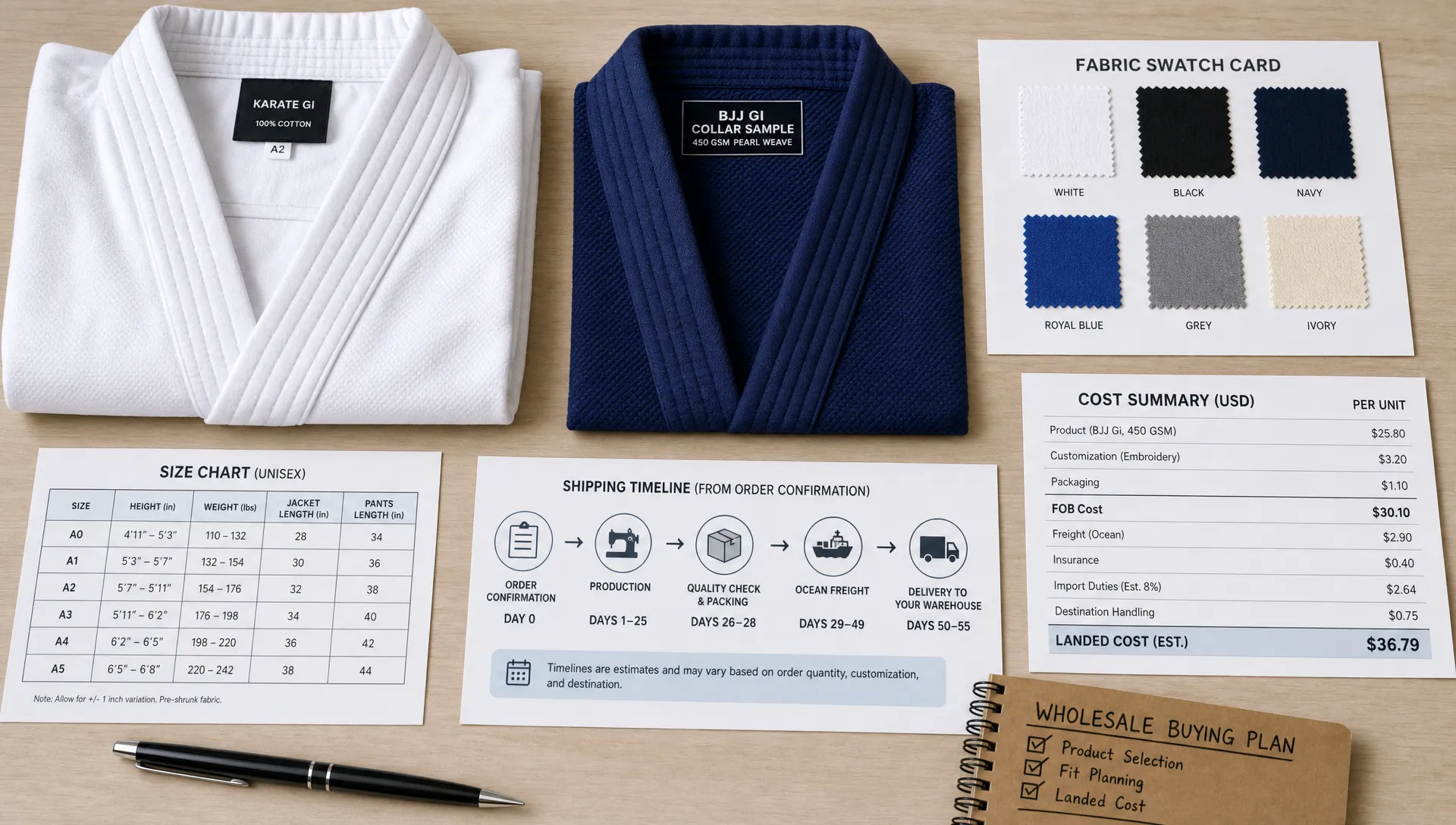
Your real cost includes product price, branding, sample fees, packaging, inspection, shipping, duties, taxes, payment fees, and the cost of delays or rejected goods. A supplier with a slightly higher unit price may be better value if they reduce defects, improve consistency, and ship reliably.
| Cost factor | Why it matters |
|---|---|
| Fabric and construction | Determines durability, comfort, and perceived value |
| Custom branding | Impacts brand presentation and production complexity |
| Sampling | Helps prevent expensive bulk-order mistakes |
| Packaging | Affects retail readiness and warehouse handling |
| Freight | Can significantly change total cost per unit |
| Duties and import charges | Vary by country, material, and product classification |
| Quality control | Reduces the risk of unsellable inventory |
| Reorder consistency | Protects your size chart, colors, and customer expectations |
When comparing suppliers, ask for pricing in a format that separates key cost components where possible. This makes it easier to see whether a quote is low because the supplier is efficient, or because something important has been removed.
Treat Sampling as a Required Investment
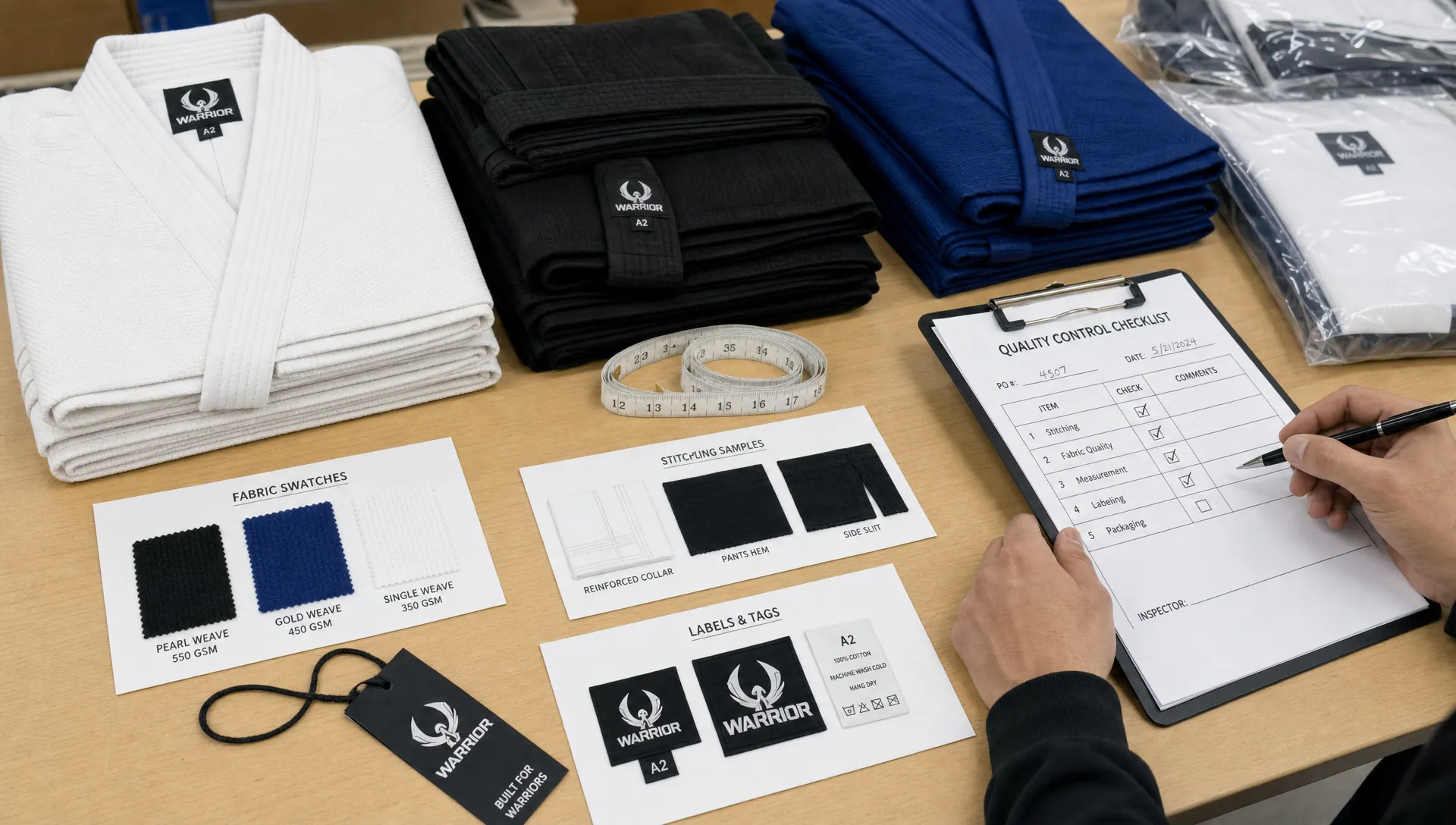
Skipping samples to save money can be expensive. A sample gives you the chance to test fit, fabric, stitching, shrinkage, branding placement, and overall finish before the bulk order begins.
There are different types of samples, and each serves a different purpose. A first prototype checks the concept. A revised sample confirms improvements. A pre-production sample is the final version that bulk production should match.
| Sample stage | What to check | Best use |
|---|---|---|
| Fabric swatch | Weight, texture, color, stretch, shrinkage risk | Early material approval |
| Fit sample | Size, movement, cut, sleeve and pant length | Pattern refinement |
| Branding sample | Logo size, placement, stitching, print clarity | Brand approval |
| Pre-production sample | Final fabric, trims, construction, labels, packaging | Bulk production sign-off |
| Shipment sample | Finished product from bulk goods | Final consistency check |
After receiving a sample, wash it according to the care label before giving approval. Measure it before and after washing. Try it during actual movement if possible. For grappling uniforms, stress the sleeves, lapel, and pant seams. For striking or traditional uniforms, test mobility, comfort, and appearance after laundering.
Pay Attention to Sizing and Grading
Sizing problems are one of the most common reasons wholesale uniform orders become difficult to sell. A size chart must be realistic for your customer base and consistent across reorders.
If you sell to children, beginners, and adult practitioners, your size range may need more careful grading than a simple small to extra-large scale. Martial arts sizing often depends on height, weight, body type, sleeve length, pant length, and discipline-specific fit.
Ask your supplier how patterns are graded between sizes. A good production partner should be able to follow your target measurements and tolerance requirements. You should also clarify expected shrinkage before creating customer-facing size charts, especially if the uniforms contain cotton.
For private label programs, sizing consistency is part of your brand reputation. If a customer buys the same size twice and receives two very different fits, the problem feels like a brand failure, even if the factory caused it.
Review Stitching, Reinforcement, and Finishing Details
Uniforms fail at stress points first. In wholesale buying, you should inspect more than the front view of a finished garment. Turn the product inside out. Look at seam alignment, thread trimming, reinforcement areas, labels, bar tacks, hems, and collar construction.
For grappling uniforms, sleeve openings, armpits, lapels, side vents, belt loops, knee panels, and crotch seams deserve special attention. For karate and taekwondo uniforms, check whether the garment hangs cleanly, whether the collar keeps its shape, and whether the seams remain comfortable during high kicks and repeated movement.
Finishing quality also affects perceived value. Loose threads, uneven embroidery, wavy seams, misaligned labels, and inconsistent folding can make even a durable uniform feel cheap. Wholesale buyers should set clear acceptable quality limits before production starts.
Compare Suppliers by Process, Not Promises
A supplier’s website or catalog can tell you what they want to sell, but their process tells you how reliable they are likely to be. Ask how they handle fabric sourcing, pattern making, grading, cutting, sewing, in-line inspection, final inspection, packing, and shipment preparation.
If you want to understand what happens behind the scenes, this guide to the martial arts uniform factory process explains the major production stages from brief to packing.
You can also borrow quality lessons from industries outside apparel. Precision manufacturers, including custom shaft and roller specialists, often compete on controlled processes, material accuracy, certified quality systems, and repeatable production. Wholesale uniform buyers should apply the same mindset by asking for documented specifications, clear tolerances, and repeatable quality checks instead of accepting vague assurances.
A dependable martial arts uniform supplier should be willing to discuss how they prevent common production problems. These include shade variation, fabric shrinkage, incorrect logo placement, skipped reinforcement, wrong size ratios, delayed trims, and inconsistent packing.
Decide How Much Customization You Really Need
Customization helps your brand stand out, but every custom choice can affect cost, lead time, and reorder complexity. In 2026, buyers are often looking for smarter customization rather than maximum customization.
For a gym, a clean embroidered logo, consistent size labels, and branded packaging may be enough. For a retail brand, custom patterns, unique trims, contrast stitching, private labels, hang tags, and specialized packaging may be worth the added investment.
Common customization options include embroidery, woven patches, sublimated panels, screen printing, heat transfers, custom waistbands, branded drawcords, woven neck labels, care labels, hang tags, and retail packaging. The best option depends on the product. Heavy embroidery may not suit every lightweight garment, while sublimation may be ideal for rash guards and MMA shorts but irrelevant for a traditional cotton gi.
If you are building a brand rather than simply buying blank uniforms, this private label martial arts clothing manufacturing guide is a useful next step for understanding how branding and production decisions work together.
Plan MOQs Around Testing and Reorders
Minimum order quantity is not just a supplier requirement. It is also an inventory risk calculation. A large order can reduce unit cost, but it can also tie up cash in slow-moving sizes or colors. A smaller order can help you test demand, but the cost per unit may be higher.
For 2026, many buyers are using a phased approach. They test a focused size range or limited colorway, review sell-through, then reorder the strongest products. This is especially useful for new brands, gyms launching merchandise, and distributors testing a new regional market.
When discussing MOQ, ask whether it applies per style, per color, per size, or per total order. This detail matters. A “low MOQ” may still be difficult to manage if each color or size requires a separate minimum.
Also ask about reorder timelines. If a uniform sells well, you need to know how quickly the supplier can reproduce the same fabric, color, fit, label, and packaging. Reorder consistency is one of the biggest advantages of choosing a long-term manufacturing partner instead of switching factories for every purchase.
Check Packaging, Labeling, and Shipping Early
Packaging is often discussed too late, but it affects both cost and customer experience. A wholesale order for retail distribution may need individual polybags, size stickers, barcodes, hang tags, carton labels, and organized size assortments. A gym order may need simpler packing, but it still needs clear size identification to avoid sorting problems.
Shipping should also be discussed early. Your supplier should know the destination country, preferred shipping method, carton requirements, and any documentation needs. If your selling season depends on tournaments, school enrollment periods, gym openings, or holiday promotions, build in time for production, inspection, freight, customs, and local delivery.
Do not plan your launch around the best-case shipping estimate. Plan around a realistic timeline with a buffer, especially for first-time orders or heavily customized products.
Watch for Red Flags Before Paying a Deposit
A supplier does not need to be perfect to be a good partner, but certain warning signs should make you slow down and ask more questions.
Common red flags include vague answers about fabric, refusal to provide samples, unclear MOQ terms, inconsistent communication, no defined production timeline, missing size charts, poor sample finishing, pressure to skip quality checks, and quotes that are far below every other supplier without a clear reason.
Another warning sign is a supplier that claims to make every product category at expert level but cannot explain the technical differences between them. A factory producing durable BJJ gis should understand reinforcement and lapel structure. A supplier making tai chi uniforms should understand drape, movement, and traditional styling. Category knowledge matters.
Use a Wholesale Buying Checklist Before Approval
Before you approve production, confirm the essentials in writing. This reduces misunderstandings and gives both sides a shared reference.
Your final approval checklist should include confirmed fabric, approved sample, size chart, color standard, logo artwork, branding placement, stitching details, packaging method, order quantity by size and color, production timeline, inspection plan, payment terms, shipping method, and delivery address.
Keep approved samples, fabric swatches, photos, measurement sheets, and packaging references. These become your quality standard for future reorders.
Frequently Asked Questions
What is the most important factor when buying martial arts uniforms wholesale? The most important factor is matching the uniform to the discipline and use case. Fabric, stitching, fit, reinforcement, and branding should all be selected based on how the uniform will actually be used.
Should I choose the cheapest martial arts uniform wholesale supplier? Not automatically. A cheaper unit price may lead to higher costs if the uniforms shrink, arrive late, have weak seams, or require replacements. Compare total landed cost and quality consistency, not price alone.
How many samples should I approve before bulk production? At minimum, approve a final pre-production sample that includes the correct fabric, fit, branding, labels, and packaging. For new designs, you may need earlier fit and branding samples before final approval.
What should I ask a martial arts uniform manufacturer before ordering? Ask about fabric options, size grading, reinforcement methods, customization choices, MOQ structure, production timeline, quality control process, packaging, shipping, and reorder consistency.
Is private label worth it for gyms and martial arts brands? Private label can be valuable if you want stronger brand recognition, better customer loyalty, and a more professional retail or academy offering. Start with practical branding choices that fit your budget and product strategy.
Build a Better Wholesale Uniform Program in 2026
The best martial arts uniform wholesale decisions come from clear specifications, realistic costing, disciplined sampling, and a supplier that understands combat sports apparel. When you treat uniforms as performance products, not generic garments, you reduce risk and create a better experience for students, athletes, coaches, and customers.
Arus Sportswear manufactures custom MMA and martial arts apparel for brands, gyms, and distributors worldwide, including private label and OEM production for fightwear, sportswear, and combat sports uniforms. If you are planning a 2026 wholesale uniform order, connect with Arus Sportswear to discuss custom designs, branding options, bulk production, low minimum orders, and worldwide shipping.