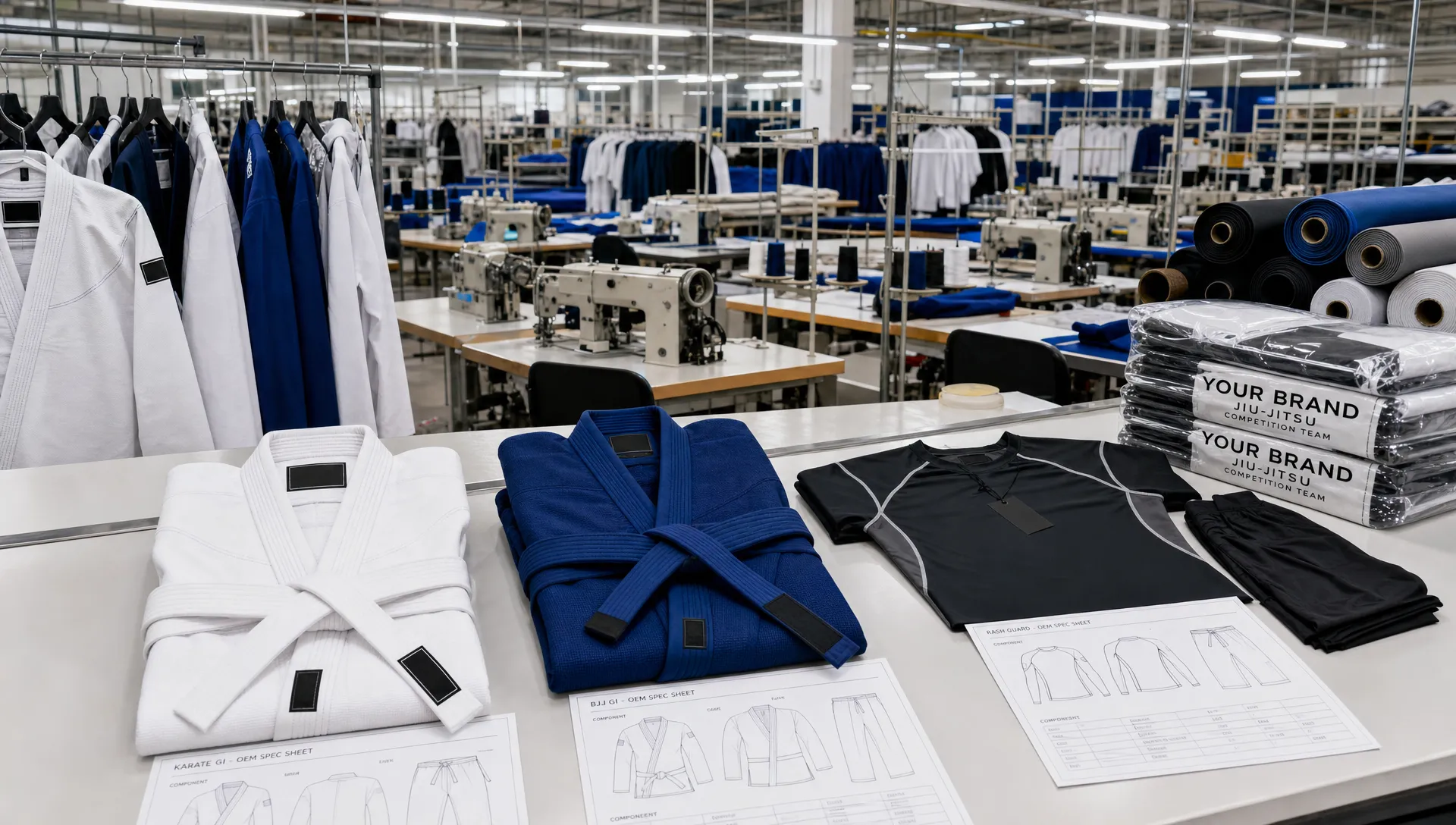
Choosing an OEM martial arts uniform manufacturer is not just a sourcing task. It is a decision that affects your product quality, brand reputation, delivery reliability, and profit margin for every order you place afterward.
A good manufacturer can help you turn a uniform concept into repeatable production. A poor one can leave you dealing with inconsistent sizing, weak stitching, delayed shipments, and unhappy customers. The goal is to find a partner that understands martial arts apparel, communicates clearly, and can grow with your brand, gym, or distribution business.
This guide walks through the key factors to check before you commit to an OEM partner, from fabric and construction to sampling, branding, quality control, and logistics.
Start With Your Product Requirements
Before contacting any factory, define what you need the manufacturer to make. Vague requests like “custom martial arts uniforms” often lead to vague quotes. A strong product brief helps the manufacturer understand your expectations and helps you compare suppliers fairly.
Your brief should explain the type of uniform, target customer, intended use, sizing range, branding placement, colors, packaging requirements, and expected order volume. A children’s beginner karate uniform is very different from a heavyweight judo gi for advanced training. A lightweight Tai Chi uniform requires a different cut, fabric feel, and movement profile than a BJJ gi or taekwondo dobok.
If you are still deciding between private label and full OEM production, this guide to private label martial arts clothing can help clarify which model fits your brand strategy.
Check Whether the Manufacturer Specializes in Martial Arts Apparel
General sportswear factories may be able to sew basic garments, but martial arts uniforms have performance demands that ordinary apparel does not. They must withstand pulling, gripping, kicking, sweating, kneeling, repeated washing, and in many cases, competition rules.
An experienced OEM martial arts uniform manufacturer should understand category-specific details such as reinforced stress points, shrinkage control, sleeve and pant proportions, collar structure, gussets, drawstrings, elastic waistbands, and embroidery placement. These details may look small on a sample, but they determine whether the finished uniform performs well in real training.
Ask the manufacturer which martial arts categories they already produce. Relevant experience may include karate uniforms, BJJ gis, judo gis, taekwondo uniforms, kung fu uniforms, Tai Chi uniforms, boxing apparel, MMA fightwear, and rash guards. The broader the relevant experience, the easier it is for the supplier to advise on fabrics, fits, and construction.
Evaluate Fabric and Construction Quality
Fabric is one of the biggest quality signals in martial arts uniforms. The right fabric depends on the discipline, price point, and end user. Some customers want a lightweight student uniform that is affordable and easy to wash. Others expect a premium heavyweight gi with a crisp feel and strong reinforcement.
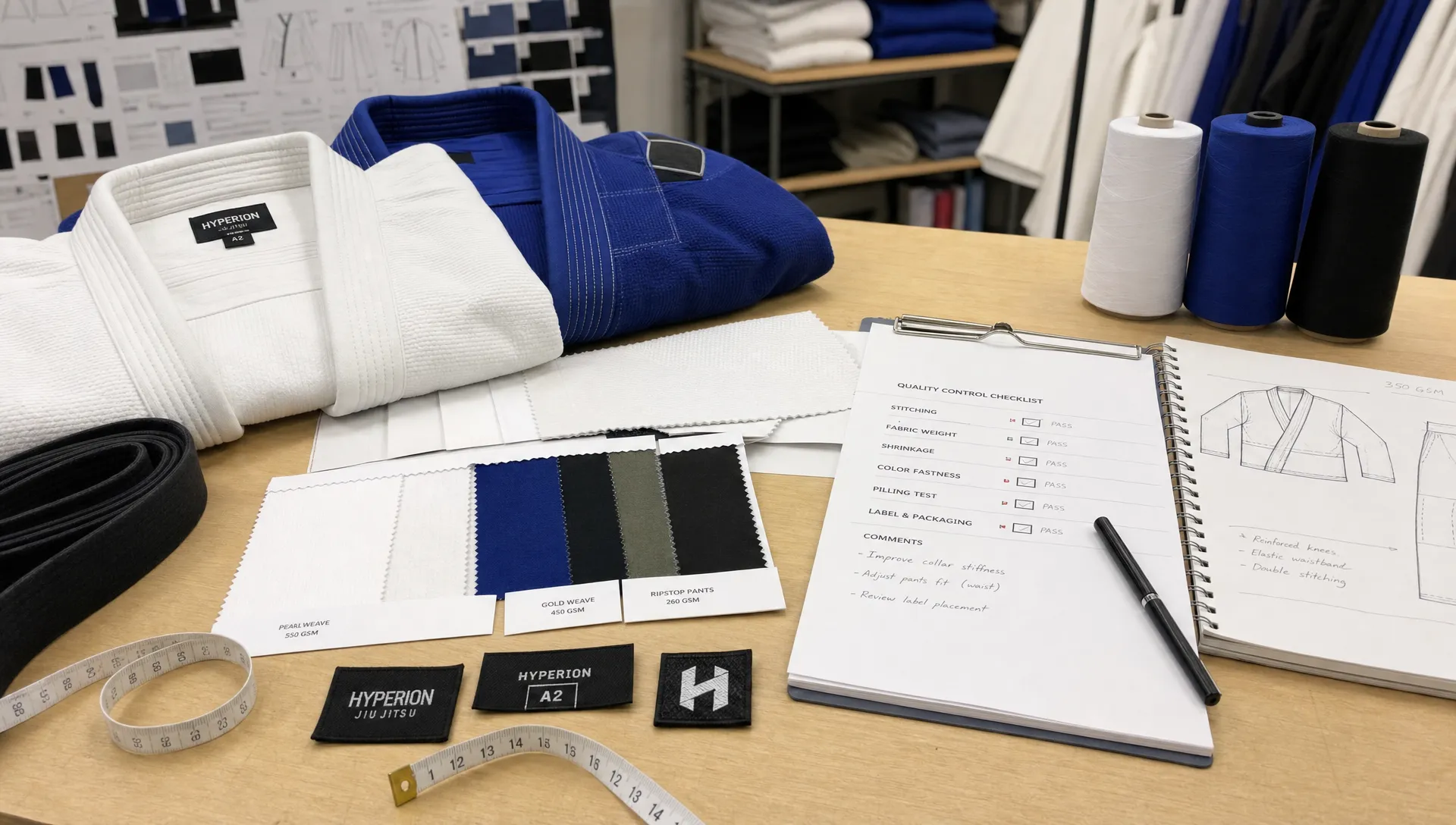
Do not rely only on fabric names. Ask for actual fabric specifications, physical swatches, and sample garments. Weight, weave, shrinkage, hand feel, colorfastness, and durability all matter.
| Uniform category | Common quality priorities | Questions to ask the manufacturer |
|---|---|---|
| Karate uniform | Crisp fabric, clean lines, reinforced seams, shrinkage control | What fabric weights do you offer for student and professional uniforms? |
| BJJ gi | Strong collar, reinforced stress points, durable weave, competition fit | Can you produce pearl weave, gold weave, or other gi fabrics? |
| Judo gi | Heavy-duty fabric, grip resistance, reinforced lapel and knees | How do you test seam strength and fabric durability? |
| Taekwondo uniform | Lightweight movement, comfortable fit, clean V-neck or wrap design | Can you customize collar style and trim colors? |
| Tai Chi uniform | Soft drape, breathable fabric, relaxed movement | Which lightweight fabrics work best for fluid motion? |
Pay close attention to stitching. Uneven seams, loose threads, weak bartacks, poor collar finishing, and inconsistent topstitching are warning signs. Martial arts uniforms face more stress than casual clothing, so construction quality is not optional.
Review OEM Capabilities, Not Just Custom Logo Options
Some suppliers use the term OEM loosely. They may only offer basic logo placement on existing stock patterns. True OEM manufacturing should give you more control over product specifications, including pattern, measurements, materials, trims, branding, packaging, and production details.
For a growing martial arts brand, OEM can support long-term differentiation. Instead of selling the same generic uniform as every competitor, you can develop your own fit, fabric combinations, colorways, labels, and packaging presentation. If scaling is part of your plan, it is worth understanding how OEM manufacturing helps martial arts brands scale faster.
Ask what parts of the product can be customized. The answer should be specific, not generic. For example, a qualified manufacturer should be able to discuss options for woven labels, neck labels, embroidery, patches, sublimated trims, custom sizing, reinforced areas, drawcords, waistbands, hang tags, polybags, and cartons.
Ask About Sampling Before Bulk Production
Sampling is where you learn how the manufacturer actually works. A polished website or product catalog is useful, but a sample reveals much more about quality, accuracy, communication, and attention to detail.
A professional sampling process should include a clear sample quote, timeline, technical discussion, and revision process. The first sample may not be perfect, especially if you are developing a custom pattern, but the manufacturer’s response to feedback is important. Do they understand your comments? Do they correct issues accurately? Do they explain tradeoffs?
When reviewing samples, test them like a customer would. Wash them, measure them before and after washing, check seam strength, inspect embroidery, try movement drills, and compare the garment against your size chart.
Understand MOQ, Pricing, and Scalability
Minimum order quantity matters, especially for new brands, gyms, and distributors testing a product line. Low MOQ can reduce risk, but it should still be balanced with production efficiency and consistent quality. Very small orders may cost more per unit, while larger orders can improve pricing but increase inventory risk.
Instead of focusing only on the lowest unit price, compare the full value of each quote. A cheap uniform that shrinks too much, arrives late, or needs rework may cost more in the long run than a slightly higher-priced product from a reliable manufacturer.
Ask for a quote that clearly separates key variables such as fabric choice, logo method, size range, packaging, sample cost, bulk quantity, and shipping terms. This makes it easier to see what is driving cost and where adjustments can be made.
Verify Quality Control Procedures
Quality control should happen before production, during production, and before shipment. If a manufacturer only inspects finished goods at the end, problems may be discovered too late.
A reliable OEM partner should be able to explain how they check fabric, patterns, measurements, stitching, branding, color consistency, packing, and final cartons. For martial arts uniforms, measurement tolerance and shrinkage control are especially important because fit affects both comfort and perceived quality.
Useful quality checks include:
- Pre-production sample approval before bulk cutting
- Fabric and trim inspection before sewing
- Inline inspection during production
- Measurement checks across sizes
- Stitching and reinforcement inspection
- Final random inspection before shipment
- Packing and labeling verification
You do not need to manage every factory detail yourself, but you do need a partner that can document the process and provide clear updates.
Look for Clear Communication and Documentation
Communication problems are one of the most common causes of sourcing mistakes. If a supplier is slow, vague, or inconsistent before you place an order, those issues usually become more serious during production.
A strong manufacturer should communicate clearly about specifications, timelines, revisions, approvals, and shipping. They should confirm details in writing and be comfortable working from a product brief, size chart, artwork file, or tech pack.
Documentation is especially important for repeat orders. Once you approve a uniform, the manufacturer should be able to reproduce it consistently. That requires recorded specifications for fabric, measurements, trims, logo placement, packaging, and any special construction details.
This principle applies across many technical buying decisions. Whether a company is evaluating apparel production or reviewing a specialized service provider such as Dahab Miners for crypto mining in UAE, transparent service details, proof of capability, and responsive support make it easier to commit with confidence.
Assess Branding and Packaging Options
For martial arts brands, branding is more than a logo. The uniform should feel like part of a complete customer experience. Labels, patches, embroidery, drawcords, hang tags, and packaging all contribute to perceived value.
Ask the manufacturer which branding methods they support and which ones are best for each garment type. Embroidery may work well on certain uniform areas, while woven patches or labels may be better for others. For compression apparel and No-Gi products, sublimation can be useful because the design becomes part of the fabric surface.
If your product range includes No-Gi or MMA apparel alongside traditional uniforms, you may also want to compare capabilities for custom rash guards so your branding remains consistent across categories.
Confirm Lead Times and Shipping Support
A manufacturer’s lead time should be realistic, not just attractive. Ask how long sampling takes, how long bulk production takes after approval, and how shipping timelines vary by destination. Also ask what happens during peak production periods.
Worldwide shipping can be a major advantage, but it still requires coordination. Clarify whether the manufacturer can support your preferred shipping method and provide the documentation needed for import. Depending on your market, this may include commercial invoices, packing lists, carton details, and product descriptions.
If you are ordering for a tournament, launch, academy opening, or seasonal promotion, build in extra time. Custom apparel production includes approvals, manufacturing, quality checks, packing, and transit. A timeline that looks safe on paper can become tight if artwork changes, fabric sourcing delays, or customs issues occur.
Watch for Red Flags Before You Commit
Not every supplier that claims to be an OEM martial arts uniform manufacturer is suitable for long-term cooperation. Some warning signs appear early if you know what to look for.
Be cautious if a manufacturer avoids specific answers, refuses to provide samples, offers unusually low prices without explaining specifications, cannot discuss fabric details, has inconsistent communication, or pushes you to bulk order before sample approval. Poor documentation, unclear payment terms, and no visible quality control process are also concerns.
Use the table below as a quick screening tool when comparing manufacturers.
| Evaluation area | Strong sign | Red flag |
|---|---|---|
| Martial arts experience | Can discuss different uniform types and construction needs | Only shows generic sportswear examples |
| Sampling | Offers sample development and revisions | Pressures you to skip sampling |
| Fabric knowledge | Provides fabric options, weights, and swatches | Uses vague terms without specifications |
| Branding | Explains logo, label, patch, and packaging options | Only offers basic logo printing |
| Quality control | Describes inspection steps and tolerances | Gives no clear QC process |
| Communication | Confirms details in writing | Relies on unclear verbal promises |
| Scalability | Can support repeat and bulk orders | Cannot explain production capacity |
Build a Shortlist and Compare Like for Like
Once you have several potential manufacturers, do not compare them only by unit price. Compare the same product specifications across all suppliers. If one quote is based on a lightweight fabric and another uses heavyweight fabric, the prices are not equivalent.
Create a simple scorecard that includes product expertise, sample quality, communication, MOQ, price transparency, branding capability, lead time, shipping support, and willingness to build a long-term relationship. The best manufacturer is not always the cheapest. It is the one that can deliver the right product consistently at a sustainable cost.
If possible, start with a controlled first order rather than a massive launch quantity. This lets you test production quality, packaging, shipping, and customer response before scaling.
Frequently Asked Questions
What is an OEM martial arts uniform manufacturer? An OEM martial arts uniform manufacturer produces custom uniforms based on your brand’s specifications. This can include fabric selection, sizing, pattern adjustments, labels, logos, packaging, and bulk production.
How is OEM different from private label martial arts clothing? Private label often uses existing manufacturer designs with your branding, while OEM usually involves more product customization. OEM is better when you want unique specifications, fits, or construction details.
What should I check in a martial arts uniform sample? Check fabric feel, stitching, reinforcement, measurements, shrinkage after washing, logo quality, comfort, range of motion, and overall finishing. Compare the sample against your approved size chart and product brief.
Is low MOQ important when choosing a manufacturer? Low MOQ can be helpful for new brands and gyms because it reduces upfront inventory risk. However, it should not come at the expense of quality, communication, or reliable repeat production.
How do I know if a manufacturer can handle bulk orders? Ask about production capacity, lead times, quality control steps, repeat order processes, and shipping support. A capable manufacturer should be able to explain how they maintain consistency as order volume increases.
Ready to Develop Custom Martial Arts Uniforms?
Picking the right OEM partner comes down to preparation, proof, and communication. Define your product clearly, inspect samples carefully, verify production capabilities, and choose a manufacturer that understands the demands of martial arts apparel.
Arus Sportswear supports brands, gyms, and distributors with OEM and private label manufacturing for martial arts uniforms, MMA apparel, BJJ gis, boxing apparel, rash guards, and related fightwear. If you are ready to build custom products with your own branding, visit Arus Sportswear to start the conversation.