A manufacturer can make your product line feel premium, reliable, and ready to scale. The wrong one can quietly drain profit, delay launches, and create customer complaints that your brand has to answer for.
If you sell MMA shorts, rash guards, BJJ gis, boxing apparel, gym merchandise, or performance uniforms, your sportswear manufacturer is not just a supplier. They are part of your product experience. Every crooked seam, faded print, late shipment, or inconsistent size chart reflects on your brand, not the factory behind it.
The difficult part is knowing when normal production challenges have become a pattern. One delayed sample may not be a reason to switch. Repeated delays, vague updates, and quality issues across multiple orders are a different story.
Here are seven signs you may need a better sportswear manufacturer, plus what to look for before making the move.
| Warning sign | What it usually means | Brand risk |
|---|---|---|
| Repeated delays | Poor planning, capacity issues, or weak production control | Missed launches and lost sales |
| Inconsistent quality | Lack of standardized inspections | Returns, bad reviews, and damaged trust |
| Weak communication | No clear account ownership or production tracking | Stress, confusion, and poor decisions |
| Poor sampling | Factory does not understand fit, materials, or sport-specific function | Products fail in real training conditions |
| Limited branding | Supplier cannot support private label growth | Your line looks generic |
| Unclear pricing | Hidden costs or weak quoting systems | Margin problems |
| No scaling support | Manufacturer cannot grow with your brand | You outgrow them quickly |
1. Your production timelines keep slipping
Every apparel business deals with occasional delays. Fabric can arrive late, trims may need replacing, and shipping lanes can become unpredictable. A reliable manufacturer communicates these issues early and gives you a realistic recovery plan.
The warning sign is not a single delay. It is the pattern: samples promised in two weeks take six, bulk production starts later than agreed, or your supplier only admits there is a problem after you chase them repeatedly.
For sportswear brands, delays are especially expensive because product launches are often tied to events, seasons, tournaments, gym openings, influencer campaigns, or retail drops. If your MMA apparel collection arrives after the fight camp, competition, or holiday sales window, even a well-made product can underperform.
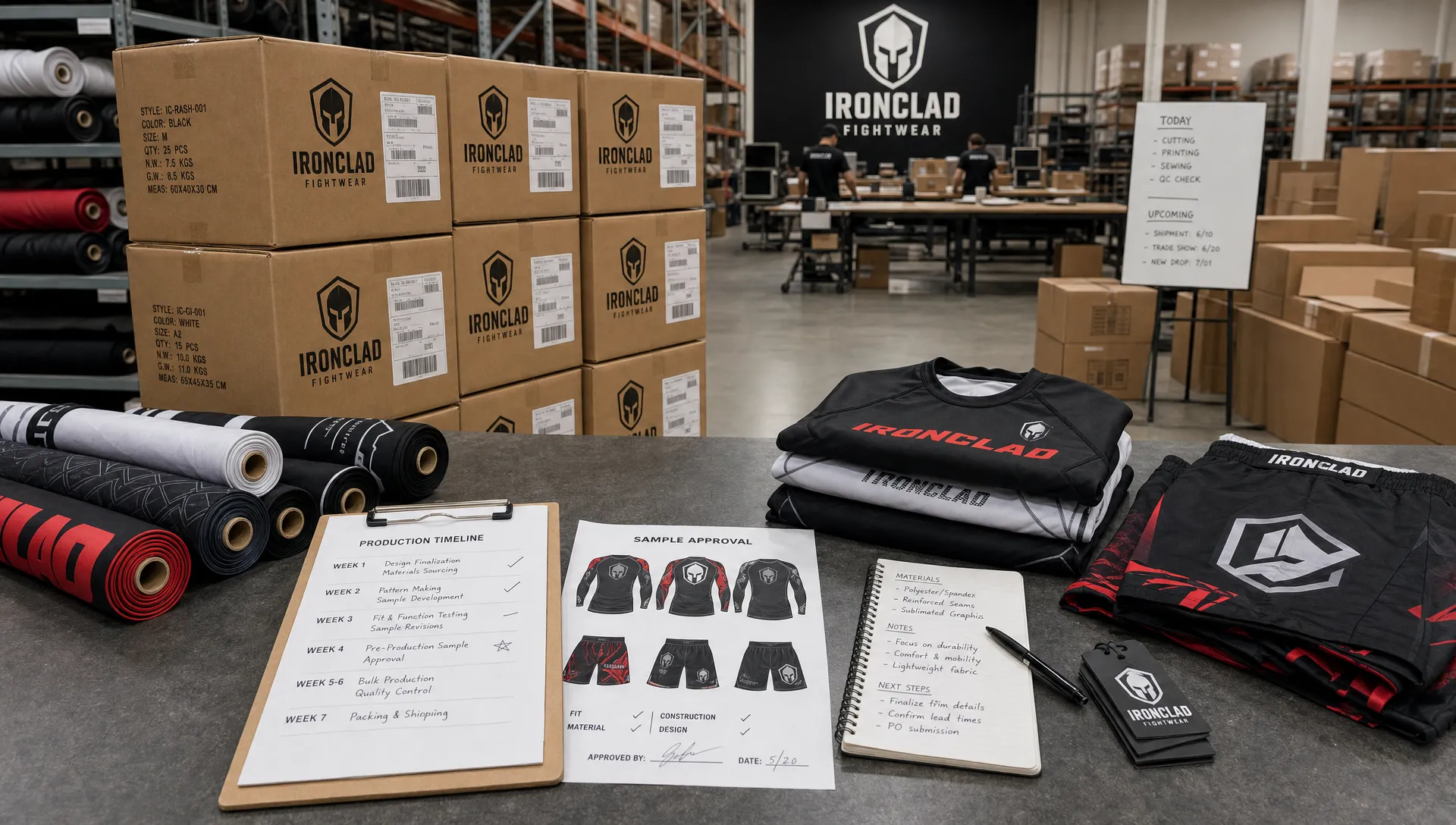
A better sportswear manufacturer should be able to explain lead times clearly, confirm production milestones, and tell you what is happening before you have to ask. You do not need perfection. You need predictability.
2. Quality changes from one order to the next
Consistency is one of the clearest differences between a basic supplier and a serious manufacturing partner. Your first order may look great, but the real test is whether the second, third, and fourth orders match the approved standard.
Common quality problems include uneven stitching, loose threads, fabric weight changes, inconsistent sublimation colors, weak elastic waistbands, shrinking, peeling logos, and sizing differences between batches. In combat sports apparel, these issues are not just cosmetic. Rash guards, fight shorts, gis, and uniforms need to handle sweat, grip, friction, pulling, washing, and repeated training.
If customers are saying, “This one fits differently than my last one,” your brand has a manufacturing consistency problem. If you are personally checking every unit before shipping because you do not trust the factory’s quality control, the process is already costing too much time.
A stronger manufacturing partner should work from approved samples, technical specifications, size charts, material references, and inspection standards. They should treat consistency as a system, not as luck.
3. Communication feels reactive instead of professional
Good communication does not mean receiving dozens of unnecessary messages. It means getting accurate updates at the right time, from someone who understands your order.
A weak manufacturer often gives short, vague replies such as “in process,” “soon,” or “we will update.” That may be acceptable for a small one-off order, but it is not enough when you are planning inventory, marketing, retail delivery, or a gym launch.
Strong communication includes clear answers about sample status, material availability, production timing, artwork approvals, packaging, labeling, shipping, and payment stages. When there is an issue, your supplier should present options, not disappear.
This matters even more if you are building a long-term apparel brand. As your product range expands, the number of moving parts increases. You may have multiple styles, colorways, size runs, private labels, and repeat orders running at the same time. If communication is already weak with one product, it will become a bigger problem as you grow.
If you are still comparing supplier options, this guide on choosing the right martial arts clothing manufacturer can help you evaluate communication, capabilities, and production fit before committing.
4. Samples look fine, but the final product does not perform
A showroom sample can look impressive on a hanger and still fail during training. This is a major issue in performance apparel because the product has to move, stretch, absorb impact, resist tearing, and stay comfortable under stress.
For example, MMA shorts need the right cut for kicking, grappling, and explosive movement. Rash guards need stretch recovery, flat seams, and fabric that does not become transparent or uncomfortable when wet. BJJ gis need reinforcement in high-stress areas. Boxing shorts and uniforms need mobility without feeling flimsy.
If your manufacturer does not understand the sport, they may copy a design visually without understanding why certain fabrics, panels, seams, closures, and reinforcements matter. The result is apparel that looks marketable in photos but disappoints athletes in real use.
A better sportswear manufacturer should ask practical questions about use case: training or competition, beginner or professional audience, gym retail or brand distribution, lightweight or heavy-duty fabric, sublimation or embroidery, fitted or relaxed cut. Those questions show they are thinking beyond decoration.
5. Your branding options feel too limited
As your brand grows, generic apparel becomes harder to sell. Customers want products that feel intentional, not like blank garments with a logo added at the last minute.
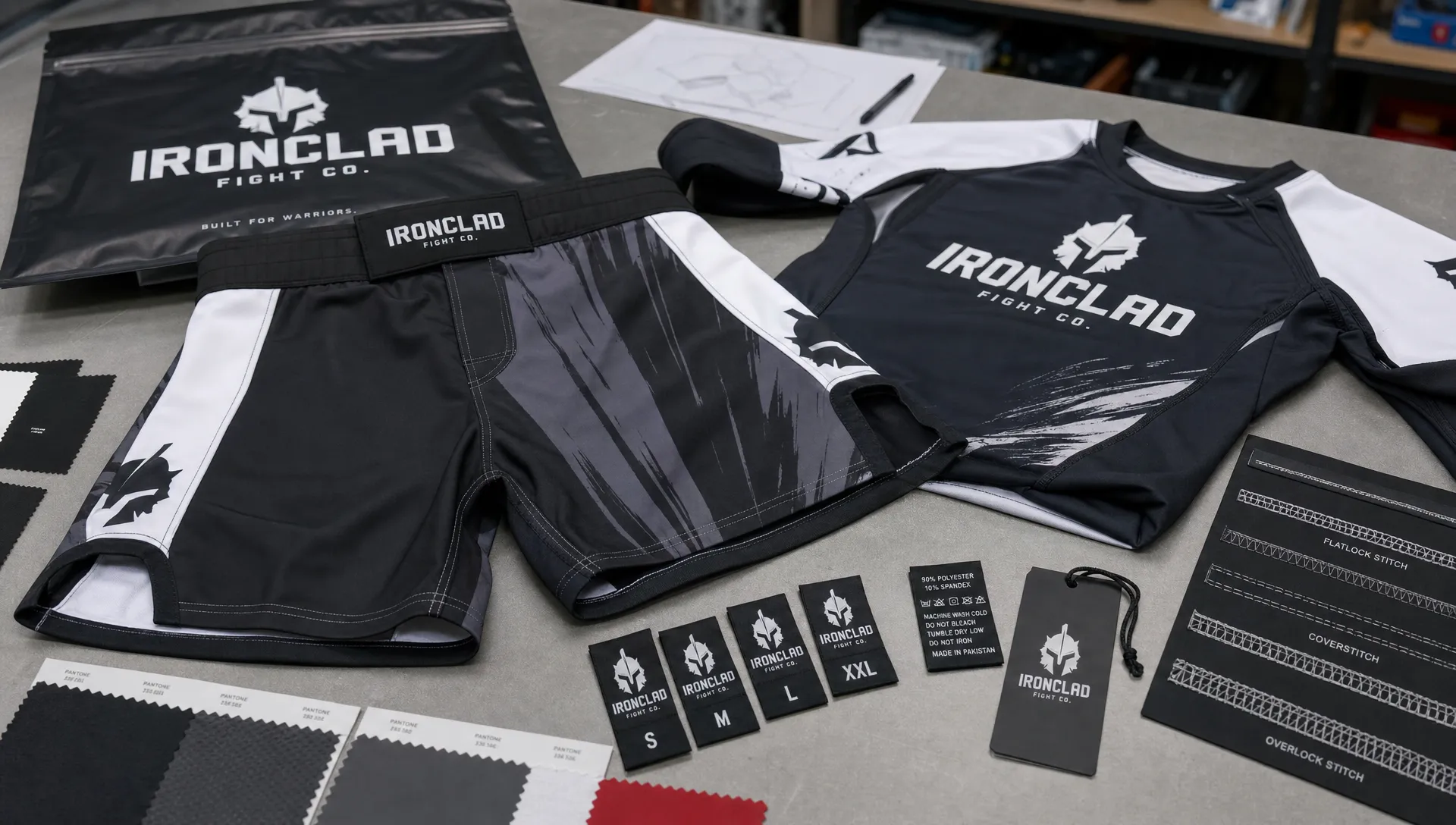
Branding goes beyond a front print. It can include woven neck labels, care labels, patches, zipper pulls, custom waistbands, printed packaging, hang tags, contrast stitching, sublimation details, and collection-specific trims. These details help your apparel feel like a real brand line rather than a simple merchandise order.
If your manufacturer can only offer basic logo placement, your product may struggle to stand out in a crowded market. This is especially true for MMA and martial arts apparel, where customers often compare brands based on both performance and identity.
Some brands also work with specialist trim suppliers for premium finishing details. For example, custom elements such as custom woven labels, patches, and ribbons can help you explore branding details that make apparel feel more polished and retail-ready.
Your manufacturer does not need to produce every label or trim in-house, but they should understand how to integrate branding elements cleanly into production. If they treat labels, packaging, and finishing as an afterthought, your final product will likely feel less premium than your design vision.
For a deeper look at why brand presentation matters, Arus Sportswear also explains how custom apparel helps sports brands stand out through identity, performance appeal, and customer loyalty.
6. Pricing is unclear, unstable, or too good to be true
Low pricing can be attractive, especially when you are launching a new sportswear brand or testing a product category. But the cheapest quote is not always the lowest total cost.
A manufacturer with unclear pricing may leave out important details such as fabric upgrades, labels, packaging, sample revisions, artwork setup, size grading, shipping, duties, or defect replacement policies. You may think you are getting a great unit price, then discover extra costs later.
Another warning sign is pricing that changes dramatically without explanation. Material prices can move, but a professional supplier should be able to explain what changed and why. If every reorder feels like starting negotiations from zero, it becomes hard to plan margins.
Good manufacturing quotes should be specific enough for business decisions. You should understand what is included, what is optional, what affects price, and how costs change at different quantities.
This is especially important for private label and OEM production. Once you build a product line around a target margin, unstable costing can damage your wholesale pricing, retail pricing, and cash flow.
7. They cannot support your next stage of growth
A supplier may be good enough for your first small order but wrong for your next phase. This is common. Early-stage brands often start with simple products and low quantities. As demand grows, they need better systems, broader product capabilities, more consistent production, and stronger support.
You may need a better manufacturer if your current supplier cannot handle multiple styles, repeat bulk orders, custom sizing, improved packaging, private label requirements, or international shipping needs. You may also feel limited if they only produce one category while your brand is ready to expand into rash guards, MMA shorts, BJJ gis, boxing apparel, or gym wear.
Scaling is not just about producing more units. It is about producing more units without losing quality, timing, or brand control.
If your brand is preparing to grow through structured production, this article on how OEM manufacturing helps martial arts brands scale faster explains why the right production model can make expansion easier.
How to evaluate a new sportswear manufacturer before switching
Switching manufacturers can feel risky, but staying with the wrong supplier can be more expensive. The goal is not to rush into a new partnership. The goal is to evaluate whether a new manufacturer can solve the problems you are experiencing.
Before placing a full bulk order, review how the supplier handles your first conversations, sample request, design files, material recommendations, pricing, and timeline expectations. Their process during the early stage often reflects how they will manage production later.
A practical evaluation should include these checks:
- Ask for experience in your product category, such as MMA shorts, rash guards, boxing apparel, BJJ gis, or martial arts uniforms.
- Review sample quality closely, including stitching, print clarity, fabric feel, stretch, fit, and finishing.
- Confirm what customization options are available for labels, trims, packaging, colors, materials, and sizing.
- Ask how quality control is handled before shipment.
- Clarify lead times for sampling, revisions, production, and shipping.
- Request transparent pricing that separates product cost, customization, sampling, and logistics where possible.
- Start with a manageable order before scaling to larger production runs.
The right partner should make you feel more confident, not more confused. They should understand your brand goals, explain tradeoffs clearly, and help you make decisions that fit your stage of growth.
When it may be time to switch immediately
Some issues can be improved through better communication, clearer tech packs, or more detailed approvals. Others are serious enough that you should begin looking for alternatives quickly.
If your manufacturer repeatedly ships defective products, ignores approved samples, uses different materials without approval, misses deadlines without notice, or refuses to take responsibility for clear mistakes, your brand is exposed. At that point, the issue is not just production. It is trust.
Trust is difficult to rebuild once customers begin associating your brand with inconsistent quality. A better manufacturer gives you the confidence to sell, promote, and reorder without fearing what will arrive.
Frequently Asked Questions
How do I know if my sportswear manufacturer is the problem? Look for repeated patterns rather than one-time issues. If you keep seeing delays, inconsistent sizing, poor communication, quality defects, or unclear pricing across multiple orders, your manufacturer may be holding your brand back.
Should I switch manufacturers after one bad order? Not always. First, identify whether the problem came from unclear specifications, unrealistic timelines, or a supplier mistake. If the manufacturer communicates professionally and fixes the issue, the relationship may be worth saving. If the same problem repeats, switching becomes more reasonable.
What should I ask a new manufacturer before ordering? Ask about product experience, customization options, minimum order quantities, sample timelines, quality control, material choices, branding options, and shipping support. For performance apparel, also ask how they test or evaluate fit, movement, and durability.
Is a low minimum order quantity important for new sportswear brands? Yes, low MOQs can help new brands test designs, manage cash flow, and avoid holding too much inventory. However, low MOQ should still come with clear quality standards and professional production support.
What is the difference between private label and OEM sportswear manufacturing? Private label usually focuses on producing apparel under your brand name, often using custom branding and selected product specifications. OEM manufacturing can involve more detailed production based on your designs, technical requirements, and brand standards.
Build with a manufacturer that supports your brand
Your apparel manufacturer should help your brand look professional, perform reliably, and scale with confidence. If your current supplier is creating delays, quality problems, or branding limitations, it may be time to explore a better fit.
Arus Sportswear manufactures custom MMA and martial arts apparel for brands, gyms, and distributors worldwide, including private label and OEM production, custom designs, branding options, bulk order support, low minimum orders, and worldwide shipping.
If you are ready to improve your next production run, start by discussing your product goals with Arus Sportswear.