Martial arts uniforms may look similar at first, but they are not interchangeable. Each design reflects the movements, traditions and contact level of a specific discipline. A judo uniform must tolerate forceful gripping and throwing. A taekwondo uniform must remain light and flexible during high kicks. An MMA kit replaces the traditional jacket with close-fitting performance clothing that works for striking and grappling.
For sportswear brands, academies and distributors, these differences affect product quality, athlete comfort and competition eligibility. Fabric weight alone does not determine quality. Fit, reinforcement, shrinkage, seam construction and the rules of the target organization are equally important.
Arus Sportswear manufactures custom martial arts uniforms for private-label brands, clubs, academies, distributors and combat-sports retailers. This guide explains the main types of martial arts uniforms, what each uniform is called, how it is constructed and how buyers can develop the right product for their marke
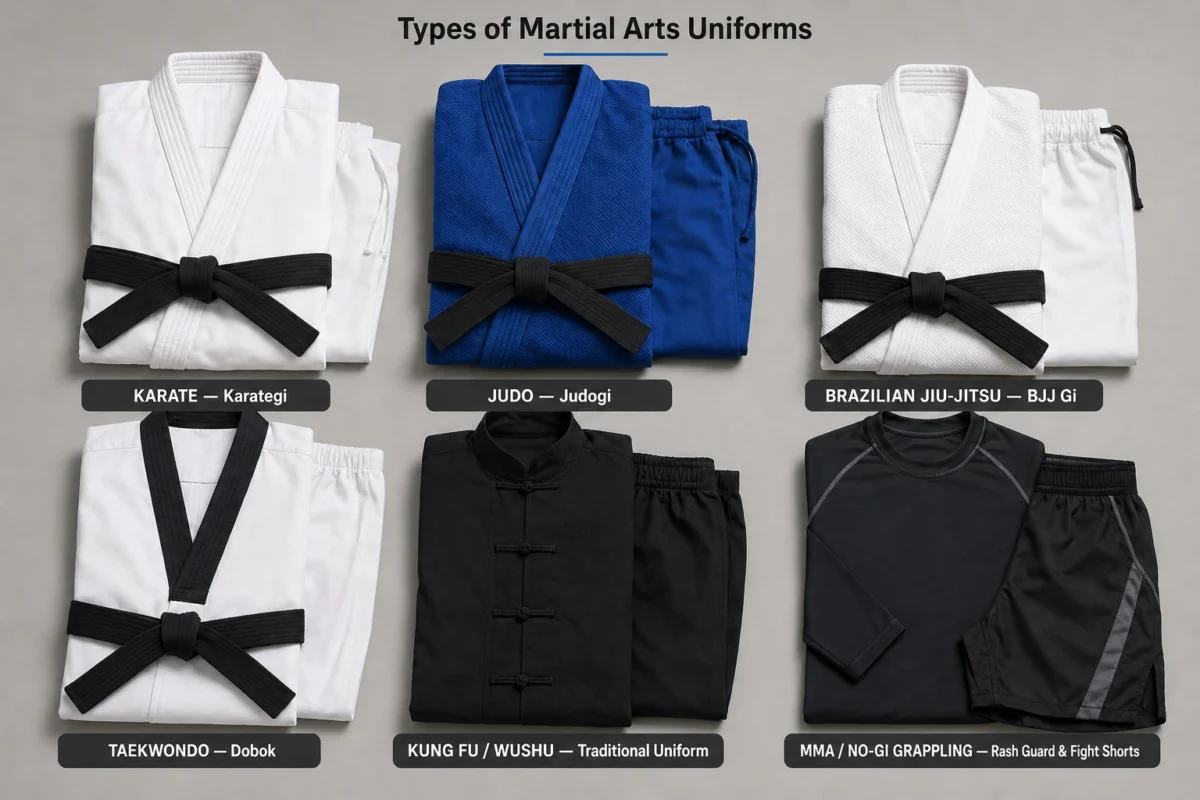
Quick Guide: Which Uniform Belongs to Which Martial Art?
The word gi is common in Japanese martial arts, while Korean systems often use dobok. Other disciplines have their own terms, such as kurtka in sambo and hakama in aikido and kendo.
Martial art | Uniform name | Main garments | Primary performance need |
Karate | Karategi or karate gi | Wrap jacket, trousers and belt | Fast strikes, kicks and sharp movement |
Judo | Judogi | Heavy jacket, trousers and belt | Grip, throw and abrasion resistance |
Brazilian Jiu-Jitsu | BJJ gi or Jiu-Jitsu kimono | Reinforced jacket, trousers and belt | Groundwork and repeated gripping |
Taekwondo | Dobok | Pullover or wrap top, trousers and belt | High kicks and unrestricted leg movement |
Aikido | Aikidogi or keikogi | Jacket, trousers, belt and sometimes hakama | Throws, wrist access and controlled movement |
Kung Fu | Kung Fu uniform | Mandarin-collar top, loose trousers and sash | Fluid movement and traditional appearance |
Wushu | Wushu uniform | Lightweight top, wide trousers and sash | Forms, jumps and performance |
Kendo | Keikogi and hakama | Woven jacket and pleated hakama | Durability under protective armour |
Hapkido | Dobok | Wrap or pullover top, trousers and belt | Kicking, throws and joint techniques |
Sambo | Kurtka and shorts | Grip jacket, belt and fitted shorts | Jacket wrestling and throwing |
MMA | MMA fightwear | Rash guard and fight shorts | Striking, wrestling and grappling |
No-gi BJJ | No-gi grappling wear | Rash guard, shorts or spats | Close-contact groundwork |
Muay Thai | Muay Thai fight kit | Short fight shorts; sometimes a training top | Kicks, knees and hip mobility |
Boxing | Boxing kit | Sleeveless vest and trunks | Punching, rotation and footwork |
Wrestling | Wrestling singlet | One-piece stretch singlet | Unrestricted close-contact movement |
What Is a Martial Arts Uniform?
A martial arts uniform is specialised clothing used for training, grading, demonstration or competition. Traditional uniforms often use a jacket-and-trouser structure, but their collars, sleeves, fit and fabric can differ substantially.
Modern combat sports use another approach. MMA, no-gi BJJ and wrestling rely on close-fitting stretch garments. These products reduce loose fabric, manage perspiration and support movement on the mat.
Uniform component | Purpose | Common construction consideration |
Jacket | Covers the upper body and may act as a gripping surface | Collar strength, sleeve length and reinforced stress points |
Trousers | Support stances, kicks and ground movement | Crotch gusset, knee panels and waistband security |
Belt | Shows rank or holds the jacket closed | Width, length, colour and stitching density |
Rash guard | Provides a close performance fit | Four-way stretch, flat seams and moisture management |
Fight shorts | Support kicking and grappling | Flexible crotch, side openings and secure waistband |
Hakama | Traditional pleated over-garment | Pleat control, ties, drape and finished length |
1. Karate Uniform: Karategi
The traditional karate uniform is called a karategi, although buyers often search for it as a karate gi. It normally consists of a wrap jacket, straight trousers and a rank belt.
Karate relies on fast strikes, blocks, stances and kicks. The uniform should therefore move cleanly without the bulky grip reinforcement found in judo and BJJ garments. A well-cut karategi gives the shoulders and hips enough room while keeping a neat, disciplined silhouette.
Types of Karate Gi
Karate gi type | Typical use | Fabric character | Buyer consideration |
Lightweight | Beginners, children and hot-weather training | Soft and easy to wash | Comfort and affordability |
Medium weight | Regular academy training and grading | Balanced structure and mobility | Versatile retail product |
Heavyweight | Kata, demonstrations and advanced practice | Crisp, structured handle | Shape, visual snap and durability |
Cotton canvas and cotton twill provide a traditional feel and absorb moisture well. Cotton-polyester fabric usually dries faster and may show less shrinkage. The right choice depends on climate, price position and intended use.
A custom karate uniform can use reinforced underarms, double-stitched main seams, a trouser gusset and either a drawstring or elasticated waistband. Adult competition styles often use a drawstring waist, while junior and entry-level products may combine elastic with a drawstring for convenience.
2. Judo Uniform: Judogi
The judo uniform is called a judogi. It consists of a jacket, trousers and belt. In Japanese terminology, the jacket is the *uwagi*, the trousers are the *zubon* and the belt is the *obi*.
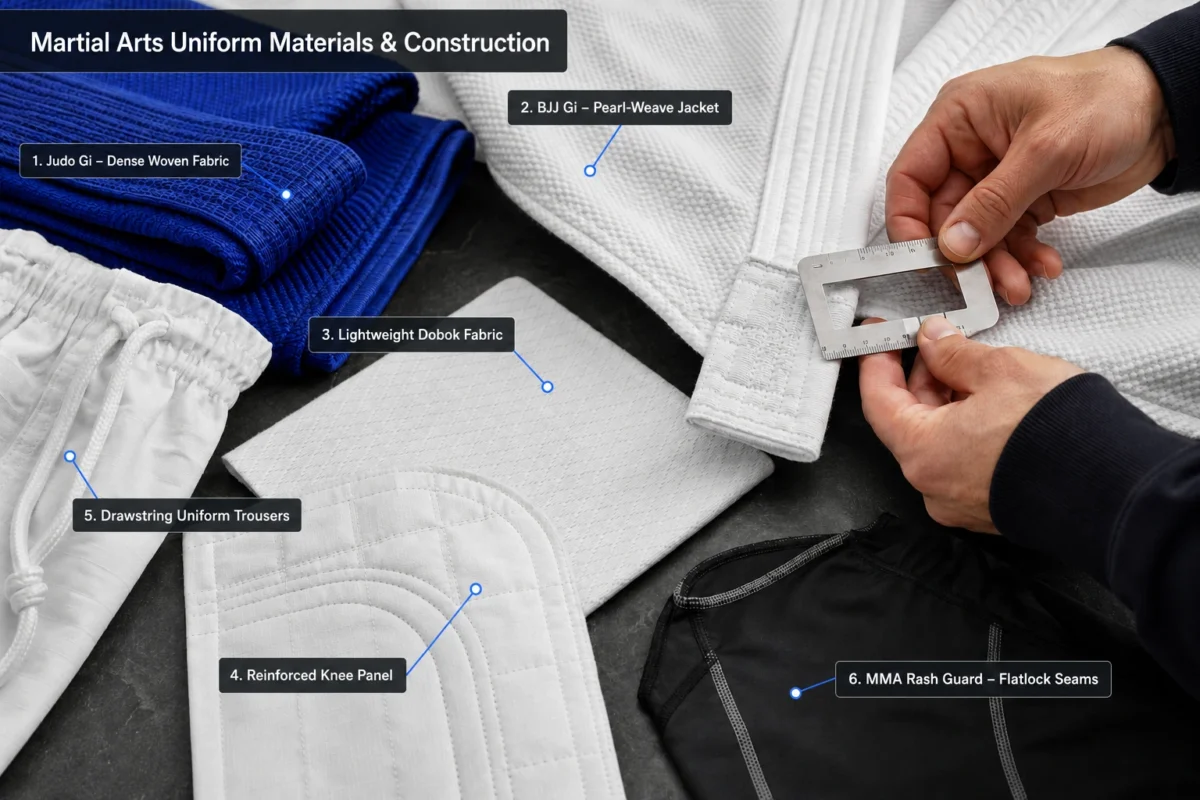
Judo involves repeated gripping, pulling, throwing and groundwork. This explains why a judogi is generally thicker and more heavily reinforced than a karate gi. The International Judo Federation describes the judogi as a garment built to tolerate gripping and throwing, and it maintains current manufacturing regulations for competition models.
Judogi Construction
Area | Common construction | Why it matters |
Upper jacket | Dense woven fabric | Resists gripping and repeated tension |
Collar | Multi-layer construction with several rows of stitching | Maintains shape and tolerates pulling |
Shoulders and underarms | Reinforced seams or panels | Supports high-stress movement |
Jacket skirt | Strong twill or integrated woven construction | Controls weight and improves durability |
Trousers | Reinforced knees and crotch gusset | Protects high-wear areas |
Side vents | Reinforcement and bar-tacking | Reduces seam failure during movement |
A training judogi should balance durability, comfort and price. An international competition judogi needs closer control of fabric, dimensions, stiffness, branding and finished fit. Because regulations change, a manufacturer should never assume that a previous season’s specification remains valid.
Arus Sportswear can develop white or blue judogi in junior and adult sizes. Custom options may include club embroidery, woven shoulder labels, branded drawstrings, reinforced knee panels and retail-ready packaging. Competition claims should only be used after the relevant approval and testing process has been completed.
3. Brazilian Jiu-Jitsu Uniform: BJJ Gi
A Brazilian Jiu-Jitsu uniform is known as a BJJ gi, Jiu-Jitsu gi or Jiu-Jitsu kimono. It includes a reinforced jacket, trousers and rank belt.
BJJ places sustained pressure on the uniform. Opponents grip the collar, sleeves and trousers during takedowns and ground fighting. For that reason, BJJ gis require strong woven fabric, secure reinforcement and carefully controlled sizing.
Common BJJ Gi Weaves and Weights
Fabric or weight | Typical product position | Main advantage | Trade-off |
Pearl weave | Competition and everyday training | Strong, flexible and widely accepted | Quality depends on yarn and finishing |
Gold weave | Traditional premium training gi | Soft, substantial feel | Heavier and less common in modern ranges |
Single weave | Entry-level or lightweight gi | Lower weight and faster drying | May be less durable under hard use |
Double weave | Heavy training gi | Very high durability | Hotter and heavier |
350–400 GSM jacket | Lightweight category | Easier to carry and cooler to wear | Requires excellent reinforcement |
400–450 GSM jacket | All-purpose category | Practical balance of weight and strength | Not the lightest option |
450–550 GSM jacket | Heavy training category | Robust feel and long service potential | More weight and slower drying |
The GSM ranges above are common product-development categories, not a universal competition rule. A lighter jacket is not automatically weaker, because yarn quality, weave density, seam design and finishing also affect performance.
BJJ trousers are commonly made from cotton ripstop, cotton-blend ripstop, drill, twill or canvas. High-stress features include the crotch gusset, knee panel, side vents and drawstring channel.
Current IBJJF guidance requires a woven cotton or cotton-like gi and permits white, royal blue or black as uniform colours. The jacket and trousers must match. Its published belt guidance specifies a belt approximately 4–5 cm wide, with the tied ends hanging about 20–30 cm. Buyers targeting IBJJF events should still check the complete current rulebook before approving production.
BJJ gi feature | Recommended development focus |
Collar | Consistent thickness, flexibility and secure internal filling |
Underarms | Reinforced construction without excessive bulk |
Side vents | Strong tape and bar-tacks at the top of each opening |
Knees | Correct panel height across the size range |
Drawstring | Smooth operation, secure eyelets and comfortable knot |
Branding | Approved patch zones, embroidery backing and colourfast thread |
Shrinkage | Fabric testing before final pattern allowance is approved |
4. Taekwondo Uniform: Dobok
The taekwondo uniform is called a dobok. It may use a wrap-style jacket or a pullover top with a V-neck, depending on the organization and purpose.
Taekwondo includes fast kicks, turns and deep stances. A dobok should be light, breathable and generous through the hip and leg. Heavy grappling fabric would restrict the movement that this sport requires.
Dobok type | Intended use | Design character |
Traditional wrap dobok | Traditional schools and general practice | Cross-over jacket construction |
V-neck dobok | Sport training and sparring | Pullover top that stays in position |
Poomsae dobok | Forms and demonstration | Structured appearance; colours may vary by division |
Sparring dobok | Fast competitive movement | Lightweight fabric and freedom through the legs |
Poly-cotton twill, lightweight ribbed polyester and diamond-texture performance fabric are common choices. Mesh ventilation can be added where the buyer’s target rules permit it. Other options include chest embroidery, back print, coloured neck trim and coordinated junior and adult sizing.
5. Aikido Uniform: Aikidogi
An aikido uniform may be called an aikidogi, aikido gi or keikogi. The jacket often resembles a lighter judogi because aikido includes grips, throws and partner practice.
Some practitioners also wear a hakama, a pleated garment tied over the trousers. The rules for who may wear a hakama vary between schools.
Component | Common design feature | Functional reason |
Jacket | Medium or heavy cotton weave | Withstands gripping and controlled throws |
Sleeves | Often slightly shorter than some other gis | Improves access to the wrist |
Trousers | Reinforced knees and drawstring waist | Supports kneeling practice |
Hakama | Deep pleats, long ties and stable back support | Maintains traditional shape and secure fit |
6. Kung Fu Uniform
Kung Fu includes many Chinese martial arts systems, so there is no single universal uniform. A common traditional style uses a Mandarin collar, frog-button closures and loose trousers.
Kung Fu uniform style | Best suited to | Common fabric |
Cotton training suit | Regular school practice | Cotton or cotton blend |
Wing Chun uniform | Academy training and demonstrations | Lightweight cotton blend |
Shaolin-style uniform | Traditional practice and performance | Cotton, linen blend or light polyester |
Satin demonstration suit | Events and visual performance | Satin or silk-look polyester |
Training garments should prioritise breathability and seam strength. Demonstration uniforms can use stronger colour, contrast piping and decorative trims, but they still need enough room for deep stances and kicks.
7. Wushu Uniform
Modern wushu uniforms are made for forms, jumps, kicks and acrobatic movement. They normally use a Mandarin-collar top, wide trousers and a sash.
Lightweight satin or performance polyester creates fluid motion and visual impact. The cut must allow a deep stance without pulling across the hips or crotch. Custom wushu uniforms can use academy colours, contrast piping, embroidery and printed detail.
8. Kendo Uniform: Keikogi and Hakama
Kendo practitioners normally wear a woven keikogi jacket and pleated hakama beneath protective armour. Navy, indigo and white are common colours.
Product area | Manufacturing priority |
Keikogi body | Breathable but durable woven texture |
Shoulder and side seams | Reinforcement for movement beneath armour |
Hakama pleats | Consistent fold depth and shape retention |
Waist ties | Strength, correct length and secure attachment |
Dyed fabric | Colourfastness and clear washing instructions |
Traditional indigo fabrics may release colour during early washes. Brands should therefore agree on dyeing, colourfastness targets and care labelling during development.
9. Hapkido Uniform: Dobok
Hapkido also uses a dobok, although its construction varies between schools. Some versions resemble a taekwondo uniform, while others use a stronger wrap jacket for throws and joint techniques.
The correct style should be based on the academy’s training system. Diamond fabric, coloured lapels, instructor colourways, Korean lettering and embroidered back logos are common custom options.
10. Japanese Jiu-Jitsu Uniform
Traditional Japanese Jiu-Jitsu includes grips, throws, joint locks and groundwork. Many schools therefore use a medium- or heavyweight gi with a reinforced collar, knees and crotch.
Some academies prefer a judo-style construction. Others choose a lighter karate-style uniform. A reference sample or approved technical specification is important because the term “Jiu-Jitsu gi” does not define one universal construction.
11. Sambo Uniform: Kurtka and Shorts
A sambo uniform differs clearly from a standard gi. It normally combines a grip jacket called a kurtka, a belt, fitted shorts and sambo shoes. Red and blue are the recognised competition colour families.
The kurtka needs a strong collar, reinforced shoulders and secure belt-guiding openings. The shorts need a stable close fit with enough stretch for wrestling movement. Competition products must follow the requirements of the target federation or event.
12. Mixed Martial Arts Uniform: MMA Fightwear
MMA athletes generally wear performance fight wear rather than a traditional gi. A typical kit combines a rash guard with flexible fight shorts or compression shorts.
MMA garment | Important features | Common material direction |
Rash guard | Compression fit, flat seams and secure neckline | Polyester-elastane stretch knit |
Fight shorts | Flexible crotch, side openings and stable waistband | Four-way stretch woven fabric |
Vale tudo shorts | Close fit and high stretch | Polyester-elastane knit |
Compression leggings | Flat seams and full leg coverage | Four-way stretch performance jersey |
Walkout apparel | Brand visibility and coordinated team appearance | Performance polyester or fleece |
Full sublimation is popular for MMA rash guards because the artwork is transferred into the fabric rather than placed as a raised surface print. Good pattern development is essential: overly loose garments can twist, while an excessively tight product can restrict breathing and movement.
13. No-Gi Brazilian Jiu-Jitsu Uniform
No-gi BJJ uses a rash guard with grappling shorts, vale tudo shorts or compression leggings. The close fit reduces loose material during ground fighting.
A complete private-label no-gi collection can include men’s, women’s and youth rash guards, rank-color versions, grappling shorts and spats. The manufacturer should test stretch recovery, colorfastness, seam comfort and sublimation clarity before bulk production.
14. Muay Thai Uniform
Muay Thai athletes are recognized by their short, wide-waisted fight shorts. The design provides room for kicks, knees and hip rotation.
Muay Thai short type | Visual character | Best use |
Traditional satin | Wide waistband and classic shape | Competition and traditional gyms |
Retro cut | Short leg with curved side opening | Modern brands and training |
Sublimated short | Detailed all-over graphics | Custom collections and teamwear |
Embroidered premium short | Appliqué, piping and raised branding | Premium retail and walkout use |
Strong waistband attachment, a comfortable crotch, reinforced side openings and lightweight fabric are more important than decoration alone.
15. Boxing Uniform
A boxing kit normally includes a sleeveless vest and loose trunks. Lightweight satin, mesh and performance interlock are common materials.
The vest should allow shoulder rotation, while the trunks need a stable waistband and enough room for footwork. Club colours, athlete names, national motifs and coordinated robes can be added through sublimation, embroidery or appliqué.
16. Wrestling Singlet
A wrestling singlet is a one-piece stretch uniform. Its close fit allows free movement and limits loose fabric during contact.
Polyester-spandex and nylon-spandex blends are common. Key development points include four-way stretch, flat seams, leg-opening recovery, coverage and a pattern created specifically for men, women or youth athletes. Competition cuts should follow the target organisation’s current requirements.
17. Kickboxing Uniform
Kickboxing apparel varies by style and governing body. Some athletes use long satin trousers and a sleeveless top. Others use boxing-style shorts or modern performance fightwear.
The product brief must therefore name the exact kickboxing format. Long trousers need enough width and crotch depth for high kicks without twisting around the knee.
18. Other Traditional Martial Arts Uniforms
Taido, ninjutsu, kempo, kenpo, iaido, kyudo, kobudo and Krav Maga may use specialised traditional or modern training apparel. Requirements often differ between schools, even within the same discipline.
For these products, an approved reference sample, measurement chart or technical pack is safer than manufacturing from a general product name.
How the Main Martial Arts Uniforms Differ
Comparison point | Karate gi | Judogi | BJJ gi | Taekwondo dobok | MMA kit |
Main movement | Striking and forms | Throws and groundwork | Grappling and groundwork | Kicking and forms | Striking and grappling |
Fabric feel | Light to structured | Dense and heavy-duty | Strong woven jacket | Light and breathable | Stretch performance fabric |
Jacket gripping | Limited | Central to the sport | Central to the sport | Limited | No jacket |
Typical reinforcement | Underarms and trouser gusset | Collar, shoulders and knees | Collar, vents, knees and crotch | Crotch and key seams | Flat seams and waistband |
Fit priority | Clean lines and mobility | Durability and regulation | Grip-resistant fit and mobility | Leg freedom | Close fit without restriction |
Common branding | Embroidery and patches | Controlled embroidery and labels | Patches, embroidery and internal artwork | Embroidery and print | Full sublimation |
How to Choose the Right Martial Arts Uniform
The best uniform is not simply the heaviest or most expensive option. It is the design that matches the discipline, user and sales market.
Buyer decision | Question to answer before sampling | Why it matters |
Discipline | What exact martial art and training format is this for? | Determines pattern, fabric and reinforcement |
Use | Training, competition, demonstration or retail lifestyle? | Changes weight, styling and rule requirements |
Governing body | Which organisation or event rules apply? | Controls colours, fit, markings and garment details |
User | Adult, women-specific, junior or unisex? | Affects grading and proportions |
Climate | Hot, temperate or cold training environment? | Influences fabric weight and breathability |
Price level | Entry, mid-market or premium? | Guides material, detailing and packaging |
Branding | Embroidery, patches, sublimation or private label? | Affects artwork preparation and production route |
Care | What shrinkage and washing performance is expected? | Influences fabric finishing and pattern allowance |
Fabric Weight, Shrinkage and Durability
GSM means grams per square metre. It describes fabric mass, not total garment weight and not quality by itself. Two fabrics with the same GSM can perform differently because of yarn type, weave, finishing and construction.
Cotton-based uniforms may shrink during washing. The factory should test the fabric before finalising the pattern. Buyers should approve both pre-wash and post-wash measurement tolerances where shrinkage is commercially important.
Quality factor | What should be tested? | Risk if ignored |
Fabric GSM | Samples from the actual production lot | Inconsistent weight and handle |
Shrinkage | Controlled wash and dry test | Incorrect finished fit |
Seam strength | Stress points and stitch security | Split seams during training |
Colourfastness | Washing, rubbing and perspiration | Dye transfer or fading |
Stretch recovery | Repeated extension of performance fabric | Bagging at knees, waist or elbows |
Print durability | Washing and abrasion | Cracking, peeling or fading artwork |
Measurements | Full graded size set | Poor fit across the range |
Custom Martial Arts Uniform Manufacturing
Arus Sportswear provides product development and production for martial arts brands, academies, clubs and wholesale buyers. The service can cover fabric sourcing, pattern development, size grading, sample making, cutting, stitching, embroidery, printing, labelling, inspection and export packaging.
Product Development Process
Stage | What happens | Buyer approval |
1. Product brief | Discipline, use, fabric, sizes and target price are defined | Written specification |
2. Material selection | Fabric, thread, trims and colours are reviewed | Swatch or material confirmation |
3. Pattern development | A discipline-specific pattern is created | Measurement chart |
4. Prototype sample | Construction and initial fit are tested | Sample comments |
5. Revised sample | Corrections are applied | Fit approval |
6. Pre-production sample | Final materials, colours and branding are combined | Signed bulk-production approval |
7. Bulk manufacturing | Cutting, stitching and decoration begin | In-line production checks |
8. Final inspection | Measurements, workmanship and packing are reviewed | Inspection record |
9. Packing and dispatch | Approved goods are packed for export | Packing list |
Private-Label Options for Martial Arts Brands
Private-label manufacturing allows a buyer to sell the product under its own brand. The uniform, labelling and packaging should feel like one coordinated system.
Branding element | Available direction | Important production detail |
Main brand label | Woven, printed or heat-transfer | Comfort, placement and durability |
Size and care label | Separate or combined label | Accurate fibre and care information |
Embroidery | Chest, sleeve, back or trouser placement | Stitch count, backing and rule compliance |
Woven patch | Academy or brand artwork | Edge finish and secure attachment |
Sublimated panel | Rash guards, shorts or gi lining | Colour profile and artwork resolution |
Drawstring and tape | Standard or branded | Colourfastness and tensile strength |
Hangtag | Product and brand information | Correct attachment and barcode area |
Packaging | Plain or branded polybag and carton | Size identification and export protection |
Quality Control for Martial Arts Uniforms
Martial arts clothing faces pulling, sweat, friction, stretching and repeated washing. Quality control must examine the garment as sports equipment, not only as fashion apparel.
Inspection area | Main check |
Fabric | Composition, weight, colour and visible defects |
Measurements | Approved tolerances for each size |
Construction | Seam security, stitch density and reinforcement |
Collar and vents | Symmetry, thickness and bar-tacking |
Trousers | Knee position, crotch strength and waistband function |
Decoration | Embroidery, patch, print and sublimation quality |
Labelling | Brand, size, fibre and care accuracy |
Packing | Correct size assortment, polybags and carton quantities |
Why Work With Arus Sportswear?
Arus Sportswear focuses on custom manufacturing for business buyers. Products are developed according to the buyer’s discipline, market position and approved specification rather than treated as generic fashion garments.
Buyer need | Arus Sportswear solution |
New product development | Fabric guidance, patterns and samples |
Existing brand expansion | Development from a tech pack or reference sample |
Academy uniforms | Club colours, embroidery and size assortments |
Private-label retail | Labels, hangtags and branded packaging |
Performance fightwear | Sublimation, stretch patterns and flat seams |
Traditional uniforms | Discipline-specific fabric and reinforcement |
Export orders | Inspection, packing and shipment preparation |
Frequently Asked Questions
What are the main types of martial arts uniforms?
The main types include the karate karategi, judo judogi, BJJ gi, taekwondo dobok, aikidogi, Kung Fu and wushu uniforms, kendo keikogi and hakama, sambo kurtka, MMA fightwear, Muay Thai shorts, boxing kits and wrestling singlets.
What is a martial arts uniform called?
The name depends on the discipline. Karate uses a karategi, judo uses a judogi, Brazilian Jiu-Jitsu uses a BJJ gi and taekwondo uses a dobok. There is no single name for every martial arts uniform.
What is the difference between a karate gi and a BJJ gi?
A karate gi is designed for strikes, kicks and clean movement. A BJJ gi is reinforced for gripping and ground fighting. It normally uses a stronger woven jacket, reinforced vents and durable trousers.
What is the difference between a judogi and a BJJ gi?
Both are grip-based uniforms, but their fit, fabric structure, reinforcement, branding rules and competition measurements differ. A garment made for one sport should not automatically be marketed for the other.
Which fabric is best for a martial arts uniform?
There is no universal best fabric. Cotton canvas or twill works well for karate, dense woven fabric is used for judo, pearl weave is popular for BJJ, lightweight polyester blends suit taekwondo, and polyester-elastane fabric supports MMA and no-gi apparel.
Can Arus Sportswear manufacture competition uniforms?
Arus Sportswear can develop a uniform to the technical specification supplied for a target event or organisation. Official approval should only be claimed after the required governing-body certification or validation has been completed.
Can a new brand order private-label martial arts uniforms?
Yes. A new brand can begin with a technical pack, measurement chart, reference sample or clear product brief. Sampling is recommended before bulk manufacturing.
What details are needed for a quotation?
Provide the uniform type, estimated quantity, size range, target fabric, colour, branding, packaging and destination country. Reference images or a technical pack will improve quotation accuracy.
Develop Your Martial Arts Collection With Arus Sportswear
The right martial arts uniform combines tradition, performance and reliable construction. Its fabric and pattern must suit the discipline, while its branding and packaging must suit the buyer’s market.
Arus Sportswear manufactures custom martial arts uniforms, BJJ gis, judo uniforms, karate gis, taekwondo doboks, MMA rash guards, grappling shorts, Muay Thai shorts and other combat-sports apparel for international B2B buyers.
Send us your design, reference sample or technical pack to discuss sampling and bulk production.
branding
website design
user experience
app design
creative & design
website development
Lorem ipsum dolor sit amet, consectetur adipiscing elit. Ut elit tellus, luctus nec ullamcorper mattis, pulvinar dapibus leo.
website support
Lorem ipsum dolor sit amet, consectetur adipiscing elit. Ut elit tellus, luctus nec ullamcorper mattis, pulvinar dapibus leo.
app development
Lorem ipsum dolor sit amet, consectetur adipiscing elit. Ut elit tellus, luctus nec ullamcorper mattis, pulvinar dapibus leo.
ecommerce
Lorem ipsum dolor sit amet, consectetur adipiscing elit. Ut elit tellus, luctus nec ullamcorper mattis, pulvinar dapibus leo.